Deepfake Scams: 6 Myths That Leave Your Organisation Exposed
Synthetic media attacks exploit human psychology and workflow gaps rather than relying on flawless visual perfection to bypass security controls.
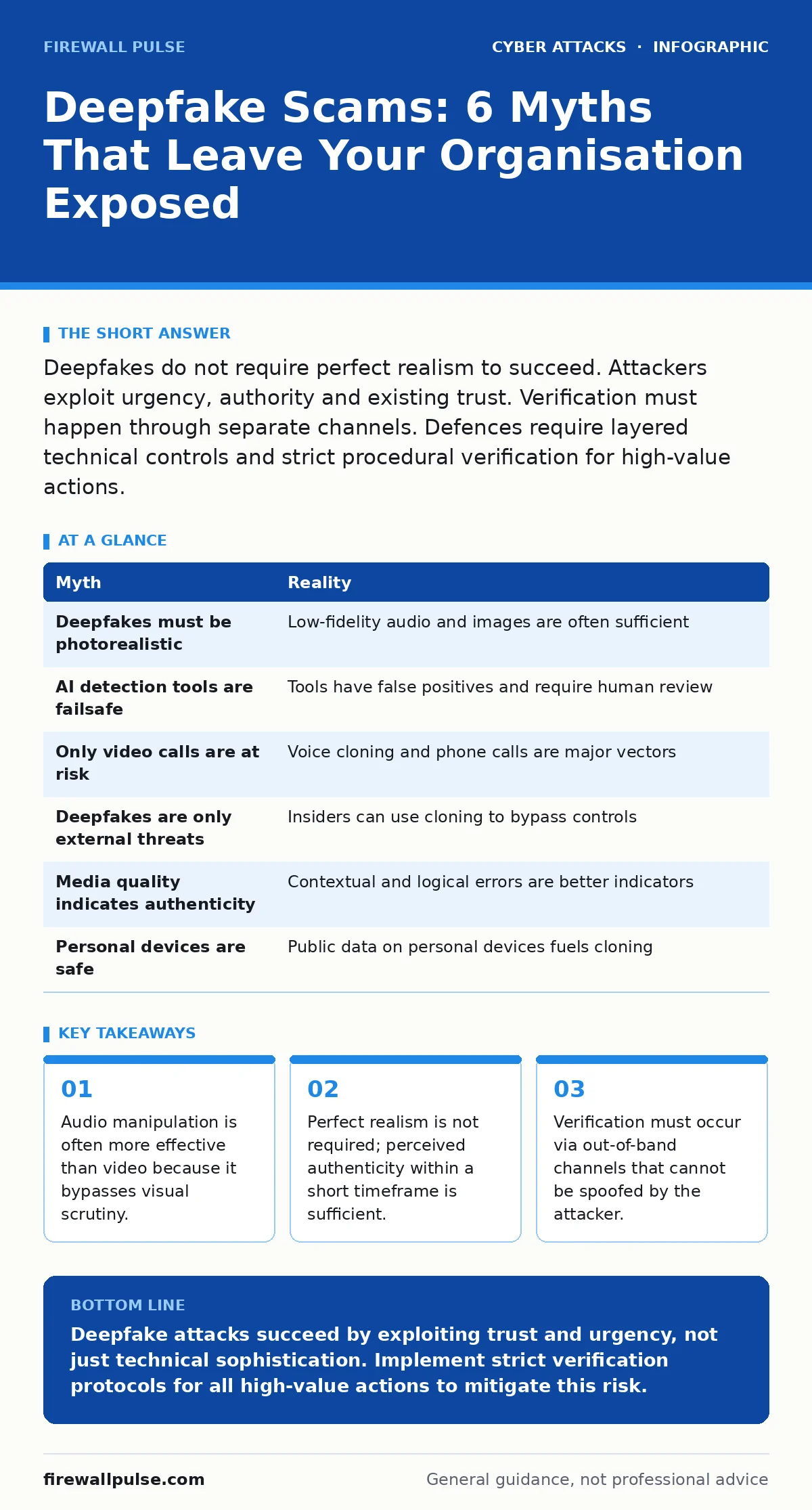
Deepfakes do not require perfect realism to succeed. Attackers exploit urgency, authority and existing trust. Verification must happen through separate channels. Defences require layered technical controls and strict procedural verification for high-value actions.
Myth: Deepfakes Require Photorealistic Video
Reality: The belief that synthetic media must be indistinguishable from reality to cause harm is dangerously incorrect. Most successful attacks rely on low-fidelity audio or static images rather than high-definition video streams. Attackers exploit the cognitive bias where humans assume authority figures would not be impersonated. The human brain fills in missing visual details when audio cues match expectations. A grainy image paired with a cloned voice is often sufficient to trigger a financial transfer or data release.
Visual fidelity matters less than contextual plausibility. If the request aligns with existing workflows, recipients rarely scrutinise the medium. Imagine a CFO receives a low-resolution image of the CEO with a urgent audio message. The urgency overrides the visual quality check. This dynamic means your defences must prioritise verification of intent over analysis of pixel quality. Relying on visual artefacts as a primary detection method leaves you vulnerable to audio-only attacks.
Myth: AI Detection Tools Are Failsafe
Reality: No automated tool currently exists that can detect all synthetic media with zero false positives. Detection algorithms are in a constant arms race with generation models. As generators improve, detectors lose accuracy on new samples. Furthermore, post-processing steps like compression or format conversion can remove digital fingerprints used by detectors. This creates a false sense of security when teams rely solely on automated scanning.
Automated tools are best used as one layer in a broader strategy. They should flag anomalies rather than make final decisions. Human review remains necessary for high-stakes interactions. The hidden cost of over-reliance on detection is alert fatigue. Teams begin to ignore warnings when false positives disrupt daily operations. This erosion of trust in the tool renders it ineffective during actual incidents. Treat detection scores as indicators, not verdicts.
Myth: Only Video Calls Are at Risk
Reality: Voice cloning poses a greater immediate threat than video deepfakes in many scenarios. Audio requires less processing power and data to generate convincingly. Many organisations have weak verification protocols for phone calls compared to video conferences. Attackers exploit this gap by calling employees from spoofed numbers. The voice of a trusted executive is often enough to bypass standard security questions.
Phone-based social engineering remains a primary vector for financial fraud. Employees are conditioned to respect verbal authority from senior management. This cultural norm is harder to break than technical controls. Imagine a supplier manager receives a call from the "CEO" asking for an urgent invoice payment. The caller uses a cloned voice that matches the CEO's tone and cadence. Without an independent verification step, the request proceeds. Audio verification protocols must be as strict as video protocols.
Myth: Deepfakes Are Only an External Threat
Reality: Insider threats can leverage synthetic media to bypass external security controls. A disgruntled employee might use voice cloning to impersonate a manager in a chat system. This allows them to approve transactions or access restricted systems. Internal communication platforms often lack the same scrutiny as external channels. Trust in internal colleagues reduces the likelihood of verification.
This scenario highlights the need for strict separation of duties. No single individual should be able to initiate and approve high-value actions. Even if an attacker clones a manager's voice, they cannot bypass dual-control requirements. Attack surface reduction techniques help limit the damage an insider can cause. Limiting access to critical functions reduces the incentive for internal impersonation. Monitor for unusual access patterns that deviate from normal behaviour.
Myth: High-Fidelity Media Is the Main Indicator
Reality: Contextual inconsistencies are more reliable indicators than media quality. Attackers often make mistakes in timing, language or procedural details. A deepfake video might show a CEO in a location they are not physically present. Or the request might contradict established company policies. These logical errors are easier to detect than subtle visual artefacts. Training staff to question the context of a request is more effective than training them to spot AI flaws.
Urgency is a common tactic used to bypass logical scrutiny. Attackers create time pressure to prevent verification. Imagine a message claiming a security breach that requires immediate password reset. The recipient acts quickly to avoid disaster, skipping standard checks. This psychological manipulation is the core of the attack. Slowing down the response process allows time for logical analysis. Establish clear protocols for handling urgent requests from authority figures.
Myth: Personal Devices Are Not a Vector
Reality: Personal devices often contain the data needed to train synthetic media models. Social media posts provide hours of audio and thousands of images. Attackers harvest this public data to create convincing clones. Employees who share personal content inadvertently fuel these attacks. The line between professional and personal digital footprints is often blurred.
Organisations must educate staff on the risks of oversharing. Reducing the amount of public data available limits the quality of potential clones. However, this does not eliminate the threat entirely. Publicly available data is sufficient for low-fidelity attacks. Focus on verification processes rather than trying to erase all digital footprints. Implement strict policies for handling sensitive information on personal devices. This reduces the risk of data leakage that could be used for cloning.
| Myth | Reality |
|---|---|
| Deepfakes must be photorealistic | Low-fidelity audio and images are often sufficient |
| AI detection tools are failsafe | Tools have false positives and require human review |
| Only video calls are at risk | Voice cloning and phone calls are major vectors |
| Deepfakes are only external threats | Insiders can use cloning to bypass controls |
| Media quality indicates authenticity | Contextual and logical errors are better indicators |
| Personal devices are safe | Public data on personal devices fuels cloning |
Key takeaways
- Audio manipulation is often more effective than video because it bypasses visual scrutiny.
- Perfect realism is not required; perceived authenticity within a short timeframe is sufficient.
- Verification must occur via out-of-band channels that cannot be spoofed by the attacker.
- Insider knowledge and social engineering are the primary drivers of success, not technical perfection.
Deepfake attacks succeed by exploiting trust and urgency, not just technical sophistication. Implement strict verification protocols for all high-value actions to mitigate this risk.
Frequently asked questions
How can I verify a suspicious phone call from a senior executive?
Hang up and call the executive back using a known, verified number from your contacts. Do not use the number provided in the suspicious call.
Are there specific signs that audio has been AI-generated?
Listen for unnatural pauses, consistent background noise, or lack of breathing sounds. However, these signs are not reliable enough for definitive detection.
Should we ban all AI-generated content in our communications?
No, but establish clear policies for its use. Ensure all synthetic media is clearly labelled and never used for official authorisation or financial requests.
How do deepfakes relate to other phishing techniques?
Deepfakes enhance clone phishing by adding realistic audio or video. They make the impersonation more convincing, increasing the success rate of the social engineering attack.
How this guide was produced: written by the Firewall Pulse editorial team with AI assistance, checked against the public references listed below, and reviewed when the facts change. See our editorial policy or report an error.