Attack Surface Reduction: How to Shrink Your Digital Exposure
Most breaches occur not because defences fail, but because too many doors were left open for attackers to try in the first place.
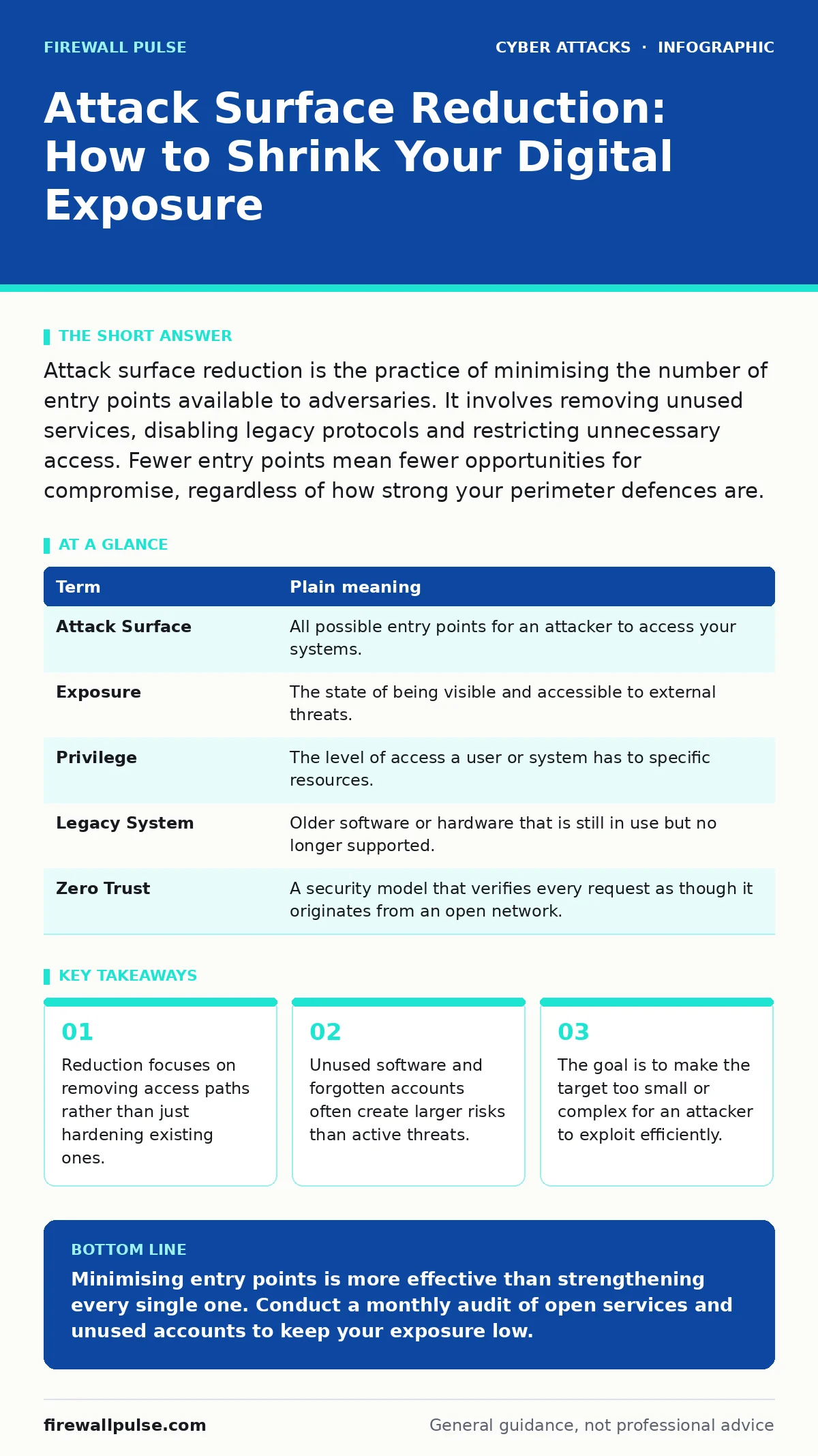
Attack surface reduction is the practice of minimising the number of entry points available to adversaries. It involves removing unused services, disabling legacy protocols and restricting unnecessary access. Fewer entry points mean fewer opportunities for compromise, regardless of how strong your perimeter defences are.
The House Analogy
Imagine you own a large, historic house. You have installed state-of-the-art locks on the front door. You have motion sensors in the garden and a camera on the porch. These are strong defences. However, if you leave every window unlocked, every basement door open and every side gate unlatched, the quality of the front lock matters very little. An attacker will not try to break the reinforced front door. They will simply walk in through the open window in the attic.
Attack surface reduction is the act of boarding up those windows, locking the basement and removing the side gates. It is not about buying a better lock for the front door. It is about eliminating the other ways someone can enter your property. In cybersecurity, your house is your network, your systems and your data. The windows are the software, services and accounts that connect to the outside world.
Defining the Exposure
Your attack surface is the total sum of all points where an untrusted entity can try to enter your data environment. This includes every server, every application, every user account and every device that connects to the internet. It also includes third-party vendors who have access to your systems. Every new piece of software you install adds another window. Every new user account adds another door.
Many teams focus exclusively on strengthening the locks. They spend months configuring firewalls and tuning intrusion detection systems. This is necessary, but it is insufficient if the number of windows keeps growing. If you add a new service without assessing its risk, you have increased your attack surface. You have given attackers more places to look for weaknesses.
| Term | Plain meaning |
|---|---|
| Attack Surface | All possible entry points for an attacker to access your systems. |
| Exposure | The state of being visible and accessible to external threats. |
| Privilege | The level of access a user or system has to specific resources. |
| Legacy System | Older software or hardware that is still in use but no longer supported. |
| Zero Trust | A security model that verifies every request as though it originates from an open network. |
The Hidden Cost of Convenience
Consider the convenience of leaving a side door unlocked for delivery drivers. It saves time, but it introduces risk. In digital environments, convenience often drives the creation of unnecessary access. A developer might enable a remote debugging port to fix a bug quickly. They forget to disable it. That port remains open for months, visible to anyone scanning the internet.
This is where the concept of least privilege becomes critical. Least privilege means giving users and systems only the access they strictly need to perform their job, and nothing more. If a web server does not need to connect to the database directly, it should not have that path. If a user does not need administrative rights, they should not have them.
Common Points of Confusion
Teams often confuse attack surface reduction with perimeter security. Perimeter security assumes there is an inside and an outside. It tries to keep the outside bad guys out. Attack surface reduction assumes the perimeter will be breached eventually. It tries to limit what the attacker can do once they are inside, or better yet, prevents them from getting in by removing the entry points entirely.
Another confusion is the belief that disabling a service is the same as securing it. Disabling a service removes the entry point. Securing it means keeping it open but adding layers of protection. Reduction is generally more effective because it removes the risk entirely. There is no window to break if the window does not exist.
The Shadow of Third Parties
Your house might be secure, but what if your cleaner has a key? In business, third-party vendors are the cleaners. They need access to perform their work. However, if they have broad access, your attack surface includes their security posture. If their systems are compromised, attackers can use their credentials to enter your environment.
This is why OAuth consent phishing is such a dangerous vector. Attackers trick users into granting malicious applications broad access to their corporate accounts. Even if your own defences are strong, the attacker is now inside via a legitimate, user-granted token. Reducing the scope of these permissions is a form of surface reduction.
Try This Now
You can begin reducing your exposure immediately with these three steps.
- Audit Open Ports: Identify all services listening for external connections. Disable any port that is not strictly required for business operations. A web server does not need to listen for file transfer requests if it only serves web pages.
- Remove Unused Accounts: Identify user accounts that have not logged in for a significant period. Disable or delete them. These accounts are often the first target for brute force attacks because they are rarely monitored.
- Patch or Remove Legacy Software: Identify software that no longer receives security updates. If it cannot be replaced, isolate it from the main network. If it can be replaced, remove it. Unsupported software is a window that cannot be locked.
Beyond the Basics
Reduction is an ongoing process, not a one-time project. New software is installed every day. New employees are hired. New services are launched. Each of these actions expands your surface. You must integrate reduction into your development and operational workflows.
When you configure DNS filtering, you are reducing the surface by blocking connections to known malicious domains. When you implement security operations centers effectively, they help you detect when your surface has expanded unexpectedly. When you train staff to recognise malicious email attachments, you reduce the likelihood of an initial breach.
The Final Check
Imagine walking around your house at night with a flashlight. You check every window, every door and every vent. You close anything that is open. You board up anything that is broken. You do this not because you expect someone to break in, but because you do not want to give them the chance.
Attack surface reduction is the same discipline. It is boring. It is administrative. It is often overlooked in favour of shiny new tools. But it is the most effective way to stay secure. By shrinking your exposure, you make yourself a harder target. You force attackers to look elsewhere, where the doors are more open and the windows are unlocked.
Key takeaways
- Reduction focuses on removing access paths rather than just hardening existing ones.
- Unused software and forgotten accounts often create larger risks than active threats.
- The goal is to make the target too small or complex for an attacker to exploit efficiently.
Minimising entry points is more effective than strengthening every single one. Conduct a monthly audit of open services and unused accounts to keep your exposure low.
Frequently asked questions
Is attack surface reduction the same as vulnerability management?
No. Vulnerability management finds and fixes weaknesses in existing systems. Attack surface reduction removes the systems or access points that create the risk in the first place.
Does removing services impact business productivity?
It can, if done poorly. You must identify which services are truly necessary. Removing unused or redundant services usually has no impact on core business functions.
How do I find hidden entry points?
Use automated scanning tools to map your external footprint. Compare the results with your list of approved services. Any difference is a potential hidden entry point.
What is the role of employees in this process?
Employees create surface area through their use of cloud apps and personal devices. Training them to avoid unnecessary connections and to report unusual access requests is vital.
How this guide was produced: written by the Firewall Pulse editorial team with AI assistance, checked against the public references listed below, and reviewed when the facts change. See our editorial policy or report an error.