Prevent Unsafe YAML Deserialization: A Security Operations Checklist
YAML parsers often execute code hidden in data structures, turning configuration files into remote execution vectors that bypass standard application firewalls.

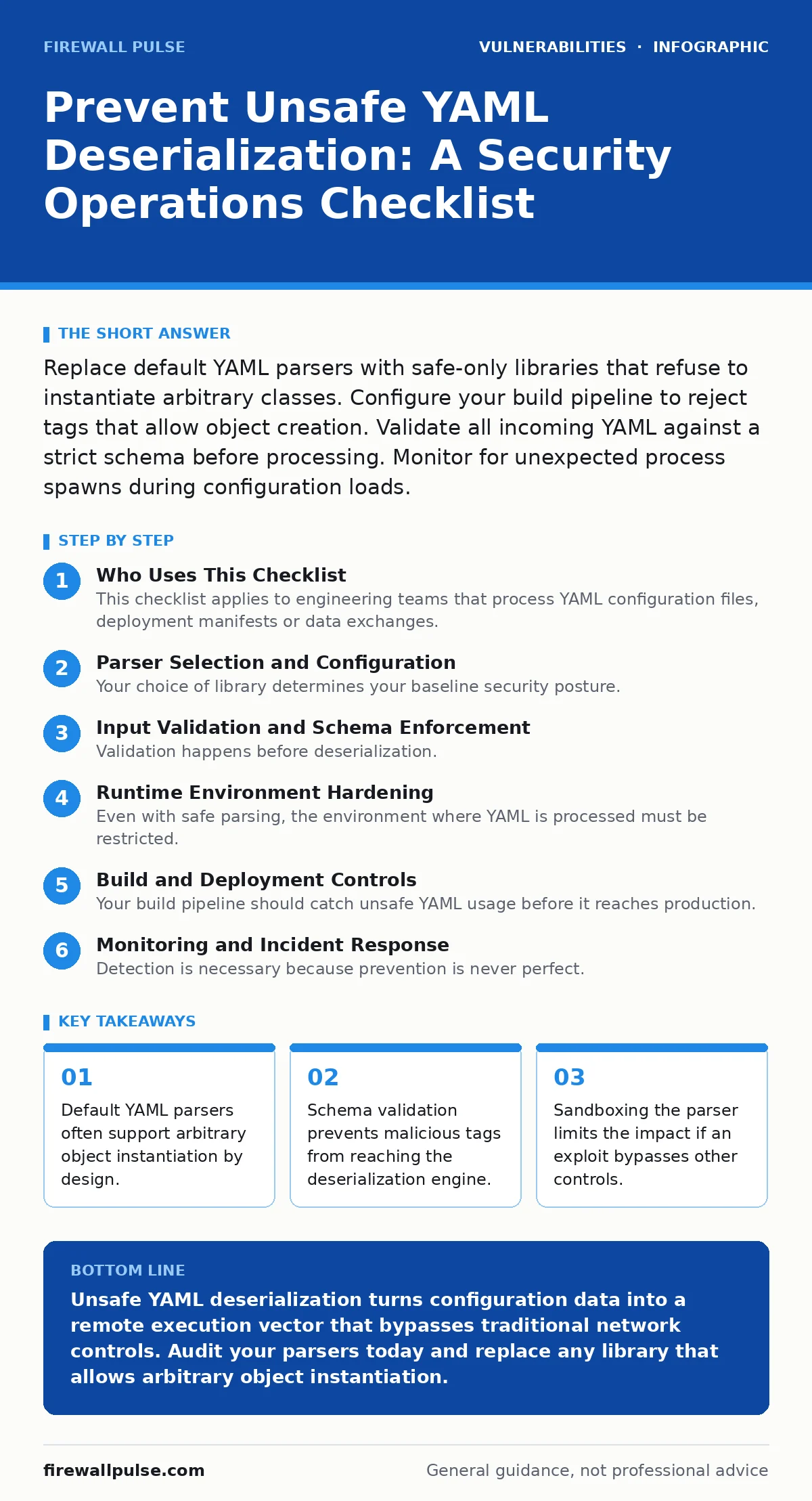
Replace default YAML parsers with safe-only libraries that refuse to instantiate arbitrary classes. Configure your build pipeline to reject tags that allow object creation. Validate all incoming YAML against a strict schema before processing. Monitor for unexpected process spawns during configuration loads.
Who Uses This Checklist
This checklist applies to engineering teams that process YAML configuration files, deployment manifests or data exchanges. You use this list to audit your deserialization layers and harden your parsing logic. Read each item carefully and mark it when you have implemented the control. The goal is to reduce the attack surface where data becomes code.
Parser Selection and Configuration
Your choice of library determines your baseline security posture. Many popular YAML libraries are not safe by default because they aim for feature completeness rather than security. You must choose a parser that explicitly disables dynamic object creation.
- Replace default YAML parsers with safe-only alternatives: Safe parsers refuse to instantiate arbitrary classes, preventing remote code execution.
- Disable dynamic typing features in your YAML library: Dynamic typing allows the parser to guess object types, which attackers exploit to trigger code.
- Pin parser versions to known secure releases: Older versions often contain unpatched deserialization flaws that allow object injection.
- Review library documentation for unsafe modes: Some libraries have hidden flags that re-enable dangerous features for backward compatibility.
Input Validation and Schema Enforcement
Validation happens before deserialization. You must ensure the structure of the YAML matches your expectations. This stops malformed or malicious tags from reaching the parser engine. Schema validation is your first line of defence against unexpected data types.
- Define strict JSON schemas for all YAML inputs: Schemas reject unexpected fields and types before the parser processes them.
- Reject YAML documents with custom tags: Custom tags often instruct the parser to instantiate specific classes, which is a primary attack vector.
- Limit the depth of nested structures: Deep nesting can cause stack overflows or hide malicious payloads in complex objects.
- Validate character sets in string values: Certain characters in strings can confuse parsers or trigger injection flaws in downstream systems.
Runtime Environment Hardening
Even with safe parsing, the environment where YAML is processed must be restricted. If an exploit bypasses your parser, the runtime controls limit what the attacker can do. You treat the parser as untrusted code.
- Run the parser in a sandboxed environment: Sandboxing restricts file access and network connections, limiting the impact of an exploit.
- Apply least privilege access to the parsing service: The process should only have permissions to read configuration files, not execute system commands.
- Disable reflection APIs in the runtime: Reflection allows code to inspect and modify objects, which is often used in deserialization attacks.
- Monitor for unexpected process creation: Sudden spawns of shell processes or network tools indicate a successful exploitation attempt.
Build and Deployment Controls
Your build pipeline should catch unsafe YAML usage before it reaches production. Static analysis tools can identify dangerous patterns in your codebase. You integrate these checks into your continuous integration workflow.
- Add static analysis rules for unsafe YAML usage: Static analysis flags code that uses dangerous parser methods or unsafe configurations.
- Block deployments with unvalidated YAML inputs: Automated checks prevent code that lacks input validation from reaching production servers.
- Audit third-party libraries for YAML dependencies: Third-party libraries may introduce unsafe parsers into your application without your knowledge.
- Test with malicious YAML payloads in CI: Automated tests using known exploit patterns verify that your parser rejects dangerous inputs.
Monitoring and Incident Response
Detection is necessary because prevention is never perfect. You need to know when an attack occurs. Monitoring your parsing logs and system behaviour helps you identify breaches early.
- Log all YAML parsing events with metadata: Detailed logs help you trace malicious inputs back to their source during an investigation.
- Alert on parser exceptions or errors: Unexpected errors during parsing may indicate an attacker probing for vulnerabilities.
- Review access logs for unusual configuration changes: Attackers often modify configuration files to maintain persistence after an initial breach.
- Update incident response plans for deserialization attacks: Your team needs specific playbooks to handle code execution via data injection.
Common Pitfalls to Avoid
Many teams make mistakes that undermine their security efforts. Understanding these pitfalls helps you avoid common errors. You must be vigilant about how your team handles configuration data.
- Avoid trusting internal users with YAML input: Internal users may be compromised or make mistakes that allow malicious data to enter the system.
- Do not rely on input sanitisation alone: Sanitisation often misses complex object injection attacks that use valid YAML syntax.
- Never parse YAML from untrusted sources without validation: Untrusted sources may contain payloads designed to exploit parser vulnerabilities.
- Do not ignore updates for YAML libraries: Security patches for parsers are frequent and critical for maintaining a secure environment.
Related Security Considerations
YAML deserialization issues often interact with other vulnerability classes. You should consider how these risks combine in your environment. Understanding these connections helps you build a more resilient defence.
- Review your handling of JWT vulnerabilities: JSON Web Tokens often use similar serialization techniques and share attack vectors with YAML.
- Assess your strategy for out-of-band patches: Critical parser updates may require immediate deployment outside normal maintenance windows.
- Check for PHP object injection risks: If you use PHP, object injection is a related threat that uses similar deserialization principles.
- Evaluate vulnerability chaining scenarios: Attackers often combine YAML exploits with other flaws to escalate privileges or move laterally.
Key takeaways
- Default YAML parsers often support arbitrary object instantiation by design.
- Schema validation prevents malicious tags from reaching the deserialization engine.
- Sandboxing the parser limits the impact if an exploit bypasses other controls.
Unsafe YAML deserialization turns configuration data into a remote execution vector that bypasses traditional network controls. Audit your parsers today and replace any library that allows arbitrary object instantiation.
Frequently asked questions
Is YAML inherently unsafe?
YAML is not inherently unsafe, but many popular parsers support features that allow arbitrary code execution through object instantiation. You must configure your parser to disable these features.
How do I know if my parser is vulnerable?
Check the documentation for your YAML library to see if it supports dynamic object creation or custom tags. If it does, you are likely vulnerable to deserialization attacks.
Can schema validation prevent all YAML attacks?
Schema validation prevents many attacks by rejecting unexpected structures, but it may not stop all exploits. You still need a safe parser and runtime hardening.
What is the difference between YAML and JSON security?
JSON parsers generally do not support object instantiation, making them safer. YAML parsers often support custom tags that can instantiate objects, creating a larger attack surface.
How this guide was produced: written by the Firewall Pulse editorial team with AI assistance, checked against the public references listed below, and reviewed when the facts change. See our editorial policy or report an error.