Detect Insecure Cloud APIs: Log Signals, Blind Spots and Detection Methods
API insecurity often hides in successful responses rather than errors, making traffic volume and payload structure more reliable indicators than failure codes.
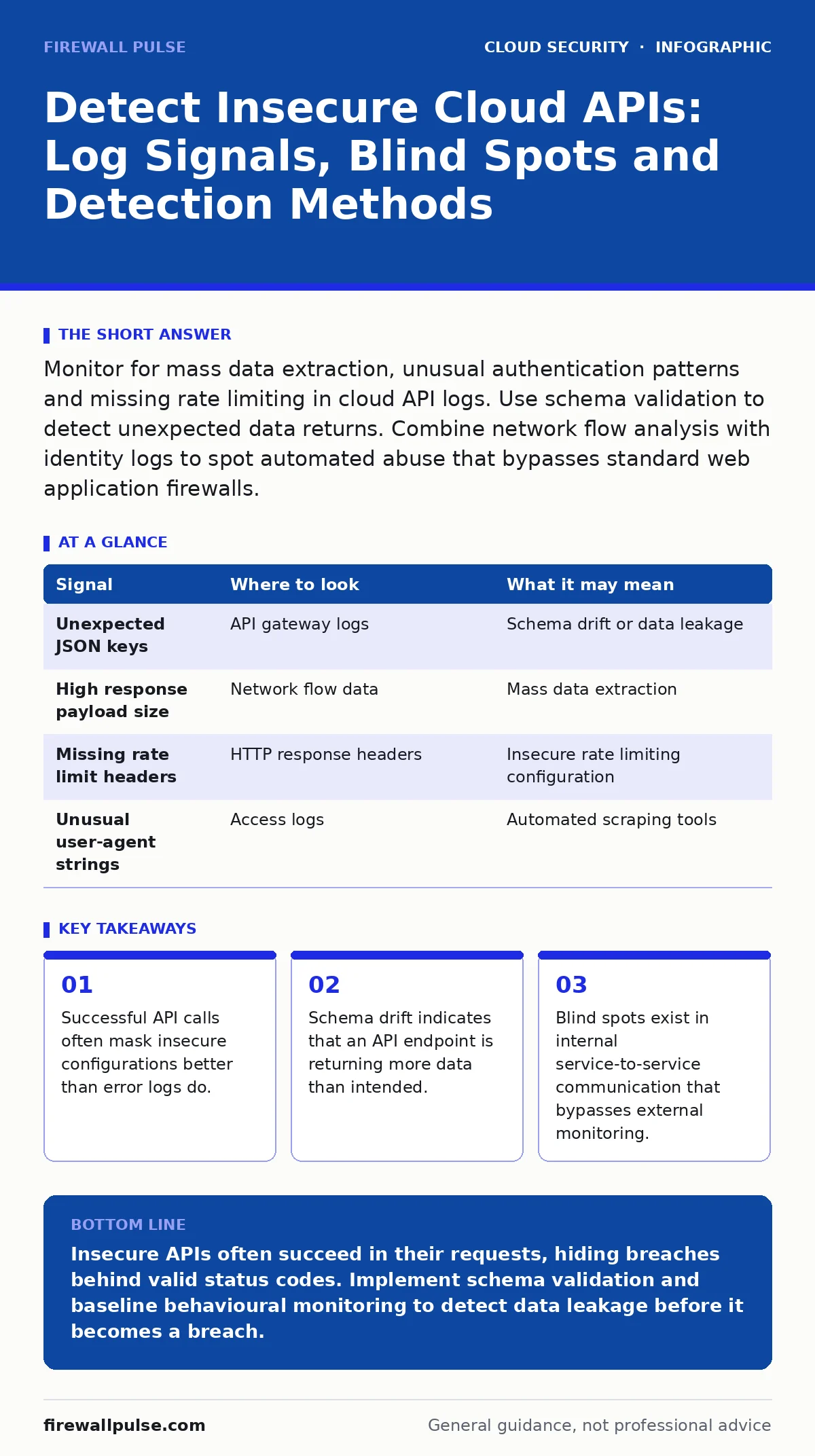
Monitor for mass data extraction, unusual authentication patterns and missing rate limiting in cloud API logs. Use schema validation to detect unexpected data returns. Combine network flow analysis with identity logs to spot automated abuse that bypasses standard web application firewalls.
The Silence of Success
Most security operations focus on failed attempts. You watch for 403 Forbidden or 401 Unauthorized responses because they signal an attacker trying to break in. This approach misses the point of insecure cloud APIs. The danger is not that the API rejects valid users. The danger is that it accepts them and reveals too much.
When an API is insecure, it often works exactly as designed by the developer, but the design was flawed. It returns full user objects instead of minimal identifiers. It allows one service to query another without proper identity verification. You will see green lights in your dashboards. The traffic looks normal. The volume might even be lower than usual because no retries are needed.
You must shift your detection logic from failure to anomaly. Look for what is being returned, not just whether the request was accepted. A successful response containing sensitive data is a breach in progress, even if the authentication token was valid.
Schema Drift and Payload Analysis
APIs rely on a contract between the client and the server. This contract defines the structure of the request and the response. Insecure APIs often suffer from schema drift. This occurs when the backend changes but the API documentation or validation rules do not.
Imagine a developer updates a user profile endpoint to include internal debugging flags. The API still returns a 200 OK status. The client application might ignore the new fields. Your log parser, however, sees new keys in the JSON payload.
You need to establish a baseline for what each API endpoint should return. Use schema validation tools to check responses against this baseline. If an endpoint that usually returns three fields suddenly returns twelve, flag it. This does not mean an attacker is present. It means the API is leaking data it should not expose.
| Signal | Where to look | What it may mean |
|---|---|---|
| Unexpected JSON keys | API gateway logs | Schema drift or data leakage |
| High response payload size | Network flow data | Mass data extraction |
| Missing rate limit headers | HTTP response headers | Insecure rate limiting configuration |
| Unusual user-agent strings | Access logs | Automated scraping tools |
Identity and Token Inspection
Cloud APIs rarely rely on username and password pairs. They use tokens. These tokens grant specific permissions for a limited time. Insecure APIs often fail to validate these tokens correctly. They might accept a token from one service to access resources belonging to another.
This is a breakdown in workload identity. The API does not distinguish between a web server and a database admin tool. It sees a valid token and grants access. You can detect this by correlating API calls with identity logs.
Look for tokens being used from unexpected sources. A token issued for a frontend application should not be making calls to a backend management API. If you see this pattern, the API is likely missing scope validation. It accepts the token but does not check what the token is allowed to do.
Rate Limiting and Throttling Signals
Rate limiting is a control, not a detection method. However, the absence of rate limiting is a strong signal of insecurity. If you see a single IP address or identity making hundreds of requests per second without being throttled, the API is likely misconfigured.
This is often seen in data exfiltration attacks. The attacker does not need to hack the API. They just need to use it faster than intended. They pull down entire databases by iterating through user IDs.
Check your API gateway logs for consistent, high-frequency requests from a single source. Compare this against the baseline for that endpoint. If a search endpoint is being hit a thousand times a minute, it is not a user. It is a script. The API should have stopped this. The fact that it did not is the vulnerability.
Internal Service Traffic
Your external APIs are monitored. Your internal APIs are often ignored. These are the endpoints that services use to talk to each other. They often run on private networks. They do not go through the same web application firewall as public traffic.
Insecure internal APIs are a major blind spot. They often lack authentication entirely. They assume that being on the private network is enough. This is false. If an attacker compromises one workload, they can pivot to others by calling these internal APIs.
You must treat internal API traffic with the same scrutiny as external traffic. Enable logging for service-to-service calls. Look for calls between services that should never communicate. A web server calling a billing API directly is unusual. It suggests the API is exposed to the wrong part of the network.
See also: How Cloud Backup Works: The Hidden Mechanics and Limits
Common Blind Spots
There are areas where detection fails. The first is encrypted traffic. If your API traffic is encrypted end-to-end, your network sensors cannot see the payload. You rely entirely on the API gateway logs. If those logs are misconfigured, you are blind.
The second blind spot is legacy APIs. Older systems may not support modern logging standards. They might not log user identity at all. They only log IP addresses. This makes it hard to distinguish between a legitimate user and an attacker using that user's credentials.
The third blind spot is dynamic APIs. These are APIs that change frequently, often in CI/CD environments. Traditional signature-based detection fails here. You need behavioural analysis. You need to know what the API is supposed to do, and alert when it deviates.
Tooling and Integration
You need tools that can parse structured data. Standard log aggregators are not enough. You need tools that understand JSON and API schemas. These tools can detect changes in the structure of the data.
Integrate these tools with your identity provider. You need to see who is making the call, not just where it is coming from. This correlation is key. An IP address is easy to spoof. A token is harder to fake.
Use these tools to build a baseline of normal behaviour. Define what normal looks like for each API. Then alert on deviations. This is not about blocking attacks. It is about seeing the insecure configuration before it is exploited.
Key takeaways
- Successful API calls often mask insecure configurations better than error logs do.
- Schema drift indicates that an API endpoint is returning more data than intended.
- Blind spots exist in internal service-to-service communication that bypasses external monitoring.
Insecure APIs often succeed in their requests, hiding breaches behind valid status codes. Implement schema validation and baseline behavioural monitoring to detect data leakage before it becomes a breach.
Frequently asked questions
How do I distinguish between legitimate high-traffic users and API abuse?
Look at the pattern of requests. Legitimate users have variable intervals and diverse endpoints. Abusers have consistent intervals and target specific data-heavy endpoints.
Can web application firewalls detect insecure API configurations?
They can block known attack patterns, but they cannot detect logical flaws like excessive data return or missing scope validation. You need API-specific monitoring.
What is the first sign of an API being used for data exfiltration?
A sudden increase in the average size of responses from a specific endpoint, combined with a high frequency of requests from a single identity.
Do I need to monitor internal APIs if they are not exposed to the internet?
Yes. Internal APIs are vulnerable to lateral movement. If an attacker compromises one service, they can use internal APIs to access others without leaving the network.
How this guide was produced: written by the Firewall Pulse editorial team with AI assistance, checked against the public references listed below, and reviewed when the facts change. See our editorial policy or report an error.