How Workload Identity Works: The Mechanism Behind Cloud Service Auth
Workload identity replaces long-lived secrets with short-lived tokens, shifting the security boundary from credential storage to identity verification at runtime.
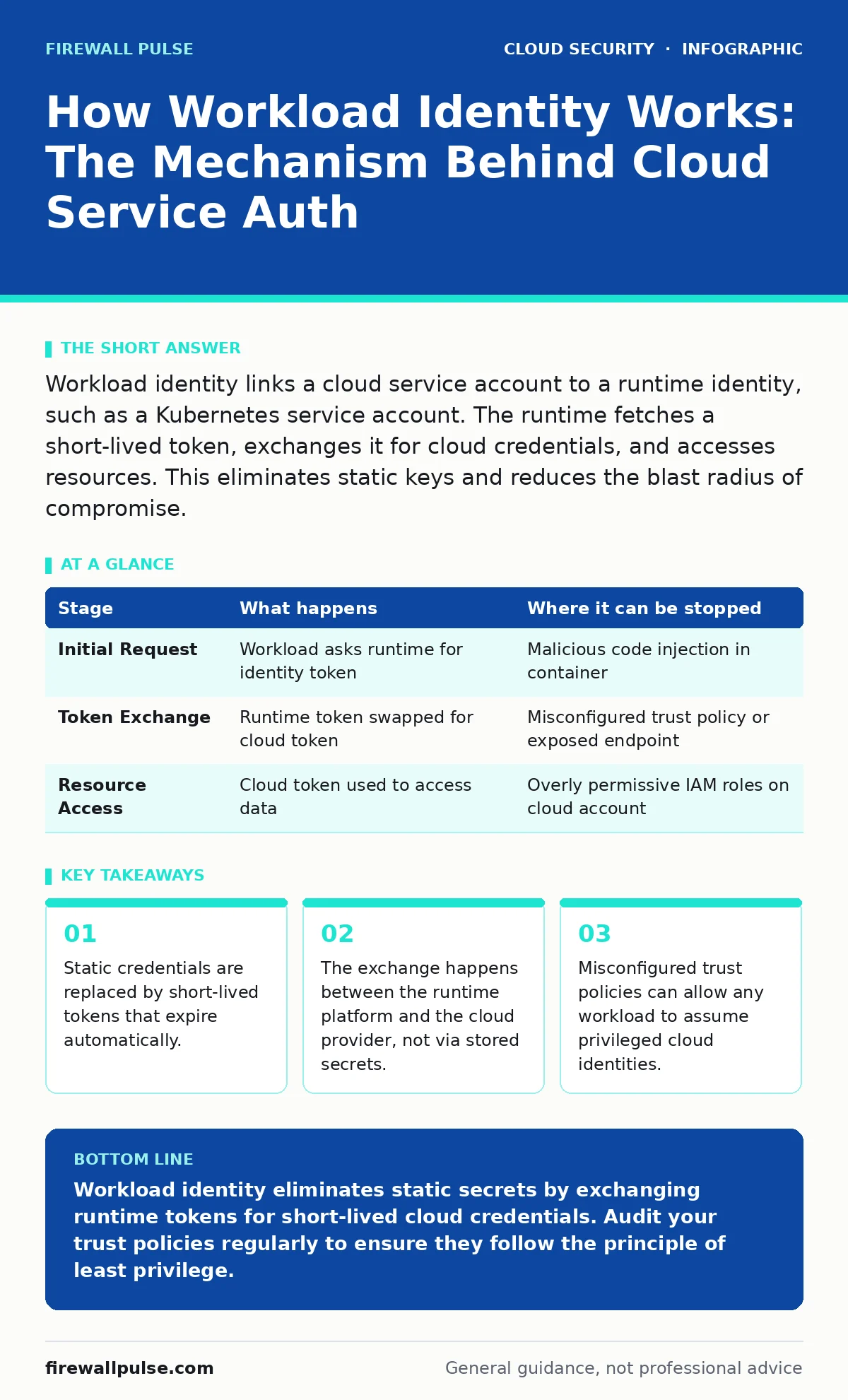
Workload identity links a cloud service account to a runtime identity, such as a Kubernetes service account. The runtime fetches a short-lived token, exchanges it for cloud credentials, and accesses resources. This eliminates static keys and reduces the blast radius of compromise.
The Problem With Static Secrets
Traditional cloud applications rely on static credentials. These are long-lived keys or passwords stored in environment variables or configuration files. If an attacker compromises the application, they steal these keys. The keys often have broad permissions, allowing the attacker to move laterally across the cloud environment.
Workload identity solves this by removing the secret from the application entirely. Instead of storing a key, the application proves who it is. The cloud provider then issues temporary credentials. This shifts the security model from protecting a static string to verifying a dynamic identity.
The Trust Boundary Shift
In this model, trust is established between two distinct systems. The runtime environment, such as a container orchestrator, acts as the identity provider. The cloud platform acts as the identity consumer.
You must define a trust policy. This policy states which runtime identities are allowed to assume which cloud service accounts. Without this policy, the runtime cannot issue valid cloud credentials. The policy is the bridge between the infrastructure layer and the cloud resource layer.
### Stage 1: Initial Token Request
The process begins when your application needs to access a cloud resource. It does not reach out to the cloud directly. Instead, it asks its immediate environment for a token.
In a containerised environment, this usually means contacting a local metadata endpoint. This endpoint is a small service running on the node. It authenticates the request based on the container’s service account. The response is a JSON Web Token. This token contains claims about the workload’s identity, such as its name and namespace.
### Stage 2: Token Exchange
The application now holds a runtime token. It sends this token to the cloud provider’s token exchange endpoint. This is a specific API call defined by open standards.
The cloud provider validates the token. It checks the signature to ensure it came from the trusted runtime environment. It then checks the claims against the trust policy you defined earlier. If the workload identity matches a permitted entry in the policy, the exchange is successful. The cloud provider issues a short-lived access token.
### Stage 3: Resource Access
The application uses the newly issued cloud token to make API calls. This token grants access to specific resources, such as storage buckets or databases. The token has an expiration time, often measured in minutes or hours.
When the token expires, the application must repeat the process. It requests a new runtime token, exchanges it, and receives a new cloud token. This cycle continues for the lifetime of the application. There is no long-term secret to rotate or protect.
See also: Tenant isolation: why shared infrastructure needs strict boundaries
What Happens Behind The Scenes
The security relies on the integrity of the chain. The runtime environment must be secure. If an attacker can inject code into the container, they can request a token. If the trust policy is too broad, that token can be exchanged for powerful cloud credentials.
The token exchange endpoint is a critical component. It must be protected against brute-force attempts and replay attacks. The cloud provider handles this validation. You must ensure the endpoint is not exposed to untrusted networks.
| Stage | What happens | Where it can be stopped |
|---|---|---|
| Initial Request | Workload asks runtime for identity token | Malicious code injection in container |
| Token Exchange | Runtime token swapped for cloud token | Misconfigured trust policy or exposed endpoint |
| Resource Access | Cloud token used to access data | Overly permissive IAM roles on cloud account |
Limits Of The Mechanism
Workload identity does not protect against all threats. It assumes the runtime environment is trustworthy. If the underlying infrastructure is compromised, the identity mechanism fails. An attacker with root access on the node can often bypass container restrictions.
It also relies on correct configuration. A trust policy that allows any service account to assume a privileged cloud role is a critical error. This is a common mistake in complex environments. You must audit these mappings regularly.
Integration With Other Controls
Workload identity works best when combined with other security measures. It reduces the risk of secret leakage but does not replace network segmentation. You should still restrict which workloads can talk to which services.
Consider how this fits with cloud IAM policies. The cloud credentials issued during the exchange must follow the principle of least privilege. Workload identity manages the who, but IAM policies manage the what. Both must be tight.
Also review cloud logging gaps. The token exchange events generate logs. If you do not capture these logs, you lose visibility into identity misuse. You need to know when a workload requests credentials.
Managing The Lifecycle
The lifecycle of these tokens is automatic, but the lifecycle of the trust policies is not. As applications change, their identity requirements change. You must update the trust policies to reflect these changes.
Old policies often accumulate. Workloads that no longer exist may still be listed in trust policies. This creates a larger attack surface. Regularly review and remove unused mappings.
This approach complements insecure container images. If your images contain static credentials, workload identity is redundant. Ensure your images are clean of secrets. Rely on the runtime identity instead.
The Hidden Cost Of Complexity
The main drawback is complexity. You must manage identities across two systems. The runtime platform has its own identity model. The cloud provider has its own. Bridging them requires careful configuration.
Misunderstanding this bridge leads to errors. A common issue is assuming that a Kubernetes service account name automatically maps to a cloud service account. It does not. The mapping must be explicit.
This complexity can lead to OAuth token abuse if not handled correctly. Ensure that the tokens issued are short-lived and scoped narrowly. Long-lived tokens defeat the purpose of the mechanism.
Final Considerations
Workload identity is a significant improvement over static secrets. It reduces the risk of credential theft and simplifies key management. However, it introduces new dependencies and configuration requirements.
You must secure the runtime environment. You must define precise trust policies. You must monitor the exchange events. When done correctly, it provides a strong foundation for cloud security.
Related Topics
For a deeper understanding of the broader security context, consider reading about cloud compliance requirements for identity management. Also, review insecure cloud APIs to understand how exposed endpoints can undermine identity controls. Finally, ensure your cloud backup strategies account for identity-based access controls.
Key takeaways
- Static credentials are replaced by short-lived tokens that expire automatically.
- The exchange happens between the runtime platform and the cloud provider, not via stored secrets.
- Misconfigured trust policies can allow any workload to assume privileged cloud identities.
Workload identity eliminates static secrets by exchanging runtime tokens for short-lived cloud credentials. Audit your trust policies regularly to ensure they follow the principle of least privilege.
Frequently asked questions
Does workload identity protect against insider threats?
It limits the damage an insider can do by removing static secrets. However, if an insider has access to the runtime environment, they can still request tokens.
Can I use workload identity for on-premises applications?
Yes, if your on-premises infrastructure supports the necessary identity protocols. You may need a bridge service to connect to the cloud provider.
What happens if the token exchange service is down?
Applications will fail to access cloud resources. Ensure you have monitoring and alerting for this service. High availability is critical.
Is workload identity compatible with all cloud providers?
Most major cloud providers support some form of workload identity. The specific implementation details vary between providers.
How this guide was produced: written by the Firewall Pulse editorial team with AI assistance, checked against the public references listed below, and reviewed when the facts change. See our editorial policy or report an error.