How CI/CD Pipeline Attacks Work: Step-by-Step Breakdown
Attackers target the build pipeline because it holds the keys to the kingdom, allowing them to plant malware before your security tools ever see the code.
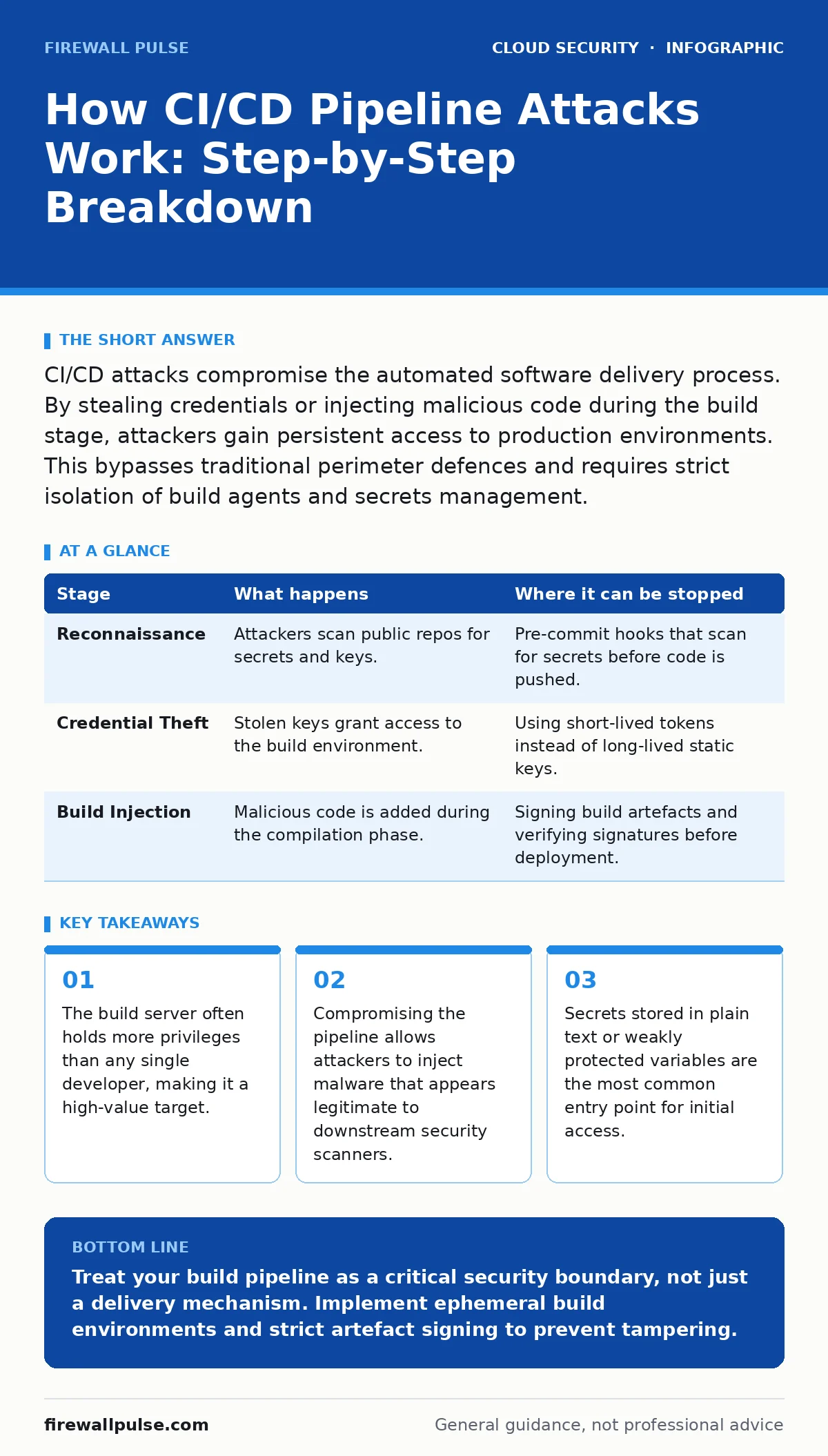
CI/CD attacks compromise the automated software delivery process. By stealing credentials or injecting malicious code during the build stage, attackers gain persistent access to production environments. This bypasses traditional perimeter defences and requires strict isolation of build agents and secrets management.
The Hidden Privilege Escalation Path
Software development relies on automation to move code from a developer’s laptop to a production server. This chain of events is the CI/CD pipeline. It pulls code, builds it, tests it, and deploys it. This process is efficient, but it creates a single point of failure. The pipeline runs with elevated privileges to push changes to live infrastructure.
Imagine you are a security engineer. You trust your code reviews. You trust your static analysis tools. But you often forget that the machine running those tests is itself a target. If an attacker controls the build environment, they can modify the artefact after your tests pass but before it reaches production. This is known as a supply chain attack. The attack vector is not the application logic; it is the machinery that builds the application.
### Stage 1: Initial Reconnaissance and Entry
The attack begins with finding a foothold. Attackers scan for public repositories that contain sensitive data. They look for configuration files that accidentally include API keys, database passwords, or SSH certificates. These secrets often reside in environment variables or configuration files that developers forget to exclude from version control.
Once a secret is found, the attacker gains access to the build server. They do not necessarily need to break into your main network. They only need the credentials that the pipeline uses to authenticate with external services. This is where the concept of least privilege fails. Build agents often have write access to container registries and deployment targets to function correctly.
| Stage | What happens | Where it can be stopped |
|---|---|---|
| Reconnaissance | Attackers scan public repos for secrets and keys. | Pre-commit hooks that scan for secrets before code is pushed. |
| Credential Theft | Stolen keys grant access to the build environment. | Using short-lived tokens instead of long-lived static keys. |
| Build Injection | Malicious code is added during the compilation phase. | Signing build artefacts and verifying signatures before deployment. |
### Stage 2: Compromising the Build Environment
With access to the build server, the attacker moves to the construction phase. The build server compiles source code into a runnable application. This step involves downloading dependencies from public repositories. Attackers can exploit known vulnerabilities in these libraries, a tactic known as dependency confusion. They publish malicious libraries with the same name as legitimate ones, hoping the build process pulls the bad version.
Alternatively, they modify the build scripts directly. If the repository is shared, an attacker with write access can insert a command that downloads a payload during the build. This payload is compiled into the final application. To the developer, the code looks normal. The build logs show success. But the resulting binary contains a backdoor.
### Stage 3: Manipulating the Deployment Artefact
The artefact is the packaged software ready for deployment. It is a container image, a binary, or a web package. At this stage, the attacker ensures the malicious code survives the transition to production. They might inject a reverse shell that opens a connection to a command-and-control server. This code is hidden within the legitimate application logic.
The attacker also modifies the configuration files. They might change logging settings to disable audit trails. This ensures their activity remains invisible. The artefact is then pushed to a container registry or package repository. Because the artefact was built by the trusted pipeline, it passes integrity checks that rely on the source code’s hash, not the build process’s integrity.
### Stage 4: Deployment to Production
The deployment stage moves the artefact from the registry to the live environment. This is where the attack becomes active. The application starts with its new malicious code. It connects to the attacker’s server, sending data back. This could be user data, internal network maps, or further credentials.
The attacker now has a persistent foothold in your production environment. They can move laterally from the compromised application to other services. This is especially dangerous in cloud environments where applications often share underlying infrastructure. The breach is not contained to the application; it spreads through the connected services.
See also: How Cloud Backup Works: The Hidden Mechanics and Limits
### Stage 5: Persistence and Evasion
To maintain access, the attacker establishes persistence. They might create a new user account with administrative privileges. They could modify the deployment scripts to re-install their backdoor if the application is updated. This makes removal difficult. Even if you patch the original vulnerability, the attacker remains inside.
They also work to evade detection. They use techniques to blend their traffic with normal application traffic. They might use encrypted channels to communicate with their command-and-control server. This makes it hard for network security tools to spot the anomaly. The attack relies on the assumption that production traffic is trusted because it comes from your own infrastructure.
Interrupting the Attack Chain
You can stop this attack at multiple points. The most effective defence is to treat the build pipeline as a hostile environment. Assume it can be compromised. Use ephemeral build agents that are destroyed after each job. This prevents persistent malware from surviving on the server.
Implement strict secret management. Never store static credentials in the pipeline. Use dynamic credentials that expire after a short time. This limits the window an attacker has to use stolen keys. You should also sign every artefact produced by the pipeline. Verify the signature before deploying. This ensures the artefact has not been tampered with since the build.
The Cost of Automation Trust
The core issue is trust. You trust the pipeline to deliver what you coded. But the pipeline is complex software with many dependencies. Each dependency is a potential attack vector. The convenience of automation reduces the visibility of the build process. You see the input and the output, but not what happens in between.
This lack of visibility is the hidden cost of CI/CD. To mitigate it, you must increase transparency. Log every step of the build process. Monitor for unusual behaviour, such as unexpected network connections from the build server. Integrate security checks into the pipeline itself, but remember that these checks can also be bypassed if the pipeline is compromised.
Final Thoughts on Pipeline Security
Securing the CI/CD pipeline requires a shift in mindset. You are not just protecting code; you are protecting the process that delivers the code. This involves securing the infrastructure, the secrets, and the artefacts. It is a layered defence strategy. No single control is sufficient.
You must also consider the human element. Developers often bypass security controls to speed up development. Education and easy-to-use security tools are necessary. Make security part of the workflow, not a hurdle at the end. By integrating security into every stage of the pipeline, you reduce the risk of a successful attack.
RELATED: For deeper context on how compromised images persist, see the guide on insecure container images. Understanding identity permissions is also key; review the guide on overprivileged cloud identities to tighten access controls. Additionally, check for gaps in your monitoring by reading about cloud logging gaps. Finally, ensure your API surfaces are protected by reviewing the guide on insecure cloud APIs.
Key takeaways
- The build server often holds more privileges than any single developer, making it a high-value target.
- Compromising the pipeline allows attackers to inject malware that appears legitimate to downstream security scanners.
- Secrets stored in plain text or weakly protected variables are the most common entry point for initial access.
Treat your build pipeline as a critical security boundary, not just a delivery mechanism. Implement ephemeral build environments and strict artefact signing to prevent tampering.
Frequently asked questions
Can a compromised CI/CD pipeline bypass code signing?
Yes, if the attacker gains access to the signing keys or modifies the code before it is signed, the malicious artefact will appear legitimate.
How do ephemeral build agents help?
They ensure that no persistent malware can survive on the build server, as the environment is destroyed and recreated for each build job.
What is dependency confusion?
It is an attack where an attacker registers a malicious library with the same name as a legitimate one, tricking the build process into downloading the harmful version.
Should I allow build servers to access the internet?
No, restrict network access to only the necessary endpoints for downloading dependencies and pushing artefacts to reduce the attack surface.
How this guide was produced: written by the Firewall Pulse editorial team with AI assistance, checked against the public references listed below, and reviewed when the facts change. See our editorial policy or report an error.