Implement Cloud Compliance: A Step-by-Step Guide for Secure Infrastructure
Compliance fails when teams treat it as a periodic audit rather than a continuous state enforced by automated policy checks at the infrastructure level.

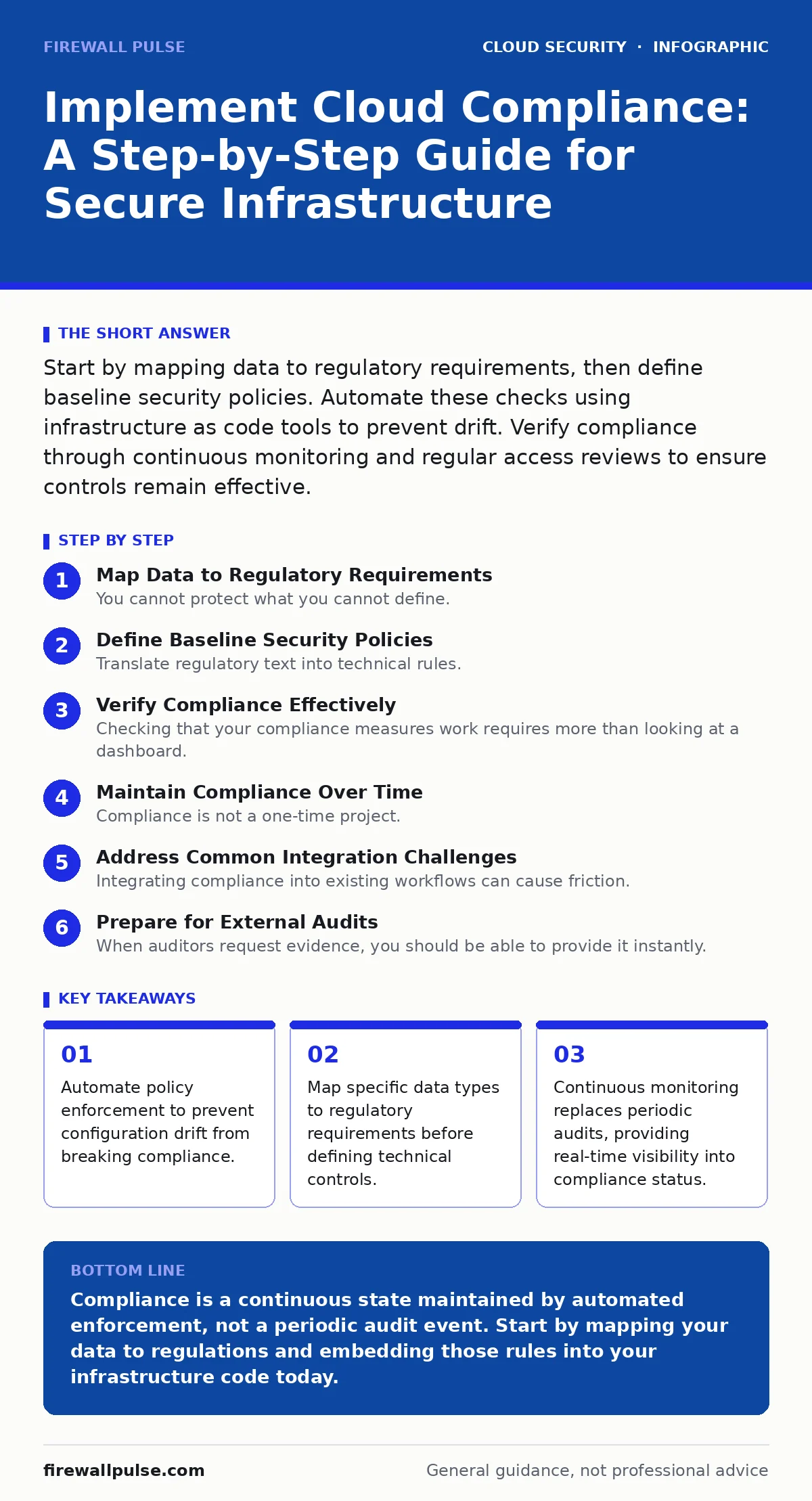
Start by mapping data to regulatory requirements, then define baseline security policies. Automate these checks using infrastructure as code tools to prevent drift. Verify compliance through continuous monitoring and regular access reviews to ensure controls remain effective.
Map Data to Regulatory Requirements
You cannot protect what you cannot define. Before configuring any security tool, you must identify the specific data sets subject to regulation. This means distinguishing between general user data and sensitive information such as health records or payment details. Each category carries different handling requirements that dictate your technical controls.
Imagine a scenario where you apply the strictest encryption standards to all data. While this seems safe, it creates unnecessary overhead and performance bottlenecks for non-sensitive logs. Instead, classify data at the point of entry. This classification drives the subsequent security policies you implement.
Define Baseline Security Policies
Translate regulatory text into technical rules. These rules become your security baseline. For example, a requirement for data encryption at rest translates to a rule that blocks the creation of unencrypted storage buckets. A requirement for access control translates to a rule that denies broad administrative permissions.
You must document these policies in a machine-readable format. This allows automation tools to enforce them consistently. Without this translation, compliance remains a manual checklist that human error can easily bypass. Refer to our guide on cloud IAM policies for detailed methods on structuring least-privilege access rules.
Step 1: Inventory Existing Resources
Conduct a full inventory of your cloud assets. You need to know every instance, storage container, and database currently in use. Many teams overlook development or testing environments, which often lack the security controls of production systems. These shadow assets become immediate compliance failures.
Use native cloud tools to generate this inventory. Compare the output against your approved architecture diagrams. Any resource that exists without a corresponding business justification should be flagged for review or removal.
- List all compute instances and their associated tags.
- List all storage containers and their access permissions.
- Identify all databases and their encryption status.
Step 2: Enforce Infrastructure as Code
Move away from manual console configurations. Define your infrastructure using code templates that embed your security policies. If a developer tries to create an unencrypted database, the code deployment fails automatically.
This approach eliminates configuration drift, where settings change over time and diverge from the secure baseline. It also provides an audit trail of who changed what and when. You can review changes as code commits, making the compliance history transparent and verifiable.
Step 3: Automate Continuous Monitoring
Set up automated tools to scan your environment against your defined policies. These tools should run continuously, not just before an audit. They detect when configurations drift from the baseline due to manual changes or software updates. Immediate alerts allow you to remediate issues before they become violations.
This continuous feedback loop is more effective than periodic manual checks. It reduces the risk of long-standing vulnerabilities going unnoticed. Ensure your monitoring covers all regions and accounts within your cloud environment to avoid blind spots.
Step 4: Implement Access Reviews
Regularly review who has access to your resources. Permissions that were necessary for a specific project may no longer be required. Over time, accumulated permissions create a larger attack surface. Automated access reviews help identify and remove unnecessary privileges.
Combine automated checks with manual validation for high-privilege accounts. This hybrid approach balances efficiency with the need for human judgment in complex permission structures. See our guide on overprivileged cloud identities for strategies to reduce excessive access rights.
Verify Compliance Effectively
Checking that your compliance measures work requires more than looking at a dashboard. You must actively test whether controls prevent unauthorized actions. Attempt to create a non-compliant resource and verify that the system blocks it. This positive testing confirms that your enforcement mechanisms are active and correct.
You should also review logs to ensure that all actions are recorded. Missing logs indicate a failure in your monitoring setup, which itself is a compliance violation. Address any gaps in logging immediately to maintain a complete audit trail. Refer to our guide on cloud logging gaps for methods to ensure comprehensive event capture.
Maintain Compliance Over Time
Compliance is not a one-time project. It requires ongoing maintenance as your infrastructure and regulations evolve. Regularly update your security policies to reflect new threats and regulatory changes. Keep your infrastructure code templates aligned with these updated policies.
Schedule periodic reviews of your compliance framework. Assess whether your current controls are still effective against emerging risks. This proactive approach prevents compliance decay and ensures your security posture remains strong. Check our guide on cloud backup to ensure your recovery procedures also meet compliance standards.
Address Common Integration Challenges
Integrating compliance into existing workflows can cause friction. Development teams may view automated blocks as impediments to speed. To mitigate this, provide clear documentation on why certain configurations are blocked and how to achieve compliant alternatives. This turns compliance from a barrier into a helpful guardrail.
Ensure that your compliance tools integrate with your existing development pipelines. This allows developers to check compliance early in the development process, rather than waiting for deployment. Early detection reduces the cost and effort of remediation. See our guide on CI/CD pipeline attacks for insights on securing the development lifecycle.
See also: How Workload Identity Works: The Mechanism Behind Cloud Service Auth
Prepare for External Audits
When auditors request evidence, you should be able to provide it instantly. Maintain a central repository of compliance reports and audit logs. This repository should be accessible to authorized personnel only. Automated report generation saves time and reduces the risk of human error during data collection.
Practice retrieving evidence before the actual audit. This ensures you know where to find specific records and that they are formatted correctly. Smooth evidence retrieval demonstrates control and confidence to auditors, facilitating a smoother review process.
Summary of Verification
Use this checklist to confirm your implementation is complete and effective.
- All data types are classified and mapped to regulatory requirements.
- Security policies are defined in machine-readable format.
- Infrastructure as code templates enforce security baselines.
- Continuous monitoring detects configuration drift in real-time.
- Access reviews are scheduled and automated where possible.
- Logs are comprehensive and immutable.
- Evidence retrieval processes are tested and documented.
Key takeaways
- Automate policy enforcement to prevent configuration drift from breaking compliance.
- Map specific data types to regulatory requirements before defining technical controls.
- Continuous monitoring replaces periodic audits, providing real-time visibility into compliance status.
Compliance is a continuous state maintained by automated enforcement, not a periodic audit event. Start by mapping your data to regulations and embedding those rules into your infrastructure code today.
Frequently asked questions
How often should I review my cloud compliance policies?
Review policies at least quarterly or whenever there are significant changes to your infrastructure or regulatory landscape.
Can I automate all compliance checks?
Most technical checks can be automated, but periodic human review is still necessary for complex permission structures and policy interpretation.
What happens if I find a compliance violation?
Immediately remediate the issue, document the root cause, and update your automated controls to prevent recurrence.
Is cloud compliance the same as cloud security?
No, compliance is about meeting specific regulatory requirements, while security is about protecting against threats. Compliance is a subset of security.
How this guide was produced: written by the Firewall Pulse editorial team with AI assistance, checked against the public references listed below, and reviewed when the facts change. See our editorial policy or report an error.