Tenant isolation: why shared infrastructure needs strict boundaries
Without enforced tenant isolation, a single misconfiguration can allow one customer to read or alter the data of another, bypassing application logic entirely.
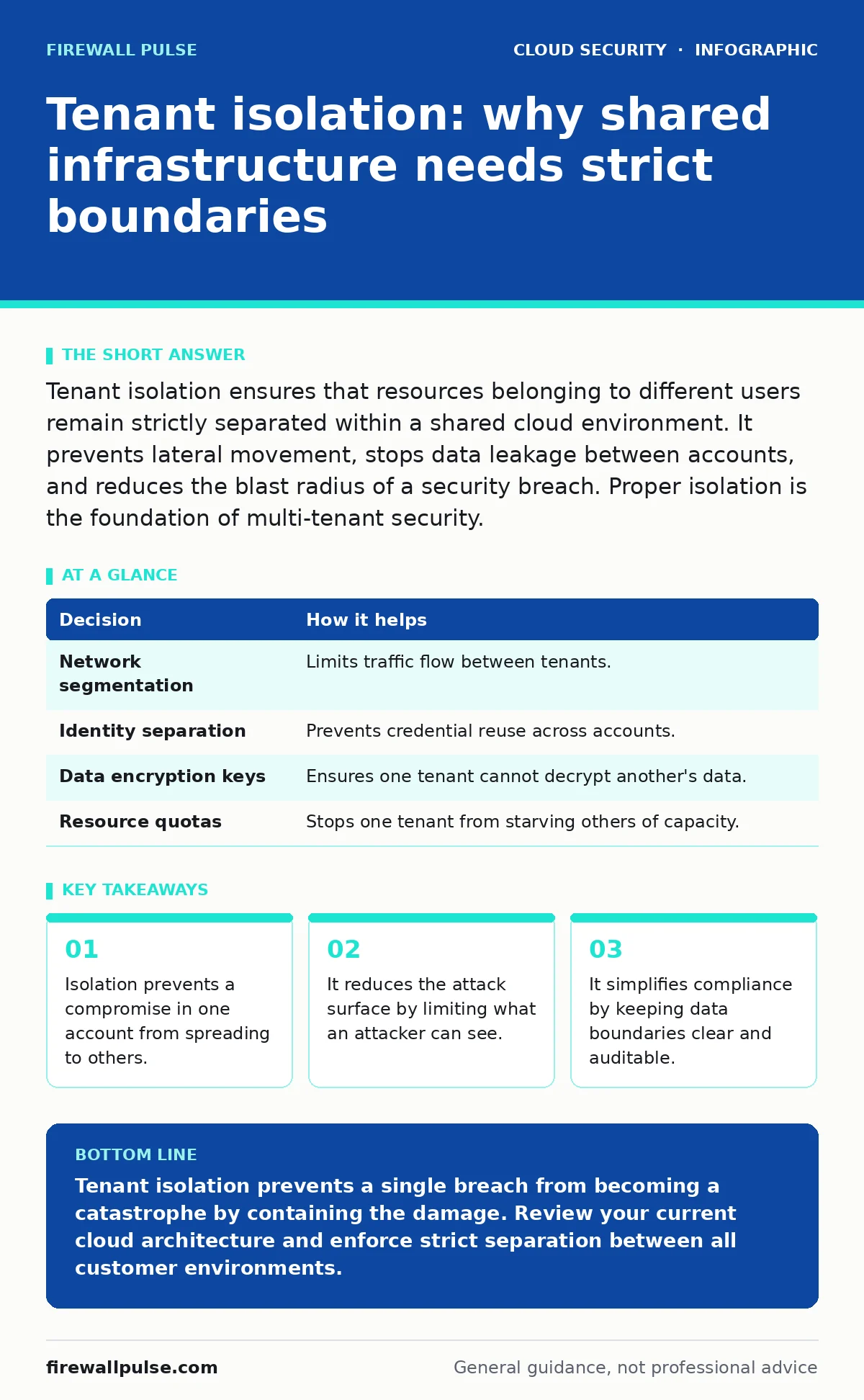
Tenant isolation ensures that resources belonging to different users remain strictly separated within a shared cloud environment. It prevents lateral movement, stops data leakage between accounts, and reduces the blast radius of a security breach. Proper isolation is the foundation of multi-tenant security.
The illusion of shared safety
Cloud platforms often market shared infrastructure as a benefit. You get cheaper storage, faster compute, and automatic scaling. The provider handles the physical hardware. You focus on your application. This model works only if the boundaries between users are impermeable.
Tenant isolation is the set of controls that keep these users separate. It ensures that User A cannot read, write, or delete resources belonging to User B. Without it, the cloud is just a large computer where everyone shares the same hard drive.
Imagine a library where every book is on a single open shelf. Anyone can take any book. Now imagine a library with private study rooms. You need a key to enter. You can only access your own materials. Tenant isolation is the key and the locked door.
When boundaries fail
What goes wrong when isolation is weak? The most common failure is data leakage. A developer might misconfigure a storage bucket. If the platform does not enforce strict separation, another tenant might access that bucket. They do not need to hack your application. They simply query the underlying infrastructure.
Another failure mode is resource exhaustion. One tenant might consume excessive CPU or memory. If the hypervisor or container engine does not isolate resources properly, this usage affects other tenants. Their applications slow down or crash. This is a denial-of-service attack caused by a neighbour, not an external threat.
Suppose you run a web application. A user finds a flaw in your code. They gain access to your server. If tenant isolation is poor, they might pivot to the host machine. From there, they could look for other customers hosted on the same physical server. The breach spreads beyond your control.
The cost of convenience
Teams often skip strict isolation for speed. It is easier to share databases or use default settings. You save time during development. You avoid the complexity of setting up separate networks. This convenience has a hidden cost.
When an incident occurs, you cannot contain it. The attacker moves laterally. You must investigate every tenant on the shared infrastructure. The forensic effort multiplies. The reputational damage grows. You lose trust with all your customers, not just the one who was targeted.
Security operations teams face a harder job. They must monitor for anomalies across a larger scope. Alerts become noise. Real threats get buried. The team spends more time triaging false positives than stopping attacks. This leads to alert fatigue and missed detections.
Decisions isolation informs
Tenant isolation is not just a technical setting. It drives architectural choices. You must decide how to structure your network, your identities, and your data storage. Each decision affects security posture.
| Decision | How it helps |
|---|---|
| Network segmentation | Limits traffic flow between tenants. |
| Identity separation | Prevents credential reuse across accounts. |
| Data encryption keys | Ensures one tenant cannot decrypt another's data. |
| Resource quotas | Stops one tenant from starving others of capacity. |
These decisions work together. Network segmentation stops direct access. Identity separation ensures that even if a password is stolen, it only works in one place. Encryption keys add a layer of protection for data at rest. Quotas protect availability.
The role of infrastructure as code
Manual configuration is prone to error. Humans forget to set permissions. They copy-paste settings from one project to another. This creates inconsistencies. Some tenants are well-protected. Others are left exposed.
Infrastructure as code solves this. You define the isolation rules in scripts. These scripts are version-controlled and reviewed. Every deployment uses the same secure baseline. There is no drift. The configuration is consistent and repeatable.
This approach also aids in cloud compliance. Auditors can review the code. They can verify that isolation standards are met. You do not need to manually check each server. The code proves the control is in place. This reduces the burden of audits and increases confidence in your security posture.
See also: Cloud IAM Policies: The Hidden Lever for Security Control
Example: Two different paths
Team A saved money on cloud bills. They paid a much higher price in incident response and legal fees. Team B spent more on setup. They saved money on risk and maintained customer trust. The choice is clear. Isolation is an investment, not a cost.
Mitigating common risks
Many teams focus on perimeter security. They build strong firewalls. They scan for vulnerabilities. They ignore the internal boundaries. This is a mistake. Attackers often bypass the perimeter. They use valid credentials. They exploit trust relationships.
You must treat the internal network as hostile. Assume that an attacker is already inside. Can they move from one tenant to another? If yes, your isolation is insufficient. You need to limit lateral movement.
This relates to overprivileged cloud identities. If a service account has too many permissions, it becomes a target. An attacker who compromises that account gains access to everything it can touch. Limit permissions to the minimum required. Use cloud IAM policies to enforce this. Regularly review these policies. Remove unused permissions.
Integrating with CI/CD
Security is not a final step. It is part of the development process. Your CI/CD pipeline attacks surface increases if you do not secure the pipeline itself. The pipeline builds and deploys your application. It has access to secrets and infrastructure.
If the pipeline is compromised, an attacker can deploy malicious code. They can change isolation settings. They can open ports. They can steal credentials. You must protect the pipeline as much as the production environment.
Use insecure container images scanning in the pipeline. Check for known vulnerabilities. Verify the integrity of the build. Ensure that the deployment process enforces isolation rules. Do not allow manual overrides. This ensures that every release maintains the security baseline.
The bottom line for operations
Security operations teams must monitor isolation controls. Look for changes in network rules. Alert on new permissions being granted. Watch for unusual traffic patterns between tenants. These are signs of a breach or misconfiguration.
You cannot prevent every attack. You can limit the damage. Tenant isolation is your first line of defence against lateral movement. It keeps breaches small. It keeps your customers safe. It keeps your business running.
Key takeaways
- Isolation prevents a compromise in one account from spreading to others.
- It reduces the attack surface by limiting what an attacker can see.
- It simplifies compliance by keeping data boundaries clear and auditable.
Tenant isolation prevents a single breach from becoming a catastrophe by containing the damage. Review your current cloud architecture and enforce strict separation between all customer environments.
Frequently asked questions
Does tenant isolation affect performance?
Proper isolation adds minimal overhead. The cost of managing separate resources is usually higher than the performance impact of isolation controls.
Can I use tenant isolation for on-premise systems?
Yes. The principles apply to any shared infrastructure. Use virtualisation and network segmentation to achieve similar results in on-premise data centres.
How do I verify my isolation is working?
Conduct regular audits and penetration tests. Attempt to access resources from one tenant using credentials from another. Monitor logs for cross-tenant access attempts.
Is encryption enough for tenant isolation?
No. Encryption protects data at rest. It does not prevent an attacker from accessing the application or the infrastructure. You need network and identity controls too.
How this guide was produced: written by the Firewall Pulse editorial team with AI assistance, checked against the public references listed below, and reviewed when the facts change. See our editorial policy or report an error.