Overprivileged Cloud Identities: How Excess Access Enables Breaches
Excess permissions often hide in long-standing service accounts, creating a silent path for attackers to move laterally without triggering immediate alerts.
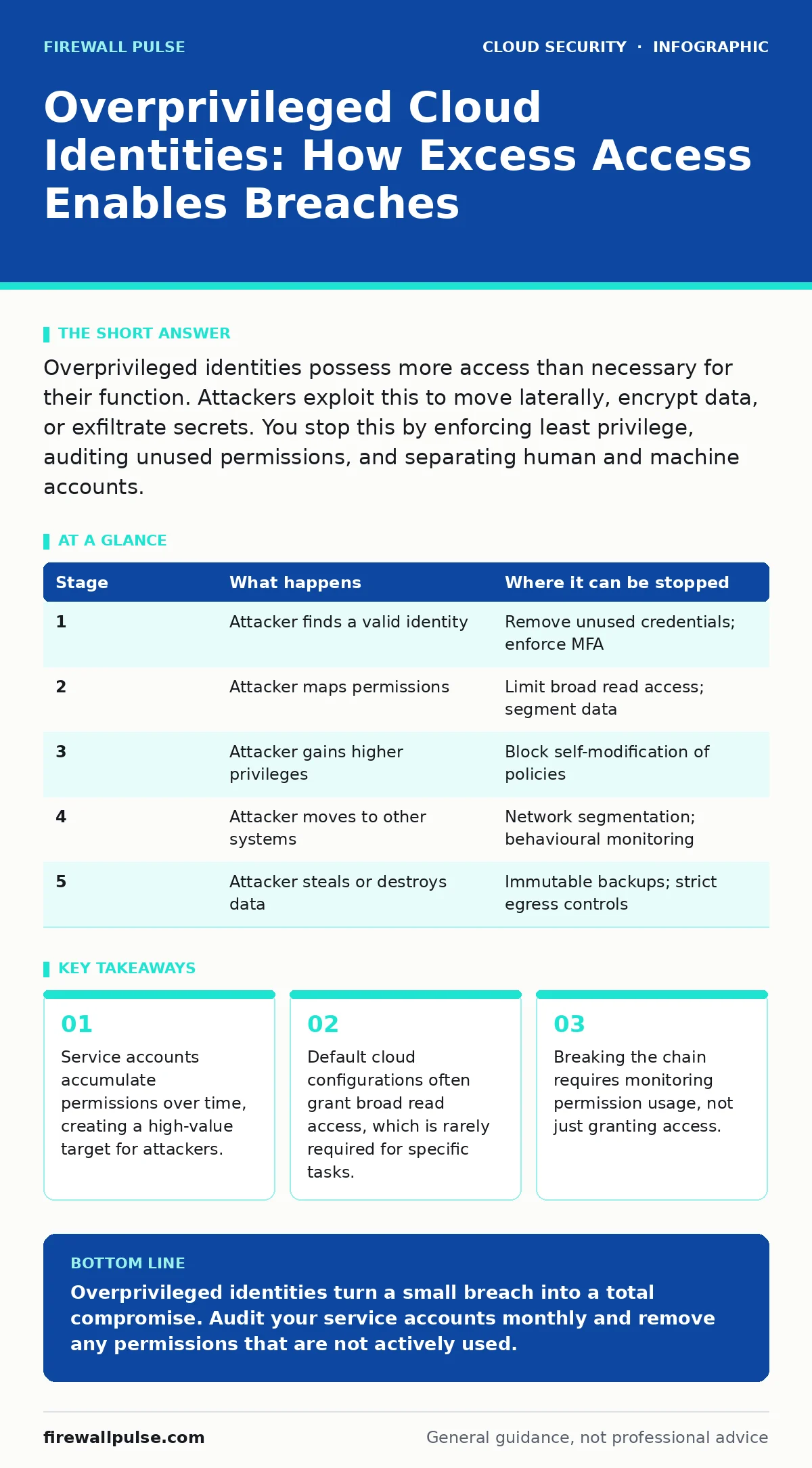
Overprivileged identities possess more access than necessary for their function. Attackers exploit this to move laterally, encrypt data, or exfiltrate secrets. You stop this by enforcing least privilege, auditing unused permissions, and separating human and machine accounts.
The Anatomy of Excess Access
Cloud environments rely on identities to manage resources. These identities include human users, automated scripts, and application services. Each identity holds a set of permissions that dictate what actions it can perform. When an identity holds more permissions than it needs, it becomes overprivileged. This is not merely a tidy-up issue. It is a structural weakness that attackers exploit to move undetected.
You might assume that restricting access to sensitive data is enough. However, an overprivileged identity can often create new identities, modify logging settings, or access backup systems. These secondary actions allow an attacker to bypass primary defences. Understanding how this happens requires walking through the stages of exploitation.
Stage 1: Identity Discovery
The process begins with the attacker finding a valid identity. This is rarely a high-profile administrator account. Instead, they look for service accounts, application roles, or CI/CD pipeline tokens. These accounts are often overlooked because they are not tied to a specific person. They exist to keep systems running.
Attackers search for credentials stored in code repositories, environment variables, or misconfigured storage buckets. They also look for temporary tokens that have not expired. The goal is not to break in, but to find a door that is already slightly ajar. A service account with broad read access is a common starting point.
Stage 2: Permission Mapping
Once the attacker has a valid identity, they map its permissions. They do not immediately steal data. Instead, they test the boundaries of what the identity can do. They check if the identity can list storage buckets, view network configurations, or read other users' access logs. This phase is quiet. It generates minimal noise because it involves standard read operations.
The attacker relies on the assumption that broad read access is harmless. In reality, read access to configuration files can reveal database passwords, encryption keys, or internal IP addresses. The attacker now knows exactly what the identity can touch. They are building a blueprint for the next phase.
Stage 3: Privilege Escalation
With a map of permissions, the attacker looks for ways to gain more power. They check if the identity can modify its own permissions. In many cloud setups, a service account can update its own policy if it has permission to write to identity management services. This is a critical flaw. It allows a low-privilege account to become an administrator.
If self-modification is blocked, the attacker looks for other paths. They might check if the identity can create new virtual machines with higher privileges. They might see if they can attach a powerful role to a resource they control. This stage relies on the complexity of cloud permissions. The sheer number of possible actions makes it easy for a single dangerous permission to slip through.
Stage 4: Lateral Movement
Having escalated privileges, the attacker moves to other parts of the environment. They use the new permissions to access resources that were previously out of reach. They might move from a development environment to a production database. They might access identity management consoles to create new, persistent backdoor accounts.
This movement is often silent. The attacker uses the legitimate permissions of the compromised identity. Security tools may see this as normal activity. The attacker relies on the lack of behavioural analysis. If the identity usually reads storage, and now it reads storage in a different region, it may not trigger an alert. The attacker is now inside the secure zone.
See also: Tenant isolation: why shared infrastructure needs strict boundaries
Stage 5: Data Exfiltration or Disruption
The final stage is the execution of the attacker's goal. This could be stealing sensitive data, encrypting files for ransom, or destroying backups. The overprivileged identity provides the access needed to perform these actions at scale. The attacker might download terabytes of data to a cloud storage account they control. They might delete critical logs to cover their tracks.
The damage is done quickly. The attacker relies on the time it takes for humans to notice the anomaly. By the time an alert is raised, the data may be gone, or the systems may be encrypted. The overprivileged identity was the key that unlocked the entire environment.
Interrupting the Chain
You can interrupt this chain at multiple stages. At Stage 1, you reduce the attack surface by removing unused credentials and enforcing short-lived tokens. At Stage 2, you limit read access to only what is strictly necessary. At Stage 3, you prevent identities from modifying their own permissions. At Stage 4, you segment your environment to limit movement. At Stage 5, you ensure backups are immutable and monitored.
The most effective interruption happens before the attack starts. You must enforce the principle of least privilege. This means every identity has only the permissions it needs to do its job. Nothing more. This requires regular auditing and automated removal of unused permissions.
| Stage | What happens | Where it can be stopped |
|---|---|---|
| 1 | Attacker finds a valid identity | Remove unused credentials; enforce MFA |
| 2 | Attacker maps permissions | Limit broad read access; segment data |
| 3 | Attacker gains higher privileges | Block self-modification of policies |
| 4 | Attacker moves to other systems | Network segmentation; behavioural monitoring |
| 5 | Attacker steals or destroys data | Immutable backups; strict egress controls |
The Hidden Cost of Convenience
Overprivileged identities often exist for convenience. Developers want easy access. Operations teams want broad permissions to troubleshoot quickly. This convenience creates a hidden cost. It increases the blast radius of every compromised account. A single leaked key can compromise the entire cloud environment.
You must balance convenience with security. Use temporary credentials for developers. Use separate accounts for different environments. Automate the granting and revoking of permissions. This reduces the risk without stopping work. See our guide on cloud IAM policies for detailed strategies on defining these permissions.
Monitoring for Anomalies
Traditional security tools look for known bad patterns. Overprivileged identity abuse often looks like normal activity. You need to monitor for anomalies. An identity that suddenly accesses a large number of resources is suspicious. An identity that runs at unusual times is suspicious. An identity that modifies logging settings is highly suspicious.
Implement behavioural analysis. Set baselines for normal activity. Alert on deviations. This helps you catch the attack at Stage 2 or 3. Do not rely on perimeter defences alone. The threat is inside. See our guide on cloud logging gaps to ensure you are capturing the necessary data.
Regular Audits and Cleanup
Permissions accumulate over time. Services change, but permissions often remain. This drift creates overprivileged identities. You must audit permissions regularly. Identify unused permissions. Remove them. This is not a one-time task. It is an ongoing process.
Automate this where possible. Use tools to identify unused resources and permissions. Review service accounts quarterly. Ensure that every identity has a clear owner. See our guide on cloud backup to ensure your audit trails are protected.
The Role of Infrastructure as Code
Infrastructure as Code (IaC) allows you to define permissions in code. This provides version control and review. You can review permission changes before they are applied. This reduces the risk of accidental over-privilege. It also allows you to scan for misconfigurations automatically.
Treat permissions as code. Review them as you would review application code. Ensure that least privilege is enforced in your templates. See our guide on CI/CD pipeline attacks to understand how to secure the process that deploys these configurations.
Final Thoughts on Identity Security
Overprivileged identities are a silent threat. They allow attackers to move freely within your environment. You must treat every identity as a potential entry point. Enforce least privilege. Monitor for anomalies. Audit regularly. This reduces your risk significantly.
See our guide on tenant isolation to understand how to limit the impact of a compromised identity. See our guide on exposed Kubernetes dashboards to identify common misconfigurations. See our guide on insecure container images to reduce the attack surface of your applications. See our guide on insecure cloud APIs to protect your management interfaces.
Key takeaways
- Service accounts accumulate permissions over time, creating a high-value target for attackers.
- Default cloud configurations often grant broad read access, which is rarely required for specific tasks.
- Breaking the chain requires monitoring permission usage, not just granting access.
Overprivileged identities turn a small breach into a total compromise. Audit your service accounts monthly and remove any permissions that are not actively used.
Frequently asked questions
How do I find overprivileged identities?
Use cloud-native tools to analyse permission usage. Look for identities with broad read access or those that have not been used recently.
What is the principle of least privilege?
It is the practice of granting only the minimum permissions necessary for an identity to perform its function. Nothing more.
Can I automate permission removal?
Yes. Many cloud providers offer tools to identify unused permissions. You can automate their removal after a review period.
Does MFA stop overprivileged identity abuse?
MFA helps protect human accounts. Service accounts often cannot use MFA. Focus on short-lived tokens and IP restrictions for machines.
How this guide was produced: written by the Firewall Pulse editorial team with AI assistance, checked against the public references listed below, and reviewed when the facts change. See our editorial policy or report an error.