OAuth Token Abuse: Risks and Protection for Small Businesses
Stolen tokens bypass multi-factor authentication because the system treats them as a verified session, not a new login attempt.
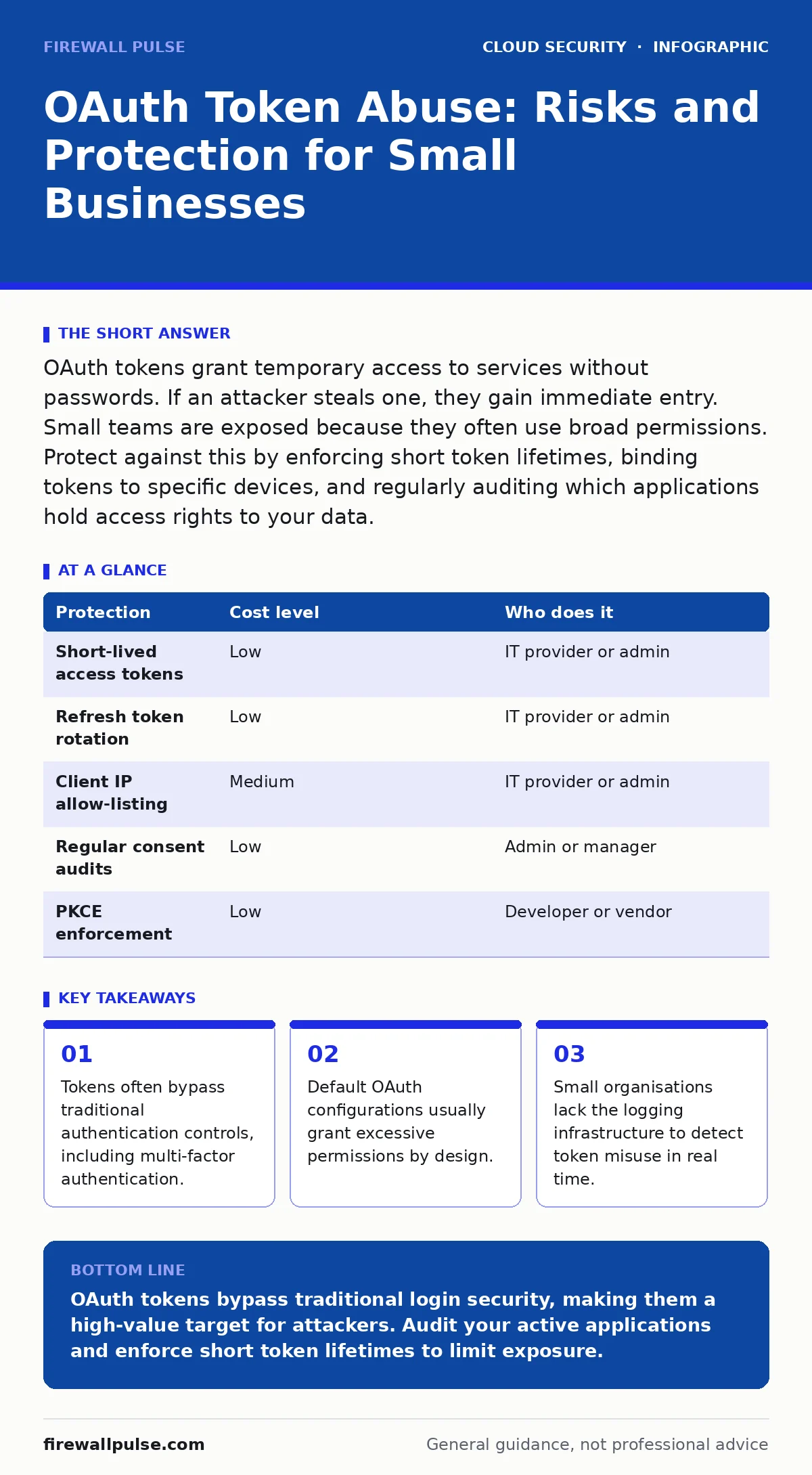
OAuth tokens grant temporary access to services without passwords. If an attacker steals one, they gain immediate entry. Small teams are exposed because they often use broad permissions. Protect against this by enforcing short token lifetimes, binding tokens to specific devices, and regularly auditing which applications hold access rights to your data.
The Mechanics of Token Theft
OAuth is an open standard that allows applications to access user data without sharing passwords. When you log into a service using another platform, you grant a token. This token acts as a temporary key. It tells the service, "This user has already verified their identity."
The danger lies in the assumption that the token holder is the original user. The service does not re-verify the user’s identity while the token is valid. It trusts the token itself. If an attacker intercepts or steals that token, they step into the user’s shoes. They do not need the password. They do not need the second factor. They simply present the valid token.
This creates a blind spot in security monitoring. Traditional alerts trigger on failed login attempts. Token abuse generates no failed attempts. It looks like legitimate activity. The system sees a valid key opening a door. It has no mechanism to question why the key is in a different city or on a different device.
Why Small Organisations Are Exposed
Small teams often rely on a patchwork of SaaS applications. Each application requires its own integration. To make these tools work, administrators grant OAuth permissions. The problem is that most applications request the maximum possible access. A simple calendar plugin may ask for full read and write access to all email.
Administrators accept these terms to reduce friction. They want the tool to work immediately. They rarely review the specific scopes, which are the individual permissions within the token. Over time, the environment accumulates dozens of active tokens. Each token is a potential entry point.
Large enterprises have teams to audit these permissions. Small organisations often do not. They rely on the default settings provided by the vendor. This creates a large attack surface with minimal oversight. The cost of managing these integrations is often seen as a technical overhead rather than a security risk.
The Hidden Cost of Convenience
The primary driver of OAuth abuse is convenience. Users prefer single sign-on because it reduces memory load. Administrators prefer it because it reduces password reset tickets. However, this convenience shifts the risk from the user to the application.
When an application is compromised, every user who granted it access is at risk. The breach is not limited to the application’s database. It extends to every connected service. This is a non-obvious consequence of modern identity management. You are not just securing your own accounts. You are trusting the security posture of every vendor you integrate with.
Another hidden cost is the lack of visibility. Many small businesses do not know which tokens are active. They cannot easily revoke access to a specific application without disrupting workflow. This makes incident response difficult. If you suspect abuse, you must disable the entire application or force a global password reset. Both actions halt productivity.
Low-Cost Protections for Limited Teams
You do not need expensive security operations centres to mitigate these risks. Several configuration changes provide significant protection with minimal cost. The goal is to limit the damage if a token is stolen.
| Protection | Cost level | Who does it |
|---|---|---|
| Short-lived access tokens | Low | IT provider or admin |
| Refresh token rotation | Low | IT provider or admin |
| Client IP allow-listing | Medium | IT provider or admin |
| Regular consent audits | Low | Admin or manager |
| PKCE enforcement | Low | Developer or vendor |
Short-lived access tokens expire quickly. If an attacker steals one, it becomes useless within minutes. Refresh tokens allow the application to get a new access token without user interaction. Rotating these means the old refresh token is invalidated after each use. This stops an attacker from using a stolen refresh token indefinitely.
PKCE, or Proof Key for Code Exchange, is a security extension for OAuth. It prevents attacks where an attacker intercepts the authorization code. It adds a cryptographic check to the flow. Most modern identity providers support this. Ensure your IT provider enables it for all public clients, such as mobile apps or single-page web applications.
Auditing the Attack Surface
You must know what you have connected. This requires a regular audit of OAuth clients and consents. Most identity providers have a dashboard showing active authorisations. Review this list quarterly. Look for applications that are no longer in use. Revoke their access immediately.
Check the scopes granted to each application. Does a invoicing tool need access to your contacts? It should not. Reduce permissions to the minimum required. This is known as least privilege. If the application fails, it fails with limited impact.
Be wary of personal accounts used for business purposes. If an employee uses their personal email to access a business tool, they may grant access to their personal data. This blurs the line between personal and corporate identity. It makes it harder to track who has access to what. Enforce the use of corporate accounts for all business integrations.
See also: How Cloud Backup Works: The Hidden Mechanics and Limits
What to Ask Your IT Provider
If you outsource your identity management, you must verify their controls. Do not assume that basic setup is sufficient. Ask specific questions about their configuration.
- Do you enforce PKCE for all public clients to prevent authorization code interception?
- What is the default lifetime for access and refresh tokens, and can it be reduced?
- How do you monitor for unusual token usage patterns, such as logins from new geographies?
- Do you provide a process for employees to view and revoke their own app consents?
- How do you handle token revocation when an employee leaves the organisation?
These questions reveal whether the provider is following best practices or just using defaults. A provider who cannot answer these questions is likely not managing the risks associated with OAuth. They may be leaving your organisation exposed to token theft.
Consider how these controls interact with other areas of your security. For instance, if you use cloud IAM policies to manage access, ensure that OAuth tokens do not bypass those policies. Similarly, if you have overprivileged cloud identities, a stolen token could amplify the damage. Regular reviews of insecure cloud APIs can also help identify weak points where tokens might be exposed.
Building a Resilient Identity Posture
Protection against token abuse is not a one-time fix. It is an ongoing process. As you add new tools, you add new risks. As you remove tools, you must clean up the permissions.
Start by reducing the number of active tokens. Revoke access to unused applications. Then, tighten the permissions on the remaining ones. Finally, implement technical controls like short lifetimes and PKCE. This layered approach ensures that if one control fails, others remain.
Remember that security is a trade-off. Stricter controls may reduce convenience. Users may find it harder to integrate new tools. Communicate the reasons for these changes. Explain that the goal is to protect company data, not to hinder work. A well-informed team is more likely to comply with security policies.
Key takeaways
- Tokens often bypass traditional authentication controls, including multi-factor authentication.
- Default OAuth configurations usually grant excessive permissions by design.
- Small organisations lack the logging infrastructure to detect token misuse in real time.
OAuth tokens bypass traditional login security, making them a high-value target for attackers. Audit your active applications and enforce short token lifetimes to limit exposure.
Frequently asked questions
Does multi-factor authentication protect against stolen OAuth tokens?
No, MFA protects the login process. Once a token is issued, it represents a verified session. The system trusts the token without re-checking MFA.
How long should an OAuth access token remain valid?
Access tokens should expire as quickly as possible, often within minutes. Refresh tokens can last longer but must be rotated after each use.
Can I revoke access to a specific app for all users?
Yes, most identity providers allow administrators to disable or remove an OAuth client application. This revokes access for all users who granted it.
What is the difference between an access token and a refresh token?
Access tokens grant immediate access to data but expire quickly. Refresh tokens are used to obtain new access tokens without user interaction and must be protected more strictly.
How this guide was produced: written by the Firewall Pulse editorial team with AI assistance, checked against the public references listed below, and reviewed when the facts change. See our editorial policy or report an error.