N-Day Vulnerabilities: Why Exploited Flaws Demand Immediate Action
N-day vulnerabilities force you to act on known exploits before attackers can automate widespread damage to your infrastructure.
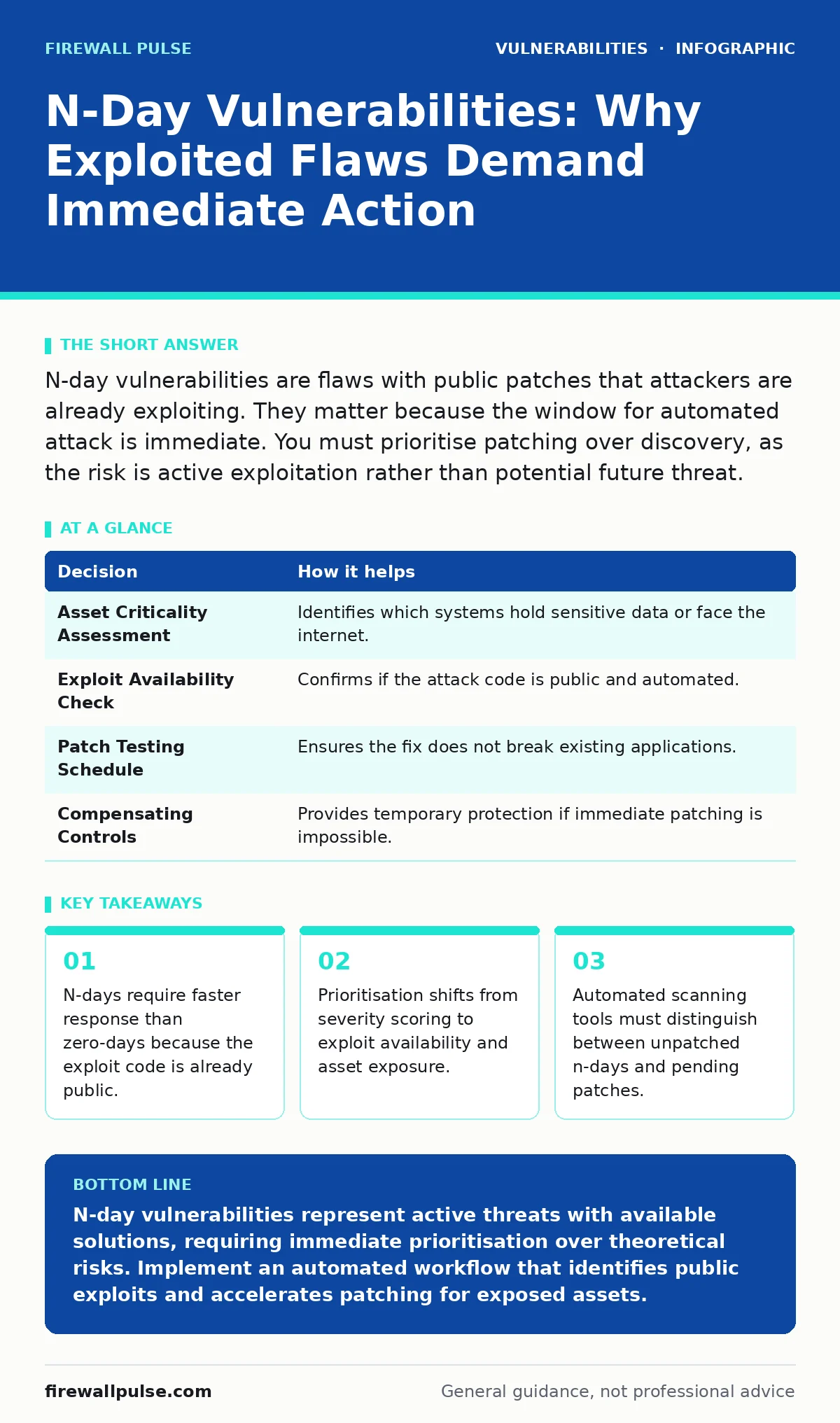
N-day vulnerabilities are flaws with public patches that attackers are already exploiting. They matter because the window for automated attack is immediate. You must prioritise patching over discovery, as the risk is active exploitation rather than potential future threat.
The Shift from Potential to Active Threat
A zero-day vulnerability has no known fix. You rely on detection and containment. An n-day vulnerability has a published patch. The attacker has the exploit. The difference is not just technical; it is temporal. The clock starts ticking the moment the patch releases. Attackers do not wait for you to schedule maintenance. They scan for unpatched systems immediately.
This distinction changes how you allocate resources. With a zero-day, you might wait for a vendor update or deploy a virtual patch. With an n-day, the solution exists. The barrier is operational speed. If you leave an n-day unpatched, you are choosing to remain vulnerable when a cure is available. This choice exposes you to automated scanning bots that target known weaknesses.
Operationalising the N-Day Window
Your security operations centre receives alerts for thousands of vulnerabilities. Not all are equal. An n-day carries a higher operational weight because the exploit is in the wild. You must treat it as an active breach waiting to happen. The goal is to reduce the time between patch availability and application. This is often called the "patching window". The shorter this window, the less likely you are to be compromised.
You cannot patch everything instantly. You must triage. Triage requires knowing which systems are exposed to the internet and which contain sensitive data. An internal printer with an n-day is less urgent than a web server. Context matters. You need accurate asset inventory data to make these decisions quickly. Without visibility, you are guessing which systems are at risk.
Decision Framework for Prioritisation
When an n-day is announced, your team faces a cascade of decisions. You must balance business continuity against security risk. Patching a critical server might require downtime. Leaving it unpatched invites intrusion. You need a clear framework to guide this choice. The framework should consider the exploitability of the flaw, the value of the asset, and the effort required to patch.
| Decision | How it helps |
|---|---|
| Asset Criticality Assessment | Identifies which systems hold sensitive data or face the internet. |
| Exploit Availability Check | Confirms if the attack code is public and automated. |
| Patch Testing Schedule | Ensures the fix does not break existing applications. |
| Compensating Controls | Provides temporary protection if immediate patching is impossible. |
This table shows the steps you must take. Each step reduces uncertainty. By assessing asset criticality first, you focus on the most valuable targets. Checking exploit availability tells you if the threat is theoretical or real. Testing the patch prevents secondary failures. Compensating controls, such as blocking specific traffic, buy you time if patching is delayed.
The Hidden Cost of Delay
Delaying n-day patches creates a hidden cost: technical debt. Each unpatched system is a liability. Over time, these liabilities accumulate. Your environment becomes a patchwork of vulnerabilities. When a new n-day emerges, you are starting from a weaker baseline. You have more systems to check and more conflicts to resolve.
This debt also erodes trust. If stakeholders see that known fixes are ignored, they lose confidence in your security posture. It is not just about preventing breaches. It is about demonstrating control. Consistent patching shows that you respect the risk. It proves that your processes work. Inconsistent patching suggests chaos. Chaos invites scrutiny and increases the likelihood of human error during crises.
Integrating with Risk-Based Strategies
You should not treat all n-days equally. Some are easy to exploit. Others require complex conditions. You can use metrics like the EPSS score to estimate the likelihood of exploitation. A high EPSS score means the vulnerability is likely to be exploited in the wild. This helps you prioritise. You patch the high-risk n-days first. Lower-risk items can wait for the next maintenance cycle.
This approach aligns with risk-based vulnerability management. It moves you away from vanity metrics. You stop chasing the number of closed tickets. You start focusing on reduced risk. This requires integrating your vulnerability scanner with your asset management system. You need to know what you have and where it is. Without this integration, you cannot apply risk context. You are just reacting to noise.
The Role of Configuration and Access
Patching is not the only defence. Configuration hardening reduces the attack surface. If you remove unnecessary services, there are fewer entry points. Even if an n-day exists in a service, disabling that service removes the risk. This is a form of compensating control. It is often faster than patching and sometimes more effective.
Least privilege access limits the damage if an attacker succeeds. If a compromised service runs with minimal permissions, the attacker cannot move laterally. They cannot access other systems or data. This containment is vital. It turns a potential catastrophe into a contained incident. You must design your systems with this failure mode in mind. Assume breach. Limit the blast radius.
Change Management and Stability
Rapid patching can introduce instability. If you rush, you might break a critical application. This is why change management for security patches is necessary. You need a process to test patches before deployment. This process should be streamlined, not bureaucratic. The goal is speed with safety. Automated testing pipelines can help. They catch conflicts early.
You must balance speed with stability. A system that is patched but broken is also a risk. It may expose data through error messages or fail to process transactions. Your change management process should have an emergency track for critical n-days. This track allows faster approval and deployment. It recognises that the risk of waiting outweighs the risk of change.
Beyond Patching: Dependency Awareness
Not all n-days are in your operating system. Many are in libraries and dependencies. Dependency confusion attacks can introduce malicious code into your supply chain. You must monitor your dependencies for vulnerabilities. Use tools that scan your codebase and container images. Identify which libraries are affected by n-days.
This adds complexity. You may not control the code in a library. You rely on the vendor to patch it. You must track these updates. When a patch is released, you must update your dependency. This is often harder than patching an OS. It requires testing your application to ensure it still works. You need a process for this too. It is part of your overall vulnerability management.
Conclusion of the N-Day Cycle
The n-day cycle is continuous. New patches are released daily. Your process must be sustainable. You cannot rely on heroics. You need automation. Automate the detection of n-days. Automate the prioritisation. Automate the deployment where possible. Human effort should focus on exceptions and complex cases.
Remember that security is a process, not a product. You will never catch everything. But by focusing on n-days, you address the most immediate threats. You reduce the window of exposure. You protect your most valuable assets. This is the core of effective vulnerability management. It is about doing the right thing, at the right time, with the right resources.
Key takeaways
- N-days require faster response than zero-days because the exploit code is already public.
- Prioritisation shifts from severity scoring to exploit availability and asset exposure.
- Automated scanning tools must distinguish between unpatched n-days and pending patches.
N-day vulnerabilities represent active threats with available solutions, requiring immediate prioritisation over theoretical risks. Implement an automated workflow that identifies public exploits and accelerates patching for exposed assets.
Frequently asked questions
How do n-days differ from zero-days in terms of response?
Zero-days require detection and containment since no patch exists. N-days require immediate patching because the fix is available and exploits are public.
Should I patch n-days immediately or wait for testing?
Patch critical, internet-facing systems immediately. Test patches for internal or complex systems to avoid breaking functionality, but minimise the delay.
What is the EPSS score and how does it help?
The EPSS score predicts the likelihood of a vulnerability being exploited. It helps you prioritise n-days that are more likely to be targeted by attackers.
Can configuration changes replace patching for n-days?
Configuration changes like disabling services can mitigate risk temporarily. They are not a permanent replacement for patching, which fixes the underlying flaw.
How this guide was produced: written by the Firewall Pulse editorial team with AI assistance, checked against the public references listed below, and reviewed when the facts change. See our editorial policy or report an error.