Dependency Confusion Attacks: Definition, Mechanics and Mitigation
Attackers exploit the fact that private package registries often prioritise internal packages over public ones, allowing malicious code to be pulled into secure networks.

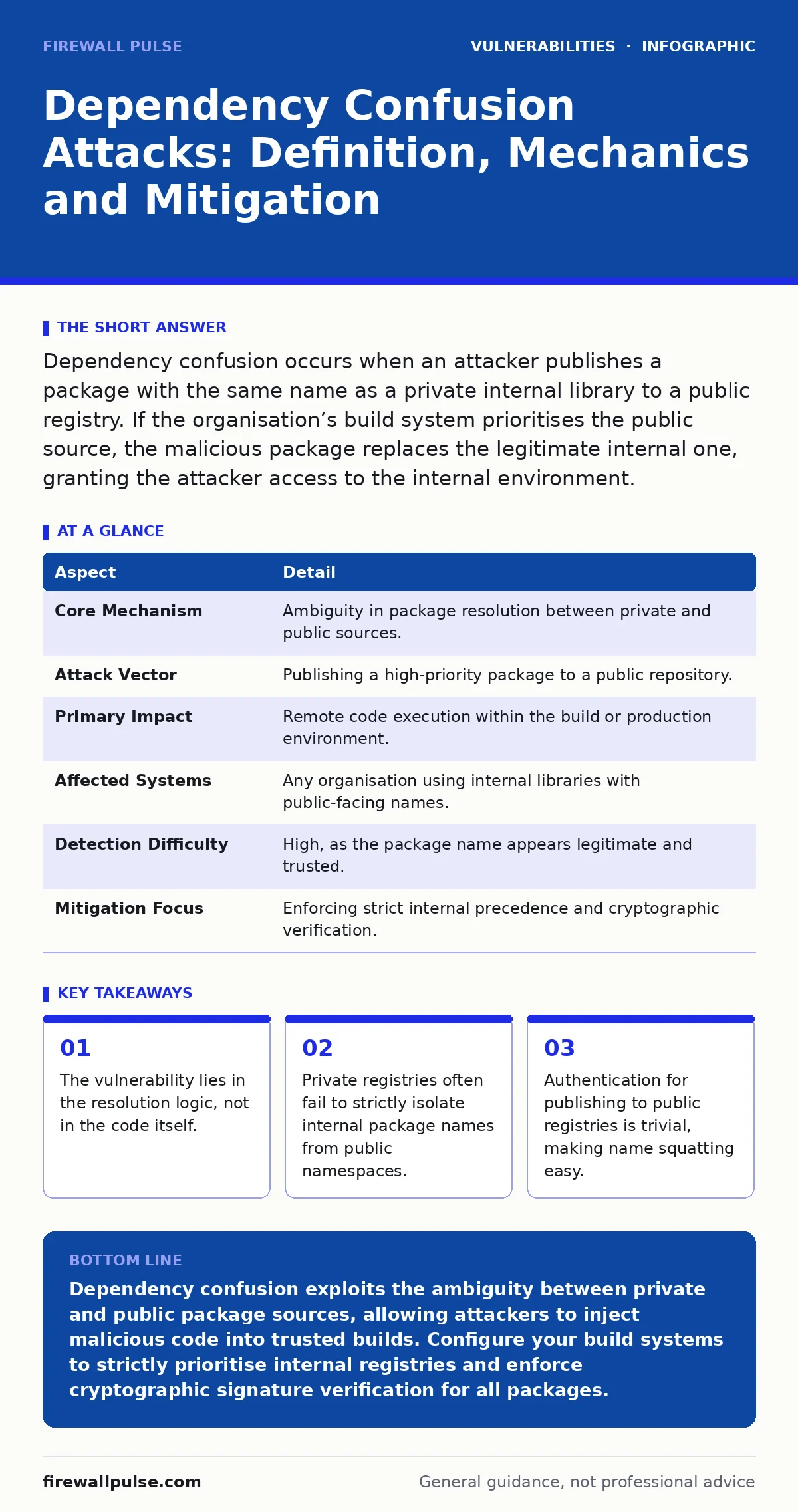
Dependency confusion occurs when an attacker publishes a package with the same name as a private internal library to a public registry. If the organisation’s build system prioritises the public source, the malicious package replaces the legitimate internal one, granting the attacker access to the internal environment.
The Coffee Shop Analogy
Imagine you work in a large office. You have a private coffee machine that only staff can use. You also have a public coffee shop next door. One day, a stranger sets up a stall outside the public shop selling coffee under the exact same brand name as your private machine. If your office policy says “buy coffee from the nearest source with the correct label,” you might accidentally buy the stranger’s coffee. That stranger has now entered your supply chain.
In software, the private machine is your internal package registry. The public shop is a service like npm, PyPI or Maven Central. The stranger is an attacker publishing a malicious package with the same name as your internal tool.
At a Glance
| Aspect | Detail |
|---|---|
| Core Mechanism | Ambiguity in package resolution between private and public sources. |
| Attack Vector | Publishing a high-priority package to a public repository. |
| Primary Impact | Remote code execution within the build or production environment. |
| Affected Systems | Any organisation using internal libraries with public-facing names. |
| Detection Difficulty | High, as the package name appears legitimate and trusted. |
| Mitigation Focus | Enforcing strict internal precedence and cryptographic verification. |
How the Confusion Occurs
Software development relies on dependencies. These are libraries or modules created by others that your application uses to function. Most organisations maintain an internal registry for their own proprietary code. They also allow builds to pull public dependencies from open repositories.
The problem arises when the build system does not clearly distinguish between these two sources. If an internal package shares a name with a public one, the resolver must decide which to download. Many systems are configured to check the public registry first, or to treat both sources as equal.
An attacker scans for internal package names. These names are often leaked in public repositories, documentation or error messages. Once the attacker identifies a name, they publish a package with that name to a public registry. They often set a very high version number to ensure it appears newer than the internal version.
When the victim’s build system runs, it sees the public package. If the configuration allows it, the system downloads the malicious code instead of the internal library. The attacker’s code now executes with the permissions of the build environment.
Who Is Affected
This attack affects any organisation that uses private package management. It is not limited to large enterprises. Small teams using simple build scripts are equally vulnerable if their resolution logic is flawed.
The risk is highest when internal packages are not namespaced. If your internal library is simply called config, it clashes with thousands of public libraries. Even if you use a namespace, such as com.company.config, attackers can still target it if the public registry supports that structure.
Organisations that do not audit their dependency resolution logic are at significant risk. Many assume that because the internal registry exists, it is automatically preferred. This assumption is often incorrect. The configuration of the build tool dictates the order, and default settings often favour public sources for convenience.
Common Forms of the Attack
The simplest form is direct substitution. The attacker publishes a package that looks like the internal one. When the build pulls it, the malicious code runs. This is the classic dependency confusion scenario.
A more subtle form involves dependency chains. The attacker does not target the internal package directly. Instead, they target a public package that the internal package depends on. By compromising a widely used public library, they indirectly affect the internal build. This is harder to detect because the internal package name remains clean.
Another form exploits version pinning failures. If an organisation allows floating versions, such as >=1.0, the attacker can release a newer version that bypasses security checks. Even if the internal registry is preferred, the build system might still check the public registry for updates, introducing the risk.
What People Usually Get Wrong
Many security teams believe that blocking internet access to build servers solves this problem. This is a partial fix. If the build server cannot reach public registries, it cannot be confused by them. However, this breaks legitimate workflows. Developers often need public dependencies. Blocking access entirely hinders productivity and pushes teams to find workarounds, which are often less secure.
Another misconception is that renaming internal packages is a complete solution. While using unique, namespaced names reduces the chance of collision, it does not eliminate it. Attackers can still find internal names through open-source code leaks or metadata. Furthermore, human error can lead to name reuse.
Teams often focus on the code inside the package. They scan for malware or suspicious functions. While this is good practice, it misses the root cause. The issue is not just malicious code; it is the mechanism that allows untrusted code to enter the trusted environment. Fixing the resolution logic is more effective than scanning the payload.
Reducing the Risk
The most effective defence is to enforce strict resolution order. Configure your build tools to always check the internal registry first. If the package is not found there, then check public sources. This ensures that internal packages are never overwritten by public ones with the same name.
Implement cryptographic signing for all internal packages. Require that the build system verifies the signature before installing a package. This adds a layer of trust that goes beyond the name and version. Even if an attacker publishes a package with the correct name, they cannot sign it with your private key.
Audit your dependency resolution settings regularly. Treat these configurations as security controls. Include them in your change management for security patches process. When you update build tools, verify that the resolution logic has not changed in a way that weakens internal precedence.
Use a proxy or cache for public dependencies. This allows you to inspect and filter packages before they reach the build environment. You can block packages that do not meet certain criteria, such as missing signatures or known vulnerabilities. This approach supports configuration hardening by reducing the attack surface of the build process.
Adopt a risk-based vulnerability management strategy. Prioritise the remediation of packages that are critical to your infrastructure. Not all dependencies carry the same risk. Focus your efforts on those that have access to sensitive data or systems.
Finally, educate your development teams. They need to understand how their build systems resolve dependencies. Encourage them to use unique, namespaced names for internal packages. Make them aware of the risks associated with floating version numbers.
Conclusion of Measures
Dependency confusion attacks exploit a fundamental ambiguity in how software builds resolve dependencies. They are not a flaw in the code, but a flaw in the process. By understanding how resolution works, you can configure your systems to prefer trusted sources.
This is not a one-time fix. As your software ecosystem grows, new dependencies are added. New build tools are adopted. You must continuously monitor and adjust your configurations. Combine strict resolution order with cryptographic verification to create a robust defence. This approach aligns with the principles of least privilege access, ensuring that untrusted code cannot execute in your environment.
Key takeaways
- The vulnerability lies in the resolution logic, not in the code itself.
- Private registries often fail to strictly isolate internal package names from public namespaces.
- Authentication for publishing to public registries is trivial, making name squatting easy.
- Remediation requires enforcing strict internal resolution order and verifying package signatures.
Dependency confusion exploits the ambiguity between private and public package sources, allowing attackers to inject malicious code into trusted builds. Configure your build systems to strictly prioritise internal registries and enforce cryptographic signature verification for all packages.
Frequently asked questions
How do I know if my organisation is vulnerable to dependency confusion?
Review your build tool configurations to see how they resolve package names. If public registries are checked before or alongside private ones, you are likely vulnerable.
Can I prevent this by just blocking public registries?
Blocking public registries prevents the attack but breaks many legitimate builds. A better approach is to enforce internal precedence and use a proxy to filter public dependencies.
What is the difference between this and a supply chain attack?
Dependency confusion is a specific type of supply chain attack. It targets the resolution mechanism rather than compromising a legitimate developer’s account or code.
Do I need to rename all my internal packages?
Renaming helps reduce the risk of collision, but it is not a complete solution. You must still enforce strict resolution order and verify package signatures.
How this guide was produced: written by the Firewall Pulse editorial team with AI assistance, checked against the public references listed below, and reviewed when the facts change. See our editorial policy or report an error.