Brute Force Attacks: Mechanics, Variants and Mitigation
Brute force attacks exploit weak authentication by testing every possible credential combination until one matches, bypassing complex security layers.
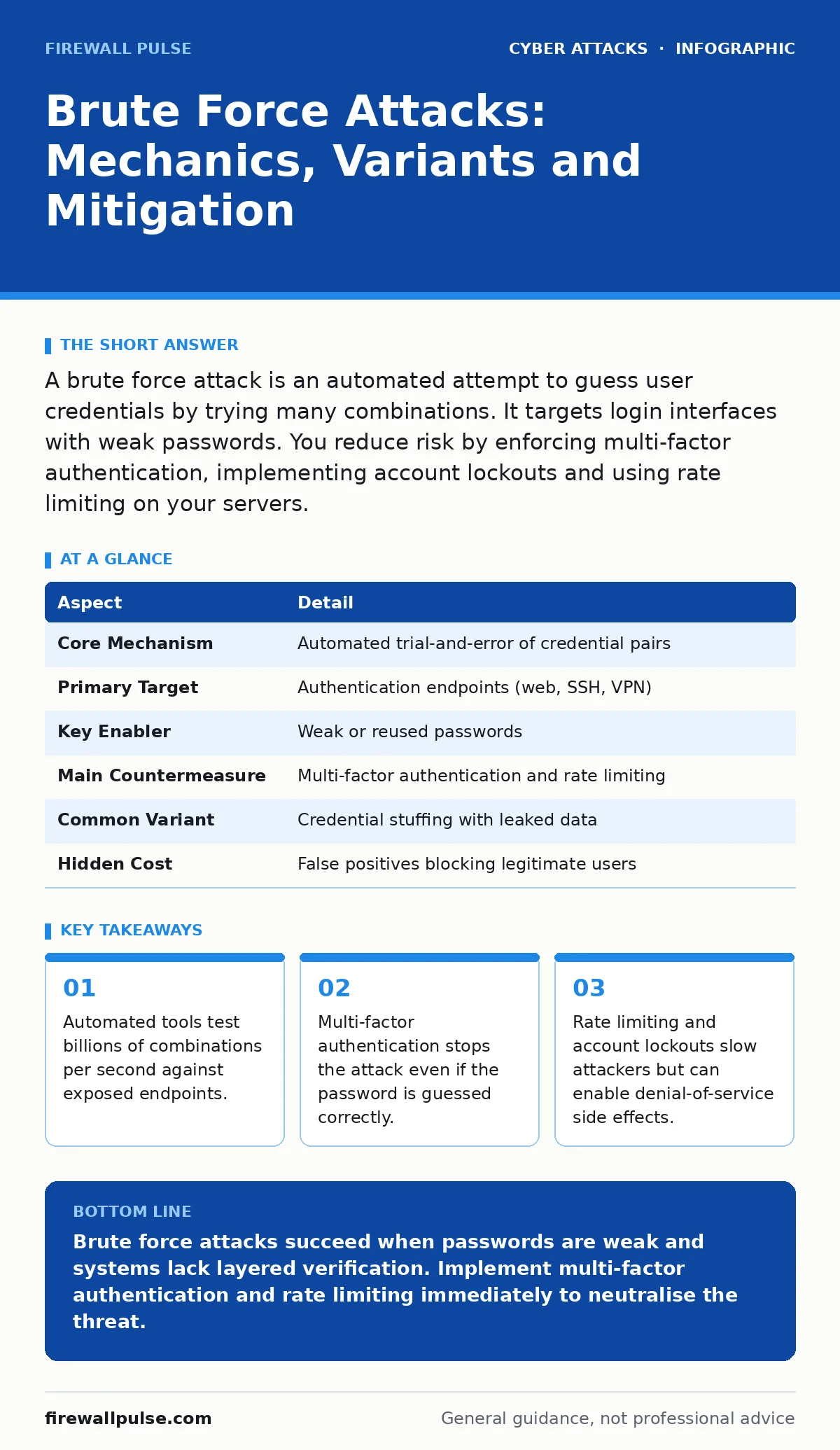
A brute force attack is an automated attempt to guess user credentials by trying many combinations. It targets login interfaces with weak passwords. You reduce risk by enforcing multi-factor authentication, implementing account lockouts and using rate limiting on your servers.
The Lock Picking Analogy
Imagine a burglar standing before a house with a simple four-digit combination lock. The burglar does not know the code. They do not try to pick the tumblers with a tool. Instead, they simply try 0000. When that fails, they try 0001. Then 0002. They continue this process mechanically until the lock opens.
This is a brute force attack. It relies on the attacker having unlimited time or computing power to test every possible option. The lock does not need to be broken. It simply needs to be exhausted. In digital security, the lock is your login screen. The combination is your password. The burglar is a script running on a remote server.
At a Glance
| Aspect | Detail |
|---|---|
| Core Mechanism | Automated trial-and-error of credential pairs |
| Primary Target | Authentication endpoints (web, SSH, VPN) |
| Key Enabler | Weak or reused passwords |
| Main Countermeasure | Multi-factor authentication and rate limiting |
| Common Variant | Credential stuffing with leaked data |
| Hidden Cost | False positives blocking legitimate users |
How the Attack Works
The attacker uses software to generate a list of potential passwords. This list can be random, or it can contain common words, names and numbers. The software sends these credentials to your login interface one after another.
The speed of the attack depends on the complexity of the password and the power of the attacker’s hardware. Simple four-digit PINs are cracked in seconds. Complex passwords with mixed characters take longer. However, the attacker does not need to crack every account. They only need to find the weak ones.
Modern attacks are distributed. The attacker uses many computers, or a botnet, to send requests from different IP addresses. This makes the traffic look like normal user activity. It also bypasses simple IP-based blocks. The system receives thousands of login attempts from around the world simultaneously.
Common Forms of Brute Force
Not all brute force attacks are the same. The method changes based on the information the attacker already has.
Basic Brute Force
The attacker tries every possible combination of characters. This is slow and inefficient for long passwords. It is mostly used against short PINs or weak passphrases.
Dictionary Attack
The attacker uses a pre-existing list of common words and phrases. This list, called a dictionary, contains passwords people actually use. It is much faster than random guessing because it focuses on likely options.
Credential Stuffing
This is a reverse brute force attack. Instead of guessing passwords, the attacker uses usernames and passwords stolen from other breaches. They test these known pairs against your system. Many users reuse passwords, so a credential from a social media site might work on your corporate portal. This is highly effective and difficult to detect because the credentials are valid.
Hybrid Attack
The attacker takes a dictionary word and modifies it. They might add numbers, symbols or capitalisation to the end. "Summer" becomes "Summer2024" or "S@mmer!". This bridges the gap between simple dictionary attacks and complex brute force.
Who Is Affected
Any system with a login screen is a target. The risk is highest for public-facing services.
Web Applications
E-commerce sites, banking portals and social media platforms are prime targets. They have millions of users, increasing the chance of weak passwords.
Remote Access Protocols
SSH, RDP and VPNs are frequently targeted. Attackers scan the internet for open ports. They then test default or common credentials. If successful, they gain direct access to your network infrastructure.
Internal Services
Even internal tools are at risk. If an attacker gains initial access, they may try to pivot to internal servers using brute force. This is why internal network segmentation matters. Refer to our guide on attack surface reduction to understand how limiting access paths reduces this risk.
What People Get Wrong
There are several misconceptions about brute force attacks that lead to poor defence strategies.
"Long Passwords Are Enough"
A long password is hard to crack by pure computation. However, if you reuse that password elsewhere, it may appear in a public data breach. The attacker will then use credential stuffing. The length does not matter if the password is already known.
"Account Lockouts Stop the Attack"
Locking an account after five failed attempts seems logical. However, attackers can exploit this. They can intentionally lock out a user by guessing their username and entering wrong passwords. This is a denial-of-service attack against that user. The legitimate user cannot log in until an administrator resets the lock. This creates a support burden and disrupts business.
"Geographic Blocking Is Secure"
Blocking login attempts from countries where you do not operate reduces noise. However, attackers use proxies and virtual private networks to mask their location. They can appear to be logging in from your own country. This measure provides a false sense of security.
How to Reduce the Risk
Defence requires layers. No single control is sufficient.
Enforce Multi-Factor Authentication
This is the most effective control. Even if the attacker guesses the password, they cannot log in without the second factor. This factor is usually a code from a mobile app or a hardware token. It breaks the chain of the brute force attack. See our guide on OAuth consent phishing to understand how attackers try to bypass this by tricking users.
Implement Rate Limiting
Limit the number of login attempts per account or per IP address. If an IP address fails ten times in a minute, block it for a period. This slows down the attacker. It does not stop them, but it makes the attack economically unviable. Ensure your rate limiting does not impact legitimate users during peak times.
Use Strong Password Policies
Require passwords of sufficient length and complexity. Length is more important than complexity. A passphrase of four random words is stronger than a short complex password. However, the best policy is to allow password managers. These tools generate and store complex passwords, removing the burden from the user.
Monitor for Anomalies
Your security operations centers should monitor login patterns. Look for multiple failures from a single IP or a single user. Alert on these events. Automated responses can block the IP or force a password reset. This requires careful tuning to avoid alert fatigue.
Keep Software Updated
Ensure your authentication servers and web applications are patched. Some older systems have vulnerabilities that allow attackers to bypass rate limiting or extract password hashes. Refer to our guide on session cookie theft to understand how attackers maintain access once they bypass initial authentication.
The Hidden Cost of Defence
Implementing strict security measures has trade-offs. Strict rate limiting can block legitimate users who forget their passwords. Complex password requirements lead to users writing passwords down or using simple variations.
You must balance security with usability. If the login process is too difficult, users will find workarounds. These workarounds often create larger security holes. Regular testing of your authentication systems helps identify these friction points.
Key takeaways
- Automated tools test billions of combinations per second against exposed endpoints.
- Multi-factor authentication stops the attack even if the password is guessed correctly.
- Rate limiting and account lockouts slow attackers but can enable denial-of-service side effects.
- Credential stuffing uses previously leaked data, making it faster than random guessing.
Brute force attacks succeed when passwords are weak and systems lack layered verification. Implement multi-factor authentication and rate limiting immediately to neutralise the threat.
Frequently asked questions
Can a brute force attack be stopped completely?
No attack can be stopped completely, but multi-factor authentication makes brute force useless even if the password is guessed.
How long does a brute force attack take?
It depends on password complexity. A four-digit PIN takes seconds. A complex passphrase can take years with current technology.
Is two-factor authentication vulnerable to brute force?
The password part is vulnerable, but the second factor is not. The attacker must also compromise the user’s phone or token, which is much harder.
Should I block all failed login attempts?
No. Block after a threshold to prevent denial-of-service attacks against legitimate users. Use adaptive blocking based on risk.
How this guide was produced: written by the Firewall Pulse editorial team with AI assistance, checked against the public references listed below, and reviewed when the facts change. See our editorial policy or report an error.