Session Cookie Theft: Six Myths That Leave Your Users Exposed
Secure flags and HTTPS do not prevent cookie theft if the application server is compromised or if JavaScript executes on the page.

Session cookies are often stolen without network interception. Misconfigurations, same-site bypasses, and server-side vulnerabilities allow attackers to steal tokens even when transport encryption is active. Understanding these vectors is necessary for effective defence.
Myth: HTTPS Prevents Cookie Theft
Reality: Transport Layer Security encrypts data between the browser and the server. It does not protect cookies once they reach the client device or the application server. An attacker who controls the client machine or the server infrastructure can read the session token regardless of the connection security. HTTPS prevents network-level eavesdropping, such as man-in-the-middle attacks on public Wi-Fi. It does not stop a malicious script running in the browser from sending the cookie to a third party. It also does not stop an administrator with server access from viewing active sessions.
Imagine a user connects to your site via HTTPS. The connection is encrypted. However, if that user’s computer has malware that injects JavaScript into web pages, the script can read the cookie value. The script then sends the value to the attacker’s server over a separate, encrypted channel. The original HTTPS connection offered no defence against this client-side compromise.
Myth: The HttpOnly Flag Blocks All Theft
Reality: The HttpOnly attribute prevents client-side scripts from accessing the cookie via document.cookie. This blocks many cross-site scripting attacks. It does not prevent the cookie from being sent with every HTTP request to the domain. If an attacker can trigger the browser to send a request, they can steal the session. This is particularly dangerous in scenarios where the application allows unauthenticated API calls or where the attacker forces a request through a proxy.
Furthermore, HttpOnly offers no protection if the session data is stored server-side in a predictable manner. If an attacker can guess the session ID structure or access the server’s session store directly, the client-side flag is irrelevant. The flag is a defence-in-depth measure, not a primary control.
Myth: SameSite=Strict Stops Cross-Site Attacks
Reality: The SameSite attribute controls whether cookies are sent with cross-site requests. Setting it to Strict prevents the browser from sending the cookie if the request originates from a different domain. This mitigates cross-site request forgery. It does not prevent cross-site scripting or direct navigation attacks. If a user clicks a link on an attacker’s site that redirects to your application, the cookie may still be sent depending on the browser implementation and the specific redirect chain.
Additionally, SameSite policies vary between browsers. A configuration that works in one browser may fail in another. Attackers often use iframe embedding or postMessage APIs to bypass these restrictions. If your application relies on third-party integrations, strict SameSite policies can break functionality, leading developers to weaken the setting. This creates a false sense of security while introducing new attack vectors.
Myth: Cookie Theft Requires Network Sniffing
Reality: Most modern cookie theft does not involve capturing network traffic. Attackers target the application logic or the client environment. Server-side vulnerabilities, such as insecure direct object references, allow attackers to access session data stored in databases or memory. If an application stores session tokens in predictable formats, attackers can iterate through possible values. This is similar to brute force attacks but applied to session IDs rather than passwords.
Client-side theft often involves data exfiltration via beacon requests. A malicious script can send the cookie value to an external server using an image tag or a fetch request. This happens silently in the background. The user sees no error message. The browser simply sends the data as part of a normal HTTP request. Network sniffing is an outdated model for understanding this threat.
Myth: Logging Out Destroys the Session Token
Reality: Logging out typically invalidates the session server-side. It does not always delete the cookie from the client’s browser. If the application does not explicitly set the cookie to expire in the past, the old token remains on the disk. An attacker who steals this cookie can attempt to reuse it. If the server has not fully purged the session data, the attack may succeed. This is a common misconfiguration in web frameworks.
Furthermore, some applications use multiple cookies for different purposes, such as analytics or user preference. If one cookie is deleted but another containing a session reference remains, the attacker may still regain access. You must ensure that all session-related identifiers are cleared during logout. This requires careful handling of cookie domains and paths.
Myth: Short Lifespans Eliminate Risk
Reality: Short session durations reduce the window of opportunity for an attacker. They do not prevent the theft of active sessions. If a session lasts only fifteen minutes, an attacker who steals the token has fifteen minutes to use it. This is often enough time to perform high-value actions, such as viewing sensitive data or initiating a transfer. The impact of the breach remains severe even if the window is narrow.
Short lifespans also create usability issues. Users may become frustrated by frequent re-authentication prompts. This leads to password fatigue or the use of "remember me" features, which often rely on long-lived tokens. These long-lived tokens become the new target. If you reduce the session length without addressing the underlying token security, you simply shift the attack surface.
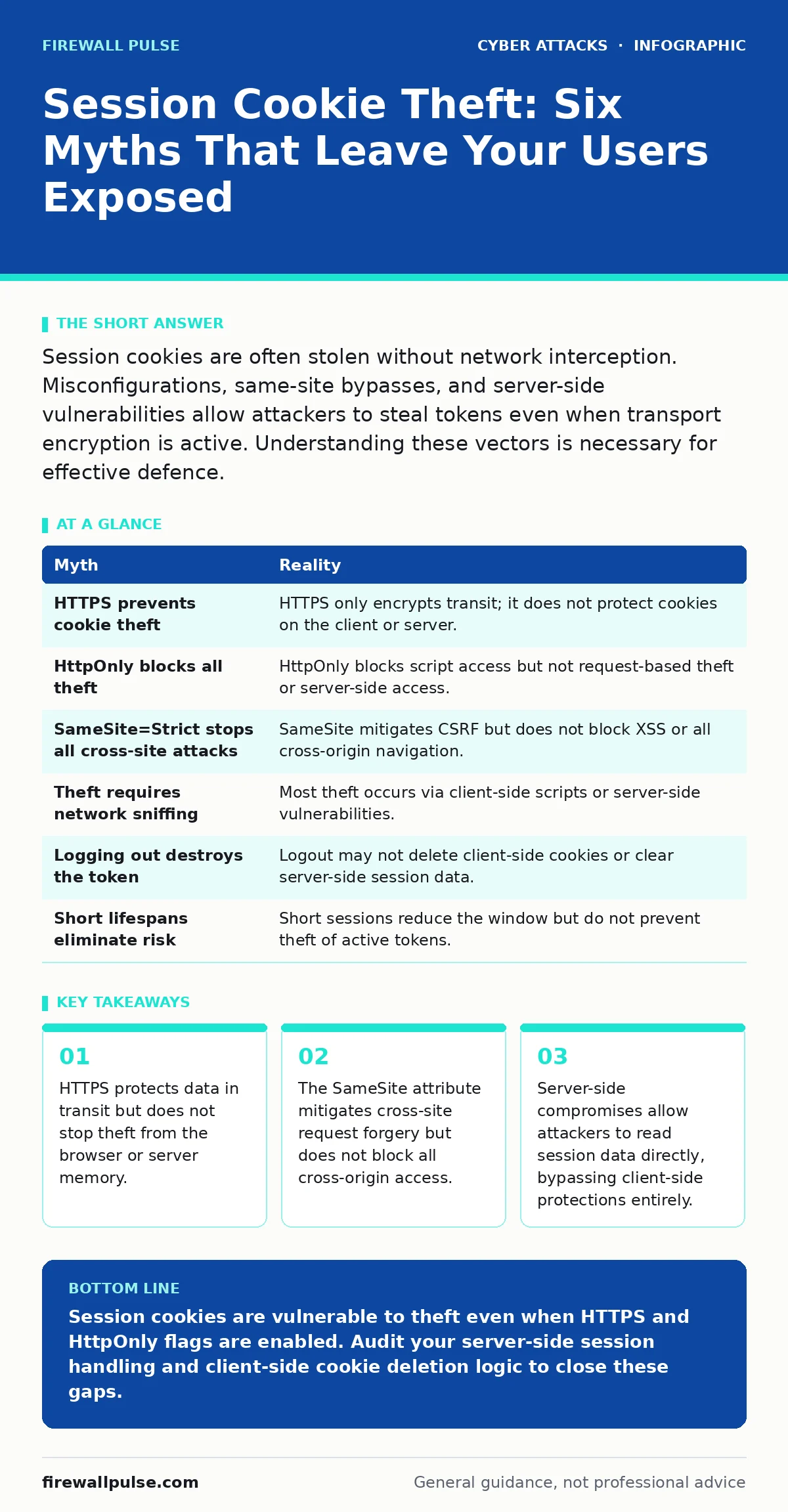
| Myth | Reality |
|---|---|
| HTTPS prevents cookie theft | HTTPS only encrypts transit; it does not protect cookies on the client or server. |
| HttpOnly blocks all theft | HttpOnly blocks script access but not request-based theft or server-side access. |
| SameSite=Strict stops all cross-site attacks | SameSite mitigates CSRF but does not block XSS or all cross-origin navigation. |
| Theft requires network sniffing | Most theft occurs via client-side scripts or server-side vulnerabilities. |
| Logging out destroys the token | Logout may not delete client-side cookies or clear server-side session data. |
| Short lifespans eliminate risk | Short sessions reduce the window but do not prevent theft of active tokens. |
Session cookie theft is a persistent threat because it exploits the fundamental trust between the browser and the server. Defending against it requires more than standard flags. You must consider the entire lifecycle of the session token. This includes generation, storage, transmission, and destruction. Understanding these nuances helps you build a more resilient architecture. See our guide on attack surface reduction for broader strategies to limit exposure.
Key takeaways
- HTTPS protects data in transit but does not stop theft from the browser or server memory.
- The SameSite attribute mitigates cross-site request forgery but does not block all cross-origin access.
- Server-side compromises allow attackers to read session data directly, bypassing client-side protections entirely.
Session cookies are vulnerable to theft even when HTTPS and HttpOnly flags are enabled. Audit your server-side session handling and client-side cookie deletion logic to close these gaps.
Frequently asked questions
Can a proxy server steal session cookies?
A proxy server that terminates HTTPS traffic can see the cookies in plaintext. If the proxy is untrusted or compromised, it can log or forward session tokens to an attacker.
Does changing the cookie name prevent theft?
Changing the name provides security through obscurity. It does not prevent theft if the attacker can read the page source or inspect network traffic.
Are secure cookies different from session cookies?
A secure cookie is one marked with the Secure flag, which ensures it is only sent over HTTPS. It is a type of session cookie, not a separate mechanism.
How do browsers handle cookie theft?
Browsers follow the specifications set by the application. They do not actively block cookie theft unless specific attributes like SameSite or HttpOnly are correctly configured.
How this guide was produced: written by the Firewall Pulse editorial team with AI assistance, checked against the public references listed below, and reviewed when the facts change. See our editorial policy or report an error.