Leaked Source Code: How to Contain and Neutralise the Threat
Exposed code reveals internal logic and hidden credentials, turning standard defensive measures into predictable obstacles for attackers.
When source code leaks, attackers gain insight into your application’s internal structure, configuration defaults, and potential vulnerabilities. You must rotate all secrets, patch exposed logic flaws, and monitor for exploitation attempts. This process requires immediate credential rotation and a review of all deployment artefacts to prevent unauthorised access.
What does a source code leak actually expose to attackers?
A source code leak exposes the internal logic, configuration files, and often the credentials required to run your application. Unlike a binary, source code contains comments, debug flags, and the exact sequence of operations your software performs. Attackers use this information to understand how data moves through your system and where validation checks might fail. This transparency removes the security benefit of obscurity, forcing you to rely entirely on cryptographic strength and strict access controls.
How do attackers find leaked source code in the first place?
Attackers continuously scan public code repositories, forgotten server directories, and discarded hardware for unsecured files. Many organisations accidentally push private repositories to public platforms or fail to remove sensitive data from public-facing assets. Search engines and automated bots index these errors, creating a searchable map of your internal infrastructure. This passive reconnaissance allows adversaries to collect intelligence without triggering intrusion detection systems.
Why is finding hard-coded secrets the most urgent priority?
Hard-coded secrets, such as API keys and database passwords, are often embedded directly within the application logic for convenience. When code is leaked, these static credentials become public knowledge immediately. Attackers can use these keys to access cloud storage, modify configurations, or pivot into other systems. Because these secrets are static, they remain valid until you explicitly revoke them, creating a wide window for unauthorised access.
Does standard encryption protect data inside the source code?
Standard file encryption protects data at rest but does not prevent the exposure of the code itself if the decryption keys are compromised. If an attacker obtains the source code along with the encryption keys, they can decrypt any protected content within the repository. Furthermore, the code often contains the logic for how encryption is applied, revealing potential weaknesses in your cryptographic implementation. You must treat the source code as a high-value asset that requires the same protection as the data it processes.
How does leaked code help attackers bypass web application firewalls?
Web application firewalls rely on signature-based detection to block known malicious patterns. Leaked source code reveals the exact input validation rules and error handling mechanisms your application uses. Attackers can craft payloads that sit just outside these defined boundaries, slipping past the firewall without triggering an alert. This knowledge allows them to exploit logic flaws rather than relying on common injection techniques that are easily blocked.
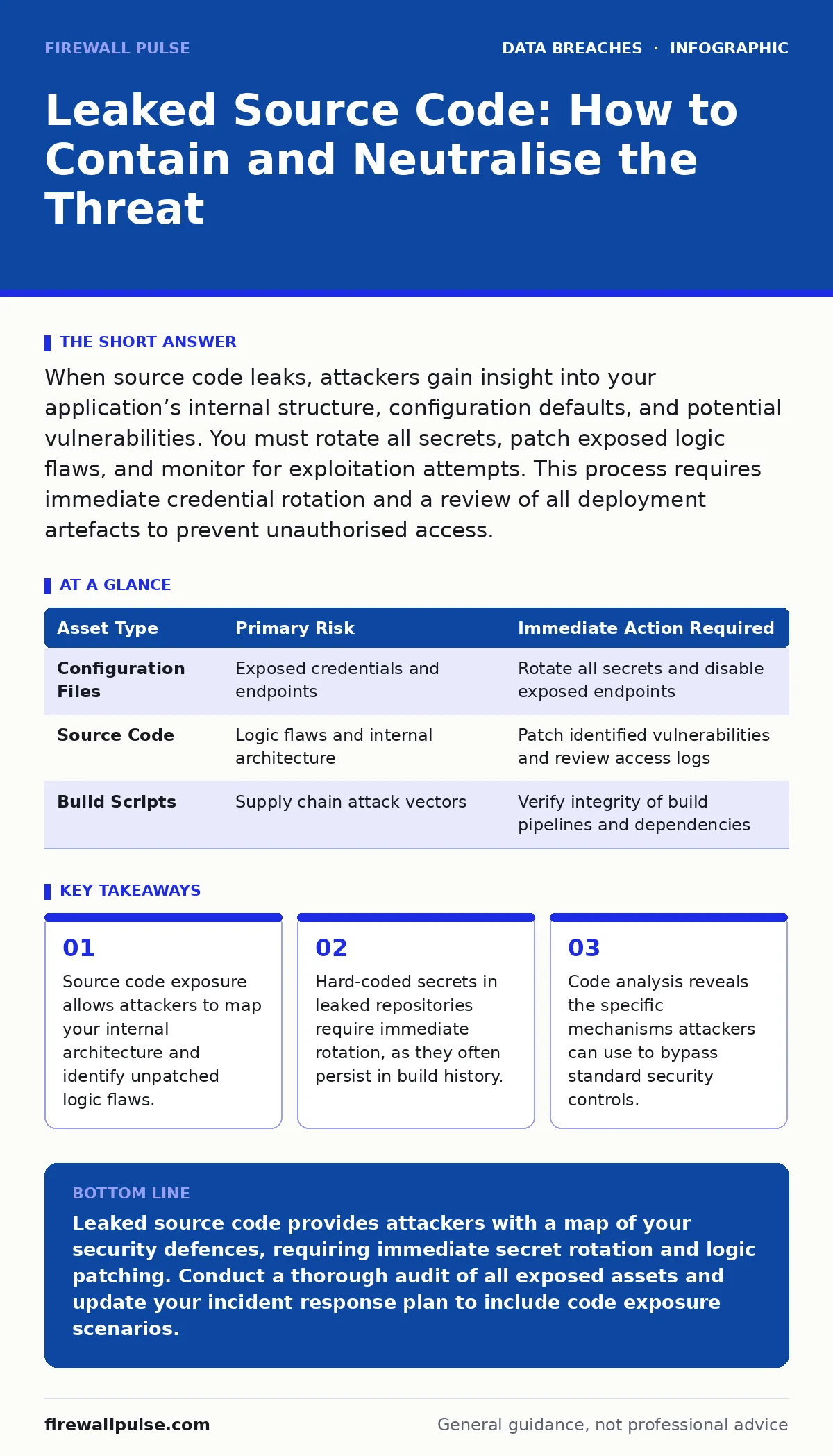
| Asset Type | Primary Risk | Immediate Action Required |
|---|---|---|
| Configuration Files | Exposed credentials and endpoints | Rotate all secrets and disable exposed endpoints |
| Source Code | Logic flaws and internal architecture | Patch identified vulnerabilities and review access logs |
| Build Scripts | Supply chain attack vectors | Verify integrity of build pipelines and dependencies |
See also: How Breach Notification Letters Work: The Hidden Mechanics · Malware Analysis: Why It Matters for Security Decisions
What is the risk of exposed internal API endpoints?
Internal APIs are often designed without the strict security controls applied to public-facing interfaces. Source code leaks reveal the existence of these endpoints, their expected input formats, and their authentication requirements. Attackers can use this information to interact with backend services directly, bypassing the user interface and its security layers. This direct access can lead to data exfiltration or system manipulation without leaving a trace in standard application logs.
How long should you monitor for exploitation after a leak?
You should monitor for exploitation attempts for at least several weeks after the initial discovery and remediation. Attackers often cache leaked code and analyse it at their own pace, meaning exploitation may occur long after the public exposure. Automated tools may also continue to scan for the exposed assets even after they have been taken down. Extended monitoring ensures you catch delayed attempts that use newly discovered vulnerabilities from the leaked code.
Can you trust third-party libraries if your code is leaked?
Leaked code often includes references to third-party libraries and their specific versions. This information allows attackers to identify known vulnerabilities in your dependencies that they might not have found otherwise. Even if your own code is secure, the exposed dependency chain provides a roadmap for exploitation. You must treat the leak as a signal to review all third-party components for unpatched security flaws.
What steps prevent a leak from becoming a breach?
Preventing a breach requires immediate rotation of all secrets and a thorough review of access logs for anomalies. You must also patch any logic flaws identified in the leaked code before attackers can exploit them. Implementing strict access controls and regular audits reduces the likelihood of accidental exposure in the first place. For broader context on managing external dependencies, see third-party risk assessments to ensure your supply chain remains secure.
How does this differ from a standard data breach?
A standard data breach involves the theft of user data, while a source code leak exposes the blueprint of your security defences. The former is a loss of confidentiality, whereas the latter is a loss of integrity and availability potential. Attackers use leaked code to plan more sophisticated attacks, making future breaches more likely and harder to detect. Understanding this distinction helps you prioritise the remediation of structural weaknesses over simple data recovery.
What role does incident response play in code leaks?
Incident response plans must include specific procedures for handling intellectual property and source code exposure. This involves coordinating with legal teams, assessing the scope of the leak, and communicating with stakeholders. Proper chain of custody procedures ensure that evidence of the leak is preserved for potential legal action. Without a tailored response plan, teams may focus on data recovery while ignoring the more dangerous exposure of internal logic.
Key takeaways
- Source code exposure allows attackers to map your internal architecture and identify unpatched logic flaws.
- Hard-coded secrets in leaked repositories require immediate rotation, as they often persist in build history.
- Code analysis reveals the specific mechanisms attackers can use to bypass standard security controls.
Leaked source code provides attackers with a map of your security defences, requiring immediate secret rotation and logic patching. Conduct a thorough audit of all exposed assets and update your incident response plan to include code exposure scenarios.
Frequently asked questions
Should I delete the leaked repository immediately?
Yes, delete the repository immediately, but assume the content has already been copied and begin remediation procedures.
How do I know if my secrets are compromised?
Check your access logs for unusual activity and rotate all credentials found in the exposed code without delay.
Can I reuse the leaked code in production?
Only after you have thoroughly audited and patched all identified vulnerabilities and rotated all embedded secrets.
Does this affect my compliance status?
Exposure of source code may violate compliance requirements depending on the data processing logic revealed; consult your legal team.
How this guide was produced: written by the Firewall Pulse editorial team with AI assistance, checked against the public references listed below, and reviewed when the facts change. See our editorial policy or report an error.