How Breach Notification Letters Work: The Hidden Mechanics
The notification letter is the final output of a legal and technical triage process that often begins weeks before you receive it, shaped by regulatory thresholds rather than pure impact.
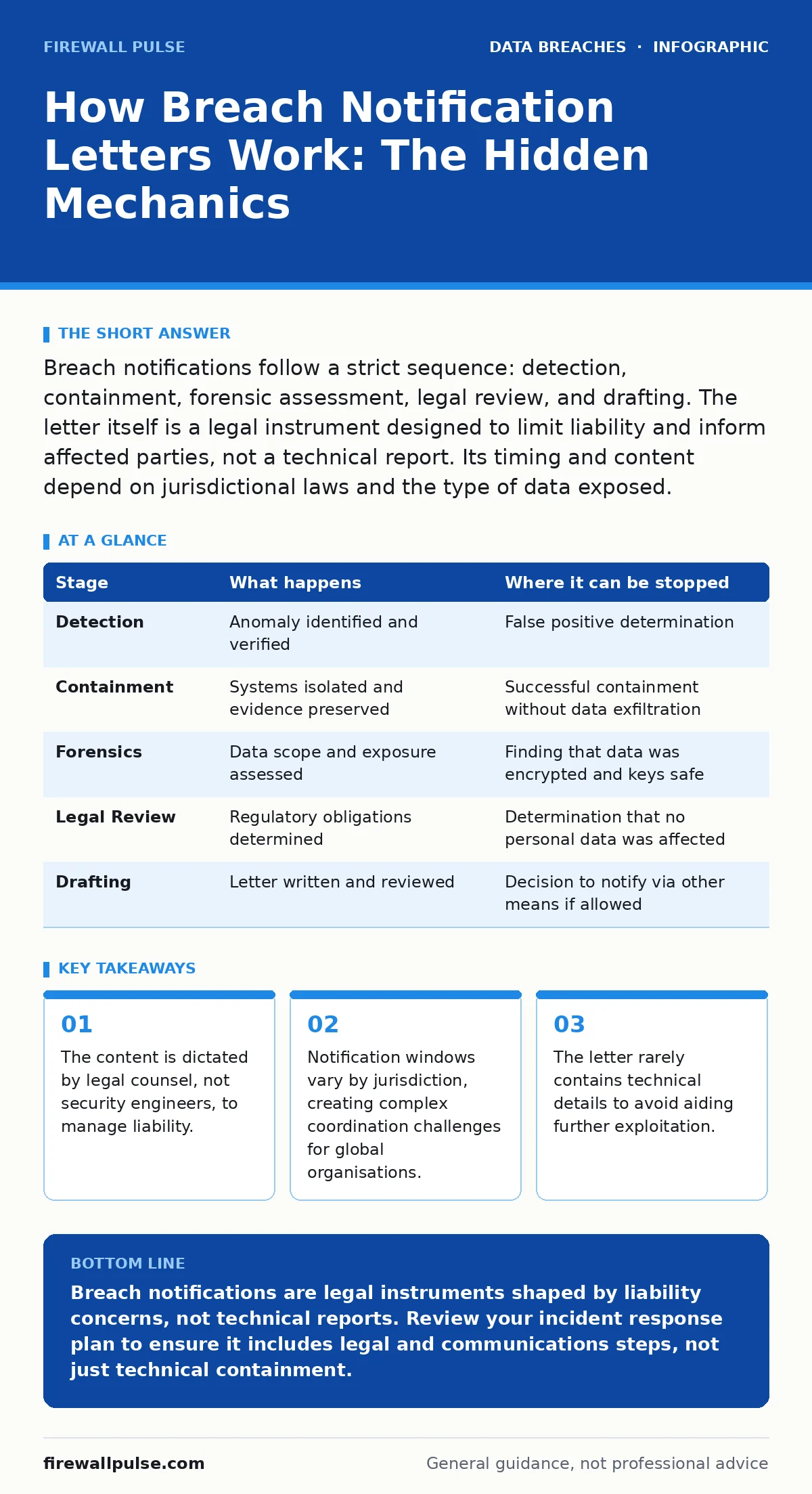
Breach notifications follow a strict sequence: detection, containment, forensic assessment, legal review, and drafting. The letter itself is a legal instrument designed to limit liability and inform affected parties, not a technical report. Its timing and content depend on jurisdictional laws and the type of data exposed.
The Trigger: Detection and Initial Triage
The process begins when an anomaly is detected. This might be an alert from an intrusion detection system, a user reporting suspicious activity, or an external researcher disclosing a vulnerability. At this stage, the organisation is not considering communications. The immediate goal is verification. Security teams must determine whether the alert represents a true compromise or a false positive.
This initial phase is critical because false alarms waste resources, while missed signals lead to extended exposure. Imagine a scenario where a server shows unusual outbound traffic. The team investigates and finds that a legitimate backup process is running late. No breach occurred. Conversely, if the traffic is encrypted and destined for an unknown IP address, the clock starts ticking.
The definition of a "breach" varies. Some jurisdictions require notification only if personal data is encrypted and the key is not exposed. Others mandate notification for any unauthorised access, regardless of whether data was actually exfiltrated. This ambiguity forces teams to assume the worst case during the initial triage.
Containment and Preservation of Evidence
Once a compromise is confirmed, the priority shifts to containment. The organisation must stop the bleeding. This often involves isolating affected systems, disabling compromised accounts, or blocking malicious IP addresses at the firewall. However, containment actions can destroy evidence if not performed carefully.
This is where the concept of chain of custody becomes relevant. Every action taken must be logged. If the organisation plans to pursue legal action or insurance claims, the integrity of the digital evidence is paramount. Deleting logs to stop an attack might save data but ruin the ability to prove what happened.
Behind the scenes, incident responders work to limit the scope. They identify which systems were accessed and what data resides on those systems. This mapping is tedious and often incomplete. Attackers move laterally, accessing systems that seem unrelated to the initial entry point. The notification letter will later reflect this mapped scope, but the initial understanding is always fuzzy.
Forensic Assessment and Data Classification
With the immediate threat contained, the organisation moves to forensic assessment. External experts may be brought in to provide an unbiased view. They analyse logs, memory dumps, and network captures to reconstruct the attacker’s actions. The goal is to answer three questions: what data was accessed, how much was taken, and was it decrypted?
Data classification plays a huge role here. Not all data carries the same legal weight. A customer’s name and email address may trigger different notification requirements than their social security number or health records. For instance, data protected under the HIPAA Security Rule has specific reporting timelines and content requirements that differ from general personal data.
This stage determines the severity of the breach. If the attacker accessed a database but the data was encrypted with strong keys, and the keys were never exposed, some jurisdictions may not require public notification. This is a key distinction that many organisations miss. The mere access is not always the breach; the exposure of usable data is.
Legal Review and Regulatory Alignment
The technical findings are handed to legal counsel. This is where the breach becomes a legal issue. Lawyers review the forensic report against applicable laws. They determine which jurisdictions are affected. If the organisation operates globally, it may need to comply with dozens of different regulations simultaneously.
This coordination is complex. One country may require notification within 72 hours, while another allows 30 days. The organisation must draft letters that satisfy the strictest requirements to avoid penalties in any region. This often leads to a "one size fits all" letter that is overly broad to ensure compliance everywhere.
Legal teams also assess liability. They consider whether the organisation had reasonable security measures in place. If the breach resulted from a failure to implement role-based access control, the legal risk increases. The notification letter must be careful not to admit negligence while still being truthful. This balancing act dictates the tone and content of the final communication.
Drafting the Notification Letter
The letter itself is a carefully crafted document. It must include specific elements mandated by law. These typically include a description of the incident, the types of data involved, what the organisation is doing to investigate, and what the recipient should do. It rarely includes technical details.
Technical details are omitted to prevent aiding further attacks. Imagine including the specific vulnerability exploited. This would allow other attackers to target the same flaw in other organisations. Instead, the letter uses vague language like "unauthorised access" or "security incident."
The letter also includes contact information for questions and resources for identity protection. This is often a standard boilerplate section. The organisation may offer credit monitoring services, though this is not always required. The goal is to show care and reduce the likelihood of class-action lawsuits.
| Stage | What happens | Where it can be stopped |
|---|---|---|
| Detection | Anomaly identified and verified | False positive determination |
| Containment | Systems isolated and evidence preserved | Successful containment without data exfiltration |
| Forensics | Data scope and exposure assessed | Finding that data was encrypted and keys safe |
| Legal Review | Regulatory obligations determined | Determination that no personal data was affected |
| Drafting | Letter written and reviewed | Decision to notify via other means if allowed |
See also: Malware Analysis: Why It Matters for Security Decisions · Web Shells: Detect, Analyse and Remove Hidden Backdoors
Distribution and Post-Notification Actions
Once the letter is approved, it is distributed. This can be via email, postal mail, or a dedicated webpage. The method depends on the scale of the breach and legal requirements. For large breaches, a dedicated website is often used to manage the volume of inquiries.
Behind the scenes, the organisation monitors for fallout. They track media coverage, customer complaints, and regulatory inquiries. They may also face audits or investigations. The notification is not the end of the process; it is the beginning of accountability.
Organisations often use this time to improve their security posture. They review their backup strategies to ensure they can restore systems quickly. They may also conduct third-party risk assessments to ensure vendors do not introduce similar vulnerabilities. The breach becomes a catalyst for change, but the immediate focus remains on managing the fallout.
Limits of the Notification Process
The notification letter has significant limits. It is a static document that reflects the understanding at a specific point in time. As the investigation continues, new facts may emerge. The organisation may need to issue updates, but these are often ignored by recipients.
The letter does not restore trust. It merely informs. Customers may still lose confidence in the organisation, regardless of how well the letter is written. The perception of security is fragile. A single breach can damage a brand’s reputation for years.
Furthermore, the letter does not prevent future breaches. It is a reactive measure. The organisation must implement technical and procedural changes to prevent recurrence. This includes patching vulnerabilities, improving monitoring, and training staff. The notification is a symptom of a deeper issue, not a cure.
The Human Element and Communication Strategy
Finally, the organisation must manage the human element. Employees may be anxious, customers may be angry, and partners may be concerned. Internal communications are as important as external ones. Staff need to know what happened and how to handle inquiries.
A consistent message is vital. Mixed signals confuse recipients and damage credibility. The organisation should designate a single point of contact for all breach-related communications. This ensures that information is accurate and consistent.
The tone of the communication matters. It should be empathetic but not defensive. Acknowledge the impact on the recipient and explain the steps being taken. Avoid jargon and technical terms. The goal is to inform and reassure, not to impress with technical expertise.
Key takeaways
- The content is dictated by legal counsel, not security engineers, to manage liability.
- Notification windows vary by jurisdiction, creating complex coordination challenges for global organisations.
- The letter rarely contains technical details to avoid aiding further exploitation.
Breach notifications are legal instruments shaped by liability concerns, not technical reports. Review your incident response plan to ensure it includes legal and communications steps, not just technical containment.
Frequently asked questions
How long does it take to send a breach notification letter?
Timing varies by jurisdiction, ranging from 72 hours to 30 days after discovery. Legal review and forensic assessment can delay this significantly.
Do I need to notify customers if only internal data was accessed?
It depends on the jurisdiction and the type of data. Some laws require notification for any unauthorised access, while others only require it if personal data is exposed.
Can I send a notification via email only?
Many jurisdictions require direct notification via email or postal mail. A website notice may be sufficient only if direct contact information is unavailable or if the breach affects a very large number of people.
What should I do if I receive a breach notification?
Monitor your accounts for suspicious activity, change passwords, and consider placing a fraud alert on your credit files. Do not click on links in the notification email; visit the organisation’s website directly.
How this guide was produced: written by the Firewall Pulse editorial team with AI assistance, checked against the public references listed below, and reviewed when the facts change. See our editorial policy or report an error.