Third-Party Risk Assessments for Small Businesses: Practical Steps
Most small business data losses occur because vendors hold keys to your systems without your knowledge, not because hackers break your own walls.

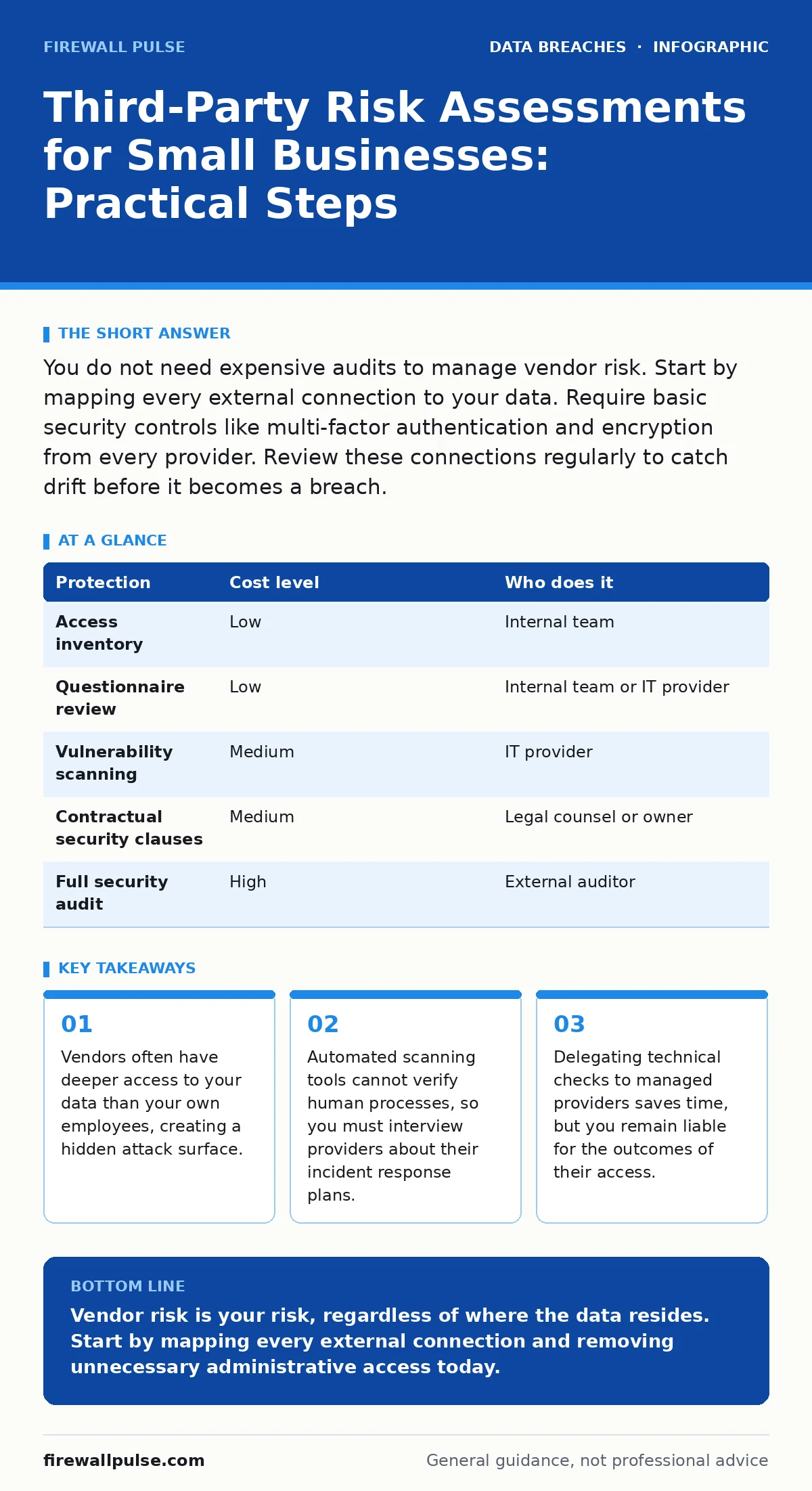
You do not need expensive audits to manage vendor risk. Start by mapping every external connection to your data. Require basic security controls like multi-factor authentication and encryption from every provider. Review these connections regularly to catch drift before it becomes a breach.
The Hidden Surface of Small Teams
Small organisations often believe that their size protects them from sophisticated attacks. This belief is false. Attackers target small businesses because they assume defences are thin. They look for the path of least resistance. That path is rarely your own firewall. It is usually a vendor who has been granted access to your systems.
When you hire a software provider, a cloud host, or an IT consultant, you are handing them a set of keys. If those keys are not managed carefully, the vendor becomes a bridge for attackers. You must treat every third party as part of your own security perimeter. Their security posture directly affects your risk profile.
Mapping Access Before Checking Controls
You cannot protect what you cannot see. The first step in any assessment is a complete inventory of third-party access. Many small teams lose track of who can touch their data. Old employees leave, but their credentials remain active. Freelancers finish projects but keep admin rights. These dormant accounts are prime targets.
Create a simple list. Include every vendor that touches your data or infrastructure. Note the type of access they have. Is it read-only? Can they modify files? Do they have administrative privileges? Administrative privileges are the most dangerous. They allow a vendor to change settings, install software, and bypass security checks. Limit these rights to the absolute minimum required for the service.
Affordable Assessment Methods
You do not need a formal audit for every small vendor. Formal audits are expensive and time-consuming. For smaller providers, use a tiered approach. High-risk vendors, such as those holding customer financial data or health records, require deeper scrutiny. Low-risk vendors, such as a newsletter provider that only sees email addresses, need less.
For high-risk vendors, request their latest security certification. Look for ISO 27001 or SOC 2 reports. These documents prove that an independent party has checked their controls. If they do not have these, ask for their security whitepaper. This document should explain how they protect data at rest and in transit. If they refuse to provide any documentation, consider them a high risk.
What to Delegate to IT Providers
Small teams often lack the technical depth to verify complex security claims. This is where managed service providers can help. You can delegate the technical verification of network security, patch management, and configuration checks to them. However, you must define exactly what you are buying.
Do not delegate the decision of who gets access. That remains your responsibility. You can ask your IT provider to scan vendor interfaces for known vulnerabilities. They can check if a vendor’s API endpoints are exposed to the public internet. They can verify that encryption standards are up to date. But they cannot judge the business risk. You must decide if a vendor’s security level is acceptable for your specific data.
| Protection | Cost level | Who does it |
|---|---|---|
| Access inventory | Low | Internal team |
| Questionnaire review | Low | Internal team or IT provider |
| Vulnerability scanning | Medium | IT provider |
| Contractual security clauses | Medium | Legal counsel or owner |
| Full security audit | High | External auditor |
Questions for Your IT Provider
When you engage an IT provider to help with vendor risk, you need clear answers. Do not accept vague assurances. Ask specific questions about their process. This ensures they are actually checking the vendors and not just your internal systems.
- How do you verify that a vendor’s encryption keys are rotated regularly?
- What happens if a vendor’s security certificate expires or is revoked?
- Can you monitor the vendor’s public-facing assets for new vulnerabilities?
- Do you have a process to revoke access immediately if a vendor is compromised?
- How do you distinguish between a vendor’s legitimate traffic and an attacker mimicking them?
These questions force the provider to explain their mechanisms. If they cannot answer clearly, they may not be performing the checks you need. You need a partner who understands the nuance of third-party connections.
See also: How Breach Notification Letters Work: The Hidden Mechanics · How to Stop Source Code Leaks Before They Happen
The Contract as a Security Tool
Technical controls can fail. Processes can be ignored. The contract is your last line of defence. It should specify the security standards the vendor must maintain. Include right-to-audit clauses. This allows you to inspect their practices if a breach occurs.
Define the timeline for breach notification. You need to know within hours, not days. If a vendor is slow to tell you about a compromise, your ability to contain the damage is reduced. Also, specify who holds the data. If the relationship ends, the vendor must delete or return your data. Verify this deletion. Do not just take their word for it.
See our guide on customer breach notification letters to understand the legal timelines you must meet once a vendor informs you of an incident.
Continuous Monitoring Over One-Time Checks
A risk assessment is not a one-time event. Vendors change. They merge, they hire new staff, they update software. These changes can introduce new risks. You must monitor your vendors continuously.
Set up alerts for changes in vendor certificates or DNS records. Use automated tools to check if a vendor’s public IP addresses have changed unexpectedly. This can indicate a takeover or a misconfiguration. Review access logs quarterly. Remove any access that is no longer needed. The goal is to reduce the attack surface over time, not just to pass an initial check.
Refer to our guide on backup strategies to ensure that even if a vendor’s compromise leads to data corruption, you can restore your systems without paying a ransom.
The Reality of Liability
You might think that if a vendor is breached, it is their fault. Legally and practically, this is often not true. If your data is exposed, your customers blame you. Regulators fine you. Your reputation suffers. You are responsible for the data, regardless of where it sits.
This means you cannot outsource your risk. You can outsource the work, but not the accountability. You must maintain oversight. You must verify that the controls you rely on are actually working. This requires time and attention, but it is cheaper than the cost of a breach.
See our guide on role-based access control to understand how to limit the damage if a vendor’s credentials are stolen.
Key takeaways
- Vendors often have deeper access to your data than your own employees, creating a hidden attack surface.
- Automated scanning tools cannot verify human processes, so you must interview providers about their incident response plans.
- Delegating technical checks to managed providers saves time, but you remain liable for the outcomes of their access.
Vendor risk is your risk, regardless of where the data resides. Start by mapping every external connection and removing unnecessary administrative access today.
Frequently asked questions
Do I need to audit every small vendor?
No. Focus on vendors with access to sensitive data or administrative rights. Low-risk vendors need only basic verification like a security questionnaire.
What if a vendor refuses to answer security questions?
Treat this as a red flag. They are either hiding weaknesses or do not take security seriously. Consider finding a different provider.
How often should I review vendor risks?
Review high-risk vendors annually or after any major change in their service. Low-risk vendors can be reviewed every two years or upon contract renewal.
Can my IT provider do all the work?
They can handle technical checks, but you must define the requirements and make the final risk decisions. You remain liable for the outcomes.
How this guide was produced: written by the Firewall Pulse editorial team with AI assistance, checked against the public references listed below, and reviewed when the facts change. See our editorial policy or report an error.