OSINT tools for investigators: spotting the silent traps
Open-source intelligence tools leak investigator identity long before targets notice the active data collection.

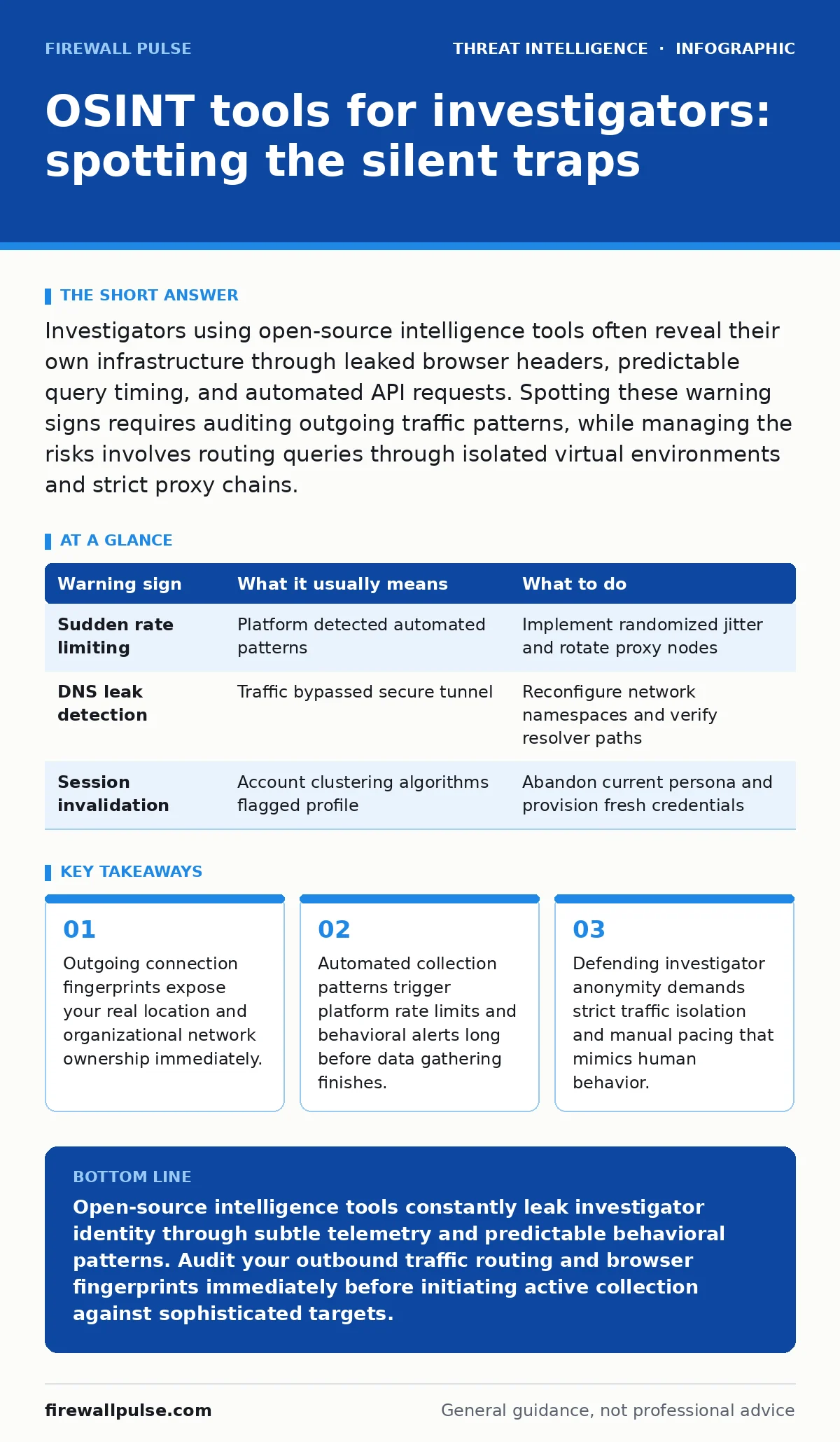
Investigators using open-source intelligence tools often reveal their own infrastructure through leaked browser headers, predictable query timing, and automated API requests. Spotting these warning signs requires auditing outgoing traffic patterns, while managing the risks involves routing queries through isolated virtual environments and strict proxy chains.
Signs people notice first
Browser fingerprinting exposes your operational reality through unmasked attributes like screen resolution, installed fonts, and hardware acceleration profiles. Web servers record these unique combinations, allowing targets to trace automated collection back to specific corporate networks or dedicated virtual private server ranges. Masking user agents provides a false sense of security because underlying TCP (Transmission Control Protocol) handshake characteristics and TLS (Transport Layer Security) cipher suites often betray automated frameworks.
Rate limiting triggers provide immediate feedback that your automated gathering has crossed the threshold from passive observation to active disruption. Platforms monitor request frequency per second, and exceeding normal human browsing speeds results in immediate captchas or outright IP bans. Adjusting query intervals randomly helps bypass simple volume checks, but sophisticated targets correlate request bursts with specific timezone working hours to identify geographic origin.
Authentication prompts act as loud alarms when scrapers attempt to view restricted profiles or historical logs without proper session cookies. Logging into platforms with personal credentials instantly tethers your real identity to the target entity, permanently destroying operational security. Creating burner accounts requires careful phone number and payment method separation to prevent platform algorithms from clustering related investigative nodes together.
Signs that are easy to miss
DNS (Domain Name System) leakage occurs when query lookups bypass configured proxy tunnels and route directly through local internet service provider resolvers. This failure exposes your actual geographic location and organization name in public query logs maintained by root name servers. Verifying routing tables continuously prevents accidental leaks during network reconnection events or browser crashes.
Automated API (Application Programming Interface) telemetry often includes internal project names, developer usernames, or proprietary software versions within custom HTTP headers. Target platforms ingest these diagnostic telemetry strings and archive them in security logs, giving persistent adversaries a blueprint of your internal tooling. Stripping unnecessary header fields from outbound requests reduces your digital footprint significantly.
Timing analysis of search queries reveals operational rhythms that distinguish automated scripts from genuine human interest. Scripts execute requests at mathematically precise intervals, whereas human investigators pause to read, take notes, and navigate organically. Injecting randomized jitter into collection scripts prevents behavioral profiling based on microsecond execution patterns.
What to do when you see one
| Warning sign | What it usually means | What to do |
|---|---|---|
| Sudden rate limiting | Platform detected automated patterns | Implement randomized jitter and rotate proxy nodes |
| DNS leak detection | Traffic bypassed secure tunnel | Reconfigure network namespaces and verify resolver paths |
| Session invalidation | Account clustering algorithms flagged profile | Abandon current persona and provision fresh credentials |
Immediate remediation begins with terminating all active collection threads associated with the compromised infrastructure. Reviewing proxy rotation logs helps determine whether the exposure was isolated to a single node or systemic across the entire investigative subnet. Never reuse tainted API tokens or burner accounts after an alert triggers, as platforms retain historical association graphs indefinitely.
Isolating investigative workloads from corporate networks prevents lateral movement if a target retaliates against your collection infrastructure. Dedicated virtual machines running transient operating systems provide clean boundaries, ensuring browser caches and local storage persist only for the duration of a single session. Documenting these operational incidents helps refine threat intelligence sharing protocols across your team without exposing sensitive attribution details.
Hidden costs of automated collection
Resource exhaustion creates silent operational blind spots when automated scrapers consume all available memory or CPU cycles on proxy nodes. This degradation causes connection timeouts that mimic network filtering, leading investigators to increase retries and generate even more anomalous traffic. Monitoring resource utilization ensures collection tools operate within stable performance thresholds.
Maintenance overhead scales exponentially as target platforms continuously update their anti-scraping defenses and layout structures. Investigators spend more time repairing broken parsers and updating query syntax than analyzing actual intelligence feeds, degrading overall operational efficiency. Factoring this engineering debt into project timelines prevents sudden capability gaps during active investigations.
Legal and compliance risks multiply when scrapers inadvertently harvest protected personal data or violate strict terms of service agreements. Unauthorized data collection can compromise the admissibility of evidence in formal proceedings and expose your organization to regulatory penalties. Maintaining strict scoping rules protects both your legal standing and your operational integrity.
Managing proxy infrastructure risks
Proxy rotation schedules require careful design to prevent exit nodes from belonging to known hosting provider ranges associated with security research. Commercial data center IPs stand out immediately on consumer platforms, whereas residential proxies offer better blending capabilities at a higher financial cost. Balancing cost and anonymity remains a constant operational compromise.
Connection persistence matters because rapidly shifting between geographically distant exit nodes during a single investigative session triggers fraud detection algorithms. Maintaining a consistent virtual location throughout a specific case study preserves behavioral continuity while still hiding your physical headquarters. Documenting these geographic tethers prevents accidental cross-contamination between unrelated investigations.
See also: Phishing Kits Exposed: 6 Misconceptions and What They Really Are · Phishing Infrastructure Prevention Checklist for Network Defenders
Auditing your investigative tooling
Source code audits should occur regularly to ensure no hardcoded credentials, debugging flags, or telemetry hooks exist within custom collection scripts. Open-source tools maintained by third parties require thorough code reviews before deployment, as upstream repositories can introduce malicious updates or accidental data leaks silently. Building an internal repository of verified tools reduces reliance on unvetted external codebases.
Environment variable management prevents accidental credential exposure when switching between test environments and live operational networks. Storing secrets securely outside of application source code avoids accidental commits to public repositories or shared network drives. Regular access reviews ensure only authorized personnel can deploy or modify active investigative scripts.
Maintaining operational discipline
Operational security fails most often through human fatigue rather than technical sophistication, especially during long-term monitoring assignments. Investigators grow complacent and check personal email accounts or corporate communication channels from within dedicated intelligence-gathering environments. Enforcing strict hardware separation between daily administrative tasks and investigative work eliminates this cross-contamination risk entirely.
Training team members to recognize subtle platform pushback prevents small data leaks from escalating into catastrophic compromises of hidden infrastructure. Establishing clear incident response procedures for burnt proxies or flagged accounts ensures rapid mitigation before adversaries map your complete operational network. Consistent adherence to these protocols protects your investigators long-term.
Key takeaways
- Outgoing connection fingerprints expose your real location and organizational network ownership immediately.
- Automated collection patterns trigger platform rate limits and behavioral alerts long before data gathering finishes.
- Defending investigator anonymity demands strict traffic isolation and manual pacing that mimics human behavior.
Open-source intelligence tools constantly leak investigator identity through subtle telemetry and predictable behavioral patterns. Audit your outbound traffic routing and browser fingerprints immediately before initiating active collection against sophisticated targets.
Frequently asked questions
What causes an open-source intelligence tool to reveal my real location?
Outgoing connection requests often leak unmasked browser fingerprints, direct DNS queries, or custom HTTP headers that expose your actual network infrastructure.
How can I prevent platform rate limits during data collection?
Introduce randomized time delays between queries and rotate proxy exit nodes to mimic organic human browsing behaviour.
Why are residential proxies preferred over data center proxies for investigations?
Residential proxy addresses belong to consumer internet service providers, making them blend in naturally compared to easily identifiable data center hosting ranges.
What should I do immediately after a burner account gets banned?
Abandon the compromised account and all associated credentials immediately, as platforms permanently cluster related behavioral nodes together.
How this guide was produced: written by the Firewall Pulse editorial team with AI assistance, checked against the public references listed below, and reviewed when the facts change. See our editorial policy or report an error.