Strategic Threat Intelligence: 6 Misreadings That Waste Resources
Strategic threat intelligence predicts long-term adversary shifts rather than providing immediate indicators for daily operational blocking.

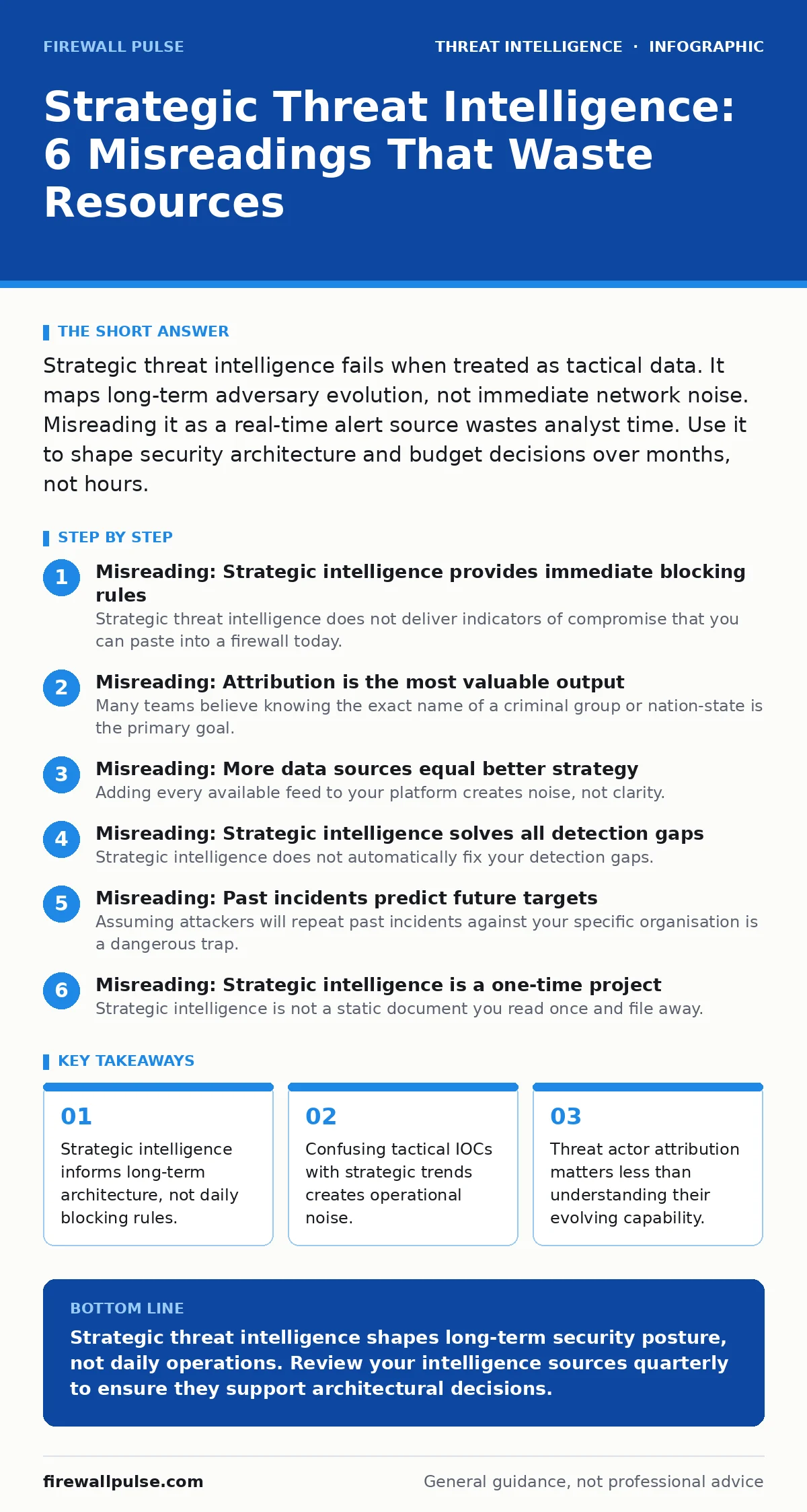
Strategic threat intelligence fails when treated as tactical data. It maps long-term adversary evolution, not immediate network noise. Misreading it as a real-time alert source wastes analyst time. Use it to shape security architecture and budget decisions over months, not hours.
Misreading: Strategic intelligence provides immediate blocking rules
Strategic threat intelligence does not deliver indicators of compromise that you can paste into a firewall today. It describes the evolution of adversary tactics, techniques, and procedures over months or years. You use this data to decide which vulnerabilities to patch next quarter or which security controls to retire. Treating strategic reports as tactical feeds causes alert fatigue. Your security operations centre drowns in false positives because the data lacks the specificity needed for real-time blocking. You must separate long-term trend analysis from immediate operational needs.
Correct reading: Use strategic intelligence to shape security architecture and resource allocation. It tells you where the threat is moving, not where it is right now. Build your detection engineering strategies around these predicted paths. This approach ensures your defences align with future adversary behaviour rather than reacting to past events.
Misreading: Attribution is the most valuable output
Many teams believe knowing the exact name of a criminal group or nation-state is the primary goal. Attribution is often speculative and changes as evidence emerges. Focusing on names distracts from understanding what the attacker can do. The specific identity matters less than the capability set and the motivation driving the attack. An anonymous group with advanced privilege escalation attacks poses the same risk as a named entity with similar tools. You waste time debating origins instead of mitigating the technical threat.
Correct reading: Focus on the adversary’s capability and intent rather than their label. Understand what systems they target and how they maintain access. This behavioural focus allows you to defend against unknown groups that mimic known tactics. Your defences should stop the action, not just the actor.
Misreading: More data sources equal better strategy
Adding every available feed to your platform creates noise, not clarity. Strategic intelligence requires synthesis, not aggregation. Combining low-quality tactical feeds with high-level analysis dilutes the signal. You end up with a dashboard full of conflicting information that no one reads. Quality outweighs quantity in strategic contexts. A single well-researched report on emerging cyber espionage trends provides more value than thousands of raw hash lists. You must curate your inputs to ensure they support long-term decision-making.
Correct reading: Select sources based on analytical depth, not volume. Prioritise providers who explain the ‘why’ behind the data. This reduces cognitive load and highlights genuine shifts in adversary behaviour. Regularly prune feeds that only provide tactical noise without strategic context.
Misreading: Strategic intelligence solves all detection gaps
Strategic intelligence does not automatically fix your detection gaps. It identifies where attacks are likely to occur, but you must build the specific logic to catch them. Knowing an adversary uses fast flux DNS for command and control is useless if your sensors do not monitor DNS traffic effectively. You must translate strategic insights into concrete detection rules. This translation step is where most teams fail. They assume the intelligence platform will do the work, but detection requires custom engineering tailored to your environment.
Correct reading: Treat strategic intelligence as input for detection engineering, not a finished product. Map each strategic insight to specific log sources and analytics. Build tests that validate whether your current controls would spot the described behaviour. This active translation turns abstract trends into actionable security controls.
Misreading: Past incidents predict future targets
Assuming attackers will repeat past incidents against your specific organisation is a dangerous trap. Adversaries evolve their methods and often shift targets based on opportunity. Just because a sector was hit last year does not mean you are safe this year. Conversely, being quiet does not mean you are invisible. Attacker reconnaissance is continuous and opportunistic. Relying on historical incident data ignores the dynamic nature of the threat environment. You must anticipate new entry points, not just reinforce old walls.
Correct reading: Model your risk based on your current value to adversaries, not past victim lists. Consider what data you hold and how your architecture might appeal to new attacker types. This forward-looking approach prepares you for novel attack vectors rather than just historical repeats.
See also: Fast Flux DNS: How Attackers Hide Malware and How to Stop It
Misreading: Strategic intelligence is a one-time project
Strategic intelligence is not a static document you read once and file away. It requires continuous review as the threat environment shifts. Adversaries adapt quickly to new defences and regulatory changes. A strategy built on outdated insights becomes a liability. You must revisit your strategic assumptions regularly. Check if the predicted trends are materialising in your logs. If the expected behaviour does not appear, your strategy may be misaligned with reality.
Correct reading: Establish a regular review cycle for your strategic intelligence. Update your risk models quarterly or when major industry shifts occur. This ensures your security posture remains aligned with current adversary capabilities. Static strategies become obsolete quickly in a dynamic threat environment.
Key takeaways
- Strategic intelligence informs long-term architecture, not daily blocking rules.
- Confusing tactical IOCs with strategic trends creates operational noise.
- Threat actor attribution matters less than understanding their evolving capability.
- Budget decisions require understanding the broader cyber espionage context.
Strategic threat intelligence shapes long-term security posture, not daily operations. Review your intelligence sources quarterly to ensure they support architectural decisions.
Frequently asked questions
How does strategic intelligence differ from tactical intelligence?
Tactical intelligence provides immediate data like IP addresses for blocking, while strategic intelligence describes long-term adversary trends and capabilities to inform security planning.
Can strategic intelligence replace vulnerability management?
No, it complements it by highlighting which vulnerabilities are likely to be targeted next, allowing you to prioritise patching efforts based on actual threat relevance.
How often should strategic intelligence be reviewed?
Review it quarterly or whenever significant changes occur in the cyber espionage environment, ensuring your security strategy remains aligned with current adversary behaviour.
What is the biggest risk of misusing strategic intelligence?
The biggest risk is wasting resources on low-priority threats while missing emerging, high-impact attack paths that require architectural changes rather than simple blocking.
How this guide was produced: written by the Firewall Pulse editorial team with AI assistance, checked against the public references listed below, and reviewed when the facts change. See our editorial policy or report an error.