Phishing Kits Exposed: 6 Misconceptions and What They Really Are
Phishing kits are automated distribution systems that standardise credential theft, not bespoke tools for individual attackers targeting specific victims.

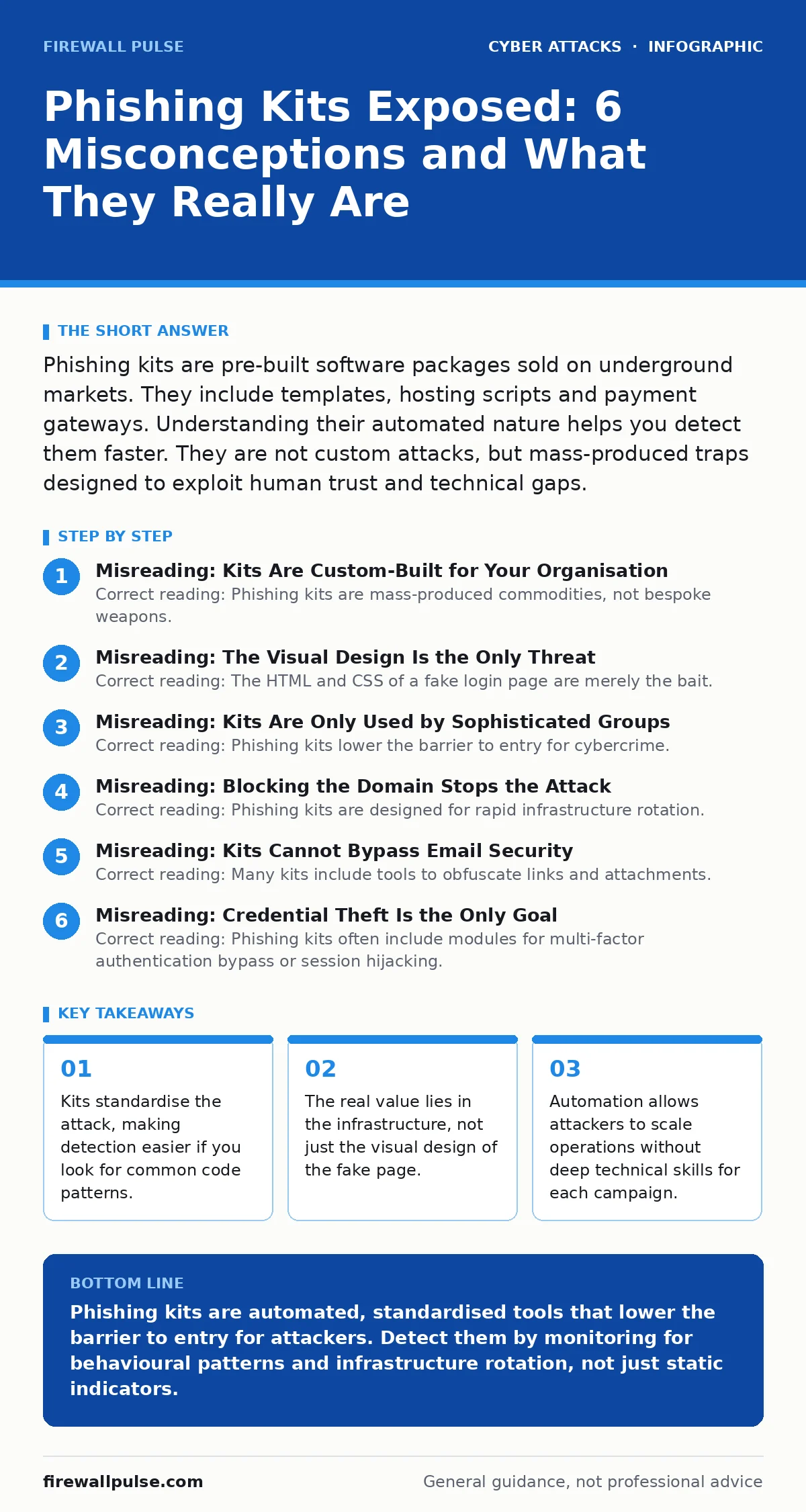
Phishing kits are pre-built software packages sold on underground markets. They include templates, hosting scripts and payment gateways. Understanding their automated nature helps you detect them faster. They are not custom attacks, but mass-produced traps designed to exploit human trust and technical gaps.
Misreading: Kits Are Custom-Built for Your Organisation
Correct reading: Phishing kits are mass-produced commodities, not bespoke weapons. Attackers purchase these packages from underground marketplaces to launch broad campaigns. The templates are generic, targeting popular services or large sectors rather than specific individuals. This standardisation creates a hidden vulnerability. Security teams often look for unique indicators, but the real threat is the volume of identical or near-identical pages.
Recognising that the attacker is using a template changes your detection strategy. You stop hunting for one-off anomalies and start scanning for known kit signatures. This shift allows you to block entire campaigns rather than reacting to single incidents. The lack of customisation is actually a strength for defenders, as it makes the attacks predictable.
Misreading: The Visual Design Is the Only Threat
Correct reading: The HTML and CSS of a fake login page are merely the bait. The true mechanism is the backend infrastructure that processes the stolen data. Kits include scripts that capture form submissions and forward credentials to the attacker’s server. They often include logic to bypass basic validation or to mimic error messages. Focusing solely on the visual appearance misses the operational reality.
A poorly designed page can still capture data if the underlying script works. Conversely, a perfect visual clone fails if the backend is detected. Understanding the separation between presentation and processing helps you prioritise monitoring. You should inspect the form action attributes and network requests, not just the logo alignment. This technical layer is where the actual theft occurs.
Misreading: Kits Are Only Used by Sophisticated Groups
Correct reading: Phishing kits lower the barrier to entry for cybercrime. They allow individuals with minimal technical skills to launch attacks. The complexity is handled by the kit developer, not the end user. This democratisation of attack tools means you face a wider range of adversaries. You cannot assume the attacker has advanced persistence or evasion techniques.
Many users of these kits are opportunistic and careless. They reuse infrastructure and make configuration errors. This carelessness creates observable patterns. Simple checks for misconfigured headers or default admin panels can reveal these operations. Do not over-engineer your defences against every threat. Sometimes, basic hygiene and monitoring for obvious mistakes are enough to stop the majority of kit-based attacks.
Misreading: Blocking the Domain Stops the Attack
Correct reading: Phishing kits are designed for rapid infrastructure rotation. Attackers expect their domains to be blocked quickly. They use dynamic DNS services and short-lived certificates to maintain access. Blocking a single domain is a temporary fix, not a solution. The kit often includes multiple landing pages and redirect chains. When one domain fails, the attacker switches to another pre-configured address.
This resilience means you must monitor for behavioural indicators, not just static URLs. Look for patterns in the request flow, such as unusual redirects or consistent form submission endpoints. Integrating this monitoring with your security operations centers allows for faster response. You need to identify the pattern of the attack, not just the specific web address.
Misreading: Kits Cannot Bypass Email Security
Correct reading: Many kits include tools to obfuscate links and attachments. They use URL shorteners, image-based links, or encoded text to evade simple filters. These techniques are standard features, not advanced customisations. Assuming your email gateway will catch everything is a dangerous assumption. The kits are updated frequently to bypass common detection rules.
You must treat email as an untrusted channel. Implementing zero trust security principles helps mitigate this risk. Verify the source of every link, regardless of how legitimate it appears. Use sandboxing to analyse attachments before they reach the user. Do not rely on perimeter defences alone. The kit’s ability to adapt means your defence must be layered and behavioural, not just signature-based.
See also: Fast Flux DNS: How Attackers Hide Malware and How to Stop It
Misreading: Credential Theft Is the Only Goal
Correct reading: Phishing kits often include modules for multi-factor authentication bypass or session hijacking. Some kits capture the second factor by prompting the user for it on the fake page. Others intercept the session cookie after login. This means that even if you enforce strong passwords, you are still at risk. The kit is not just stealing a username and password.
It is attempting to maintain access. Understanding this broader scope is critical. You must monitor for unusual login locations and times. Implement conditional access policies that require re-authentication for sensitive actions. This approach limits the damage if credentials are compromised. It also helps detect the session hijacking attempts that standard password resets miss.
Misreading: Users Are the Only Weak Link
Correct reading: While user error is a factor, technical misconfigurations often enable kit success. Open proxies, misconfigured web servers, and lack of certificate transparency monitoring provide the infrastructure attackers need. These technical gaps are easier to exploit than human psychology. Focusing solely on user training ignores the structural vulnerabilities.
You must secure your own infrastructure to prevent it from being used in these attacks. Ensure your DNS settings are locked down. Monitor for signs of your domains being used in phishing campaigns. This proactive stance reduces the attack surface. It also prevents your organisation from becoming an unwitting participant in the distribution of these kits.
Misreading: Kits Are Static and Unchanging
Correct reading: Phishing kits are updated regularly by their developers. New templates, evasion techniques, and backend scripts are released frequently. Assuming a kit is static leads to outdated detection rules. The underground market is competitive, driving innovation in these tools. Attackers share updates and patches to improve effectiveness. You must keep your threat intelligence current. Subscribe to feeds that track known kit signatures and indicators. Integrate this data into your detection systems. This ensures your defences evolve alongside the threats. Static rules will fail against dynamic kits. Continuous monitoring and updating are necessary to stay ahead.
Misreading: Legal Action Stops the Distribution
Correct reading: The developers of phishing kits often operate from jurisdictions with weak enforcement. Takedowns are temporary and do not stop the underlying business model. New kits emerge as old ones are shut down. Relying on legal action is not a viable security strategy. You must assume these kits will always be available. Focus on your own defences and detection capabilities. Collaborate with industry groups to share intelligence, but do not expect a permanent solution from law enforcement. This realistic view helps you allocate resources effectively. Invest in technology and training, not just legal remedies.
Key takeaways
- Kits standardise the attack, making detection easier if you look for common code patterns.
- The real value lies in the infrastructure, not just the visual design of the fake page.
- Automation allows attackers to scale operations without deep technical skills for each campaign.
Phishing kits are automated, standardised tools that lower the barrier to entry for attackers. Detect them by monitoring for behavioural patterns and infrastructure rotation, not just static indicators.
Frequently asked questions
How do phishing kits bypass email security filters?
They use obfuscation techniques like URL shorteners, image-based links, and encoded text to evade signature-based detection.
What is the difference between a phishing kit and a custom phishing attack?
Kits are pre-built, mass-produced packages, while custom attacks are tailored to specific targets with unique content and infrastructure.
Can phishing kits steal multi-factor authentication codes?
Yes, many kits include modules to capture second factors or session cookies, allowing attackers to bypass MFA.
How often are phishing kits updated?
They are updated frequently, with new templates and evasion techniques released regularly by developers.
How this guide was produced: written by the Firewall Pulse editorial team with AI assistance, checked against the public references listed below, and reviewed when the facts change. See our editorial policy or report an error.