Dark web monitoring alerts: how to respond and recover safely
Discovering leaked credentials on hidden forums often triggers panic resets that lock out legitimate users instead of stopping automated stuffing.

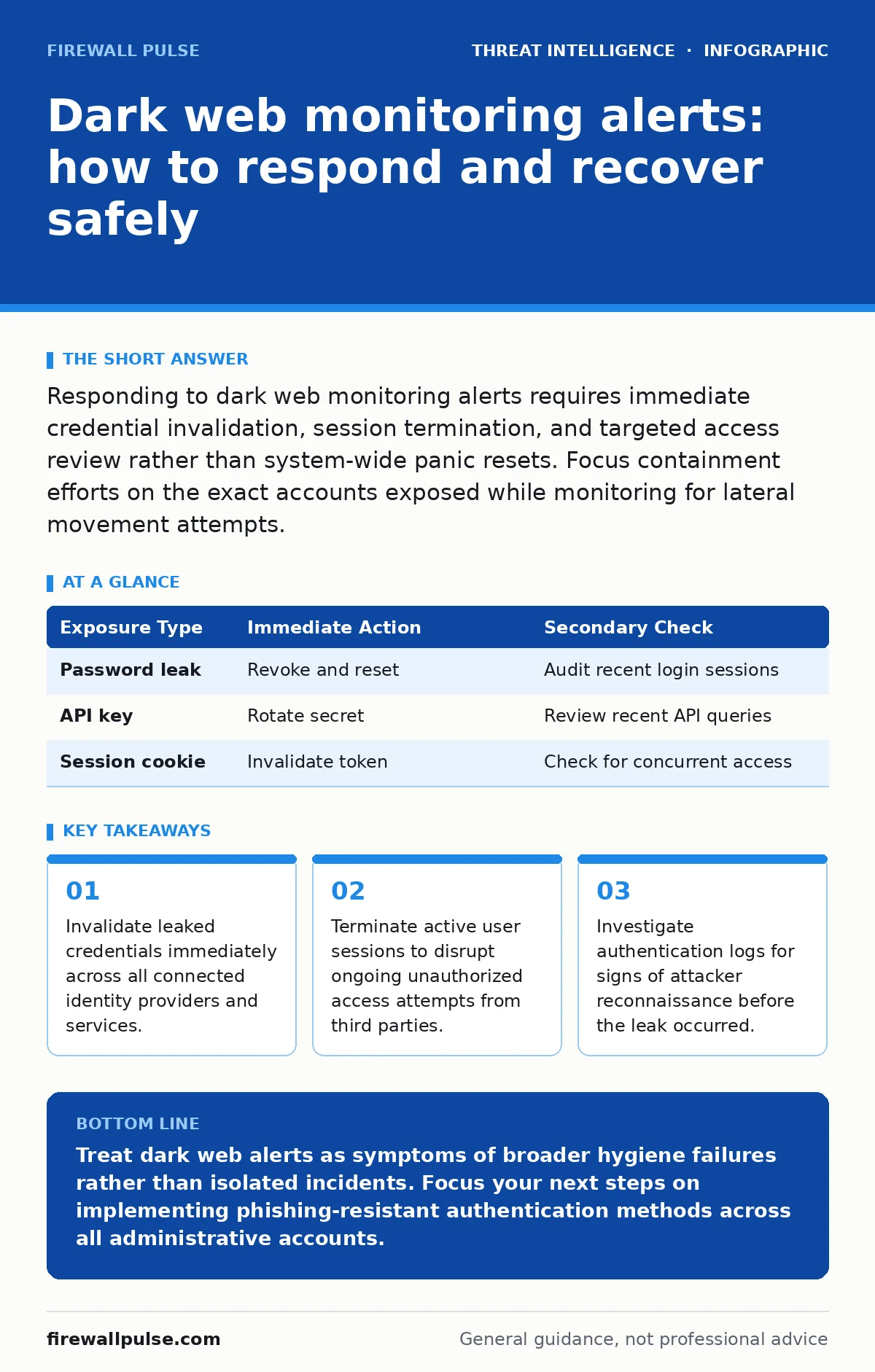
Responding to dark web monitoring alerts requires immediate credential invalidation, session termination, and targeted access review rather than system-wide panic resets. Focus containment efforts on the exact accounts exposed while monitoring for lateral movement attempts.
Understanding dark web alerts
Dark web monitoring services scan hidden forums and illicit marketplaces for corporate credentials, API keys, and internal documentation. These automated scanners capture data dumps published by unauthorized actors, alerting defenders after an exposure occurs elsewhere. Threat intelligence feeds ingest these findings, yet raw alerts frequently lack crucial context regarding whether a credential remains active or already expired.
Relying solely on automated notifications creates operational blindness because scanners cannot verify active exploitation. A leaked password might belong to an inactive test account, rendering the alert benign. Conversely, a valid credential combined with stolen session cookies bypasses multi-factor authentication entirely. Evaluating the actual risk requires examining internal authentication logs rather than trusting the severity score provided by the monitoring vendor.
Actions for the first hour
Immediate triage prevents exposed credentials from turning into full-scale network intrusions. Time matters because automated scripts harvest fresh data dumps rapidly to test them against common authentication portals.
- Invalidate the specific compromised credentials across all connected directory services and single sign-on providers immediately.
- Terminate all active user sessions for the affected account to revoke existing access tokens.
- Check authentication logs for unusual login locations or impossible travel anomalies preceding the alert.
- Notify the affected user through an out-of-band communication channel to confirm their awareness.
Containment during the first day
Containing an exposure involves cutting off attacker access without disrupting legitimate business operations. Once you secure the initial account, examine whether the actor used that access to map internal resources. Attackers often perform automated enumeration to find misconfigured endpoints and service accounts.
Analysing perimeter logs helps determine if the exposed credentials facilitated privilege escalation attacks within your environment. You must inspect endpoint telemetry for unexpected administrative tool usage or newly created service principals. Isolating affected workstations prevents further credential harvesting if malware contributed to the original leak.
| Exposure Type | Immediate Action | Secondary Check |
|---|---|---|
| Password leak | Revoke and reset | Audit recent login sessions |
| API key | Rotate secret | Review recent API queries |
| Session cookie | Invalidate token | Check for concurrent access |
Recovery and remediation
Recovery extends beyond changing passwords to hardening the systems that allowed the initial exposure. You need to investigate how the data left your organisation, whether through endpoint compromise, third-party vendor breaches, or phishing campaigns. Reviewing existing policies around credential hygiene prevents identical exposures from recurring in future quarters.
Remediation requires deploying deceptive elements such as honeytokens to detect persistent unauthorized access attempts across internal directories. If attackers managed to establish persistence before you contained the breach, standard password resets will fail to remove their footprint. Clean recovery ensures that all secondary access mechanisms left behind by the intruder are systematically neutralized.
Who to tell and when
Internal and external communication requires precise timing to prevent panic while meeting regulatory or operational obligations. Informing stakeholders too early with incomplete data leads to confusion, while delaying notification violates incident response protocols.
- Inform the internal security operations team immediately to begin log correlation and threat hunting.
- Brief relevant department heads if the compromised account belongs to a privileged system administrator or finance personnel.
- Notify legal counsel if the exposure involves regulated customer data or proprietary source code protected by compliance mandates.
- Escalate to external regulatory bodies only when forensic findings confirm actual unauthorized data exfiltration occurred.
See also: Phishing Kits Exposed: 6 Misconceptions and What They Really Are · Phishing Infrastructure Prevention Checklist for Network Defenders
Preventing repeat incidents
Stopping recurring exposures demands a shift from reactive monitoring to proactive architecture changes that reduce reliance on static passwords. Implementing hardware-backed authentication tokens stops credential replay attacks even if database hashes leak publicly.
Regularly auditing external-facing assets ensures that shadow IT platforms do not collect employee credentials without organizational oversight. Training staff to recognize sophisticated phishing frameworks reduces the likelihood of future credential harvesting events. Continuous validation of access controls ensures that compromised accounts remain restricted to minimal necessary privileges.
Key takeaways
- Invalidate leaked credentials immediately across all connected identity providers and services.
- Terminate active user sessions to disrupt ongoing unauthorized access attempts from third parties.
- Investigate authentication logs for signs of attacker reconnaissance before the leak occurred.
Treat dark web alerts as symptoms of broader hygiene failures rather than isolated incidents. Focus your next steps on implementing phishing-resistant authentication methods across all administrative accounts.
Frequently asked questions
Why do dark web monitoring services report old credentials as new threats?
Monitoring services aggregate historical data dumps from various illicit forums and re-package them, meaning a leak from years prior might only appear in a vendor feed today.
Should we shut down the entire network when a single user credential appears online?
Shutting down entire networks causes unnecessary business disruption and fails to target the specific vector used by the unauthorized actor.
How can we tell if a leaked password was actually used by an attacker?
Cross-reference the timestamp of the leak with your internal authentication logs to spot anomalous login attempts, unusual geographic locations, or impossible travel patterns.
What makes hardware-backed authentication better against dark web credential leaks?
Hardware tokens require physical presence and cryptographic challenges that stolen password hashes cannot replicate on remote login portals.
How this guide was produced: written by the Firewall Pulse editorial team with AI assistance, checked against the public references listed below, and reviewed when the facts change. See our editorial policy or report an error.