Threat Intelligence Sharing: How Collective Data Stops Attacks
Sharing indicators of compromise transforms isolated defensive data into a coordinated shield that reduces detection times across entire sectors without requiring direct operational control.
Threat intelligence sharing is the structured exchange of data about cyber threats between organisations or systems. It allows defenders to identify known attack patterns faster by using data from other networks. This collective approach closes gaps in local visibility and accelerates incident response.
The Radio Operator Analogy
Imagine a network of remote radio operators during a storm. One operator hears a specific static pattern that precedes lightning strikes. If they keep this pattern secret, their station stays safe, but their neighbours remain blind to the danger. By broadcasting the audio signature of that static, every other station can tune their filters to block it before the lightning hits.
Threat intelligence sharing works on this same principle. It is the distribution of data regarding malicious actors, their tools, and their methods. The goal is not to hoard knowledge for local advantage, but to raise the defensive baseline for the entire group.
What It Solves
Local defenders suffer from limited visibility. You can only see what happens on your own networks. An attacker who targets your supply chain partner might use the same infrastructure to target you, but you would not know until they breach your perimeter.
Sharing fills these blind spots. When one organisation identifies a new command-and-control server, sharing that identifier allows others to block it immediately. This reduces the window of opportunity for attackers. It shifts the advantage from the attacker, who often moves faster than any single defender can react, to the collective, which can scale its response instantly.
The Core Components
Effective sharing requires more than just sending email alerts. It relies on three distinct layers that work together to turn raw data into defence.
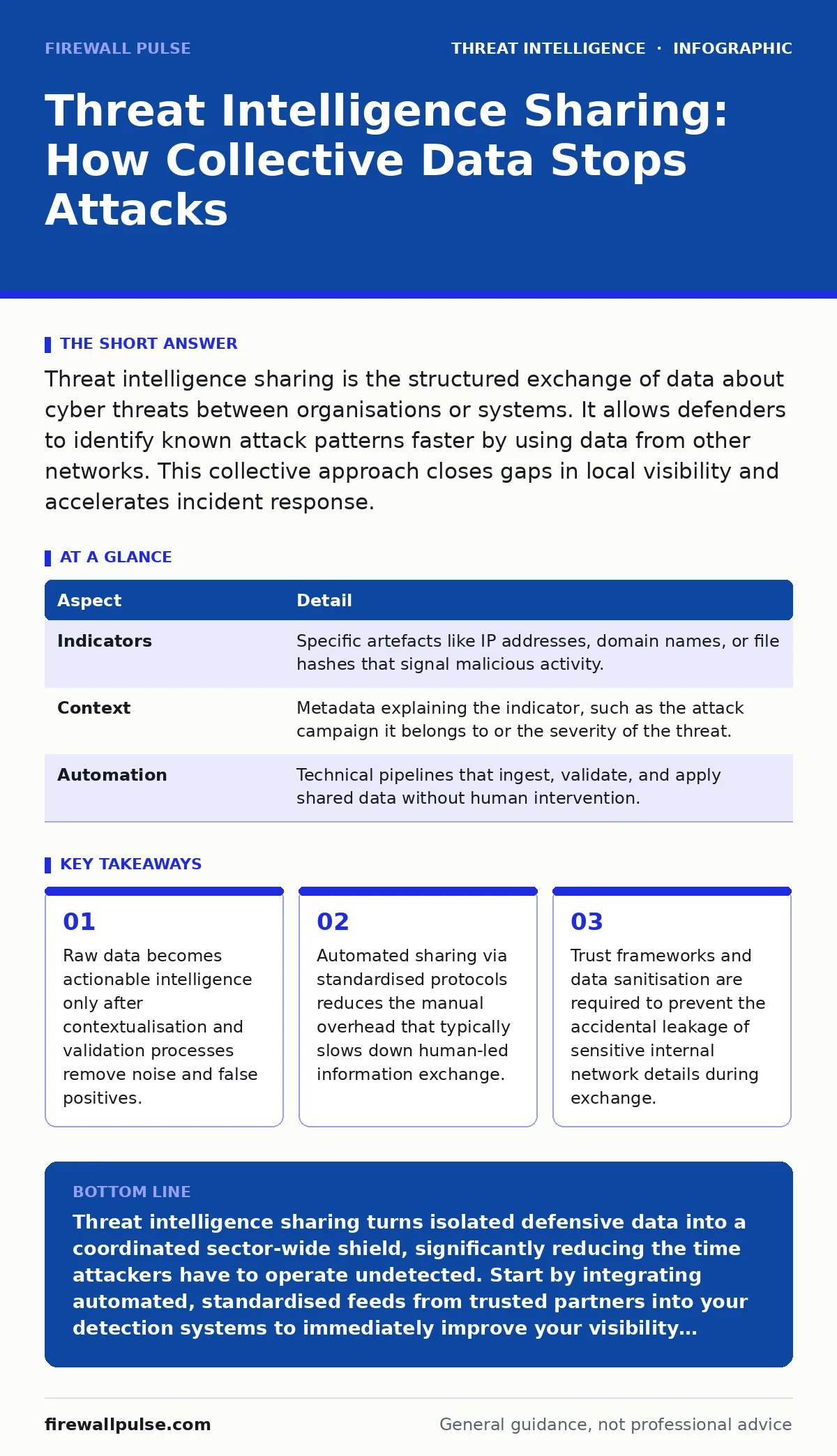
| Aspect | Detail |
|---|---|
| Indicators | Specific artefacts like IP addresses, domain names, or file hashes that signal malicious activity. |
| Context | Metadata explaining the indicator, such as the attack campaign it belongs to or the severity of the threat. |
| Automation | Technical pipelines that ingest, validate, and apply shared data without human intervention. |
Indicators are the raw material. An IP address alone tells you little. Context explains why that IP matters. Automation ensures the data is used before the attacker changes their tactics. Without automation, the volume of shared data overwhelms human analysts, leading to alert fatigue.
Standardised Protocols Matter
You cannot share intelligence effectively if every organisation uses a different language. Standardised formats allow systems to understand each other. The most common standard is STIX, which defines a common vocabulary for cyber threat intelligence. It allows you to describe threats in a way that any compliant system can read.
TAXII is the transport mechanism that moves STIX data between systems. It acts as the pipeline. Together, they enable threat intelligence platforms to exchange data automatically. This removes the friction of manual copy-pasting and reduces the risk of human error in data entry.
Without these standards, sharing remains a manual, slow, and error-prone process. It becomes a burden rather than a benefit.
Where It Fits in Defence
Threat intelligence sharing does not replace your existing controls. It enhances them. It feeds into your network detection and response systems, providing the signatures and patterns they need to identify anomalies.
It also informs your understanding of the Unified Kill Chain. By sharing data on early-stage activities, such as attacker reconnaissance, you can detect preparation phases before the attacker executes the strike. This pushes your detection point further back in the attack timeline.
However, it does not stop attacker persistence techniques on its own. Once an attacker is inside, shared intelligence helps you identify their tools, but you still need internal visibility to find them. Sharing is a force multiplier for detection, not a substitute for internal hygiene.
See also: Threat Intelligence Platforms: 8 Practices for Actionable Data · Implement Mean Time to Detect: A Step-by-Step Rollout Plan
The Hidden Costs of Sharing
Sharing is not free. The primary cost is not monetary, but operational. You must manage the risk of leaking sensitive information. If you share raw network logs, you might expose your own internal IP ranges or employee data.
This requires sanitisation. You must strip out identifying information before sharing. This process adds complexity. It also requires trust. You need to know that the recipients will not misuse the data or leak it to adversaries.
There is also the risk of false positives. If a partner shares incorrect data, your systems might block legitimate traffic. This causes operational disruption. You need validation mechanisms to verify data before applying it. Blindly trusting shared intelligence is a recipe for outages.
What People Usually Get Wrong
Many organisations believe that sharing is simply about exchanging IP addresses. This is a narrow view. IP addresses are ephemeral. Attackers change them frequently. Sharing infrastructure data alone has a short shelf life.
The real value lies in sharing tactics, techniques, and procedures. Knowing how an attacker moves laterally is more valuable than knowing which server they used. This behavioural data remains relevant even when the attacker changes their infrastructure.
Another mistake is assuming that more data is better. Volume without context creates noise. It drowns out real threats. You need to curate the data you share and receive. Quality outweighs quantity in threat intelligence.
Building a Sustainable Practice
Start small. Identify one or two trusted partners with whom you can share low-risk indicators. Test the process. Ensure your systems can ingest and apply the data automatically.
Gradually expand the scope. Move from sharing indicators to sharing context. Then move to sharing behavioural patterns. This gradual approach allows you to build trust and refine your processes.
Integrate this practice with your broader security operations. Use the shared data to improve your mean time to detect metrics. Track how much faster you identify threats after implementing sharing. This data justifies the investment and highlights the value.
Remember, sharing is a two-way street. You must contribute to be a member of the community. If you only take, you will lose access. Contribute what you can, even if it is small. The collective strength depends on everyone participating.
Key takeaways
- Raw data becomes actionable intelligence only after contextualisation and validation processes remove noise and false positives.
- Automated sharing via standardised protocols reduces the manual overhead that typically slows down human-led information exchange.
- Trust frameworks and data sanitisation are required to prevent the accidental leakage of sensitive internal network details during exchange.
Threat intelligence sharing turns isolated defensive data into a coordinated sector-wide shield, significantly reducing the time attackers have to operate undetected. Start by integrating automated, standardised feeds from trusted partners into your detection systems to immediately improve your visibility against known threats.
Frequently asked questions
Is threat intelligence sharing legal?
Yes, provided you comply with local data protection laws and sanitise any personally identifiable information before sharing. Always review your legal obligations regarding data privacy.
Can I share intelligence with competitors?
Yes, through trusted information sharing and analysis centres that act as intermediaries. These centres anonymise data so competitors do not know who contributed specific intelligence.
How do I prevent false positives from shared data?
Implement a validation layer that checks incoming intelligence against your own network data. Only apply indicators that match known malicious patterns or have high confidence scores from trusted sources.
Does sharing work against advanced persistent threats?
It helps, but advanced threats often use custom tools and slow-moving techniques. Sharing behavioural data and tactics is more effective than sharing simple indicators like IP addresses for these groups.
How this guide was produced: written by the Firewall Pulse editorial team with AI assistance, checked against the public references listed below, and reviewed when the facts change. See our editorial policy or report an error.