Vulnerability Disclosure Policy Reward: How Bug Bounties Actually Work
Reward structures in vulnerability disclosure policies often penalise high-impact findings by capping payouts, forcing researchers to choose between safety and income.

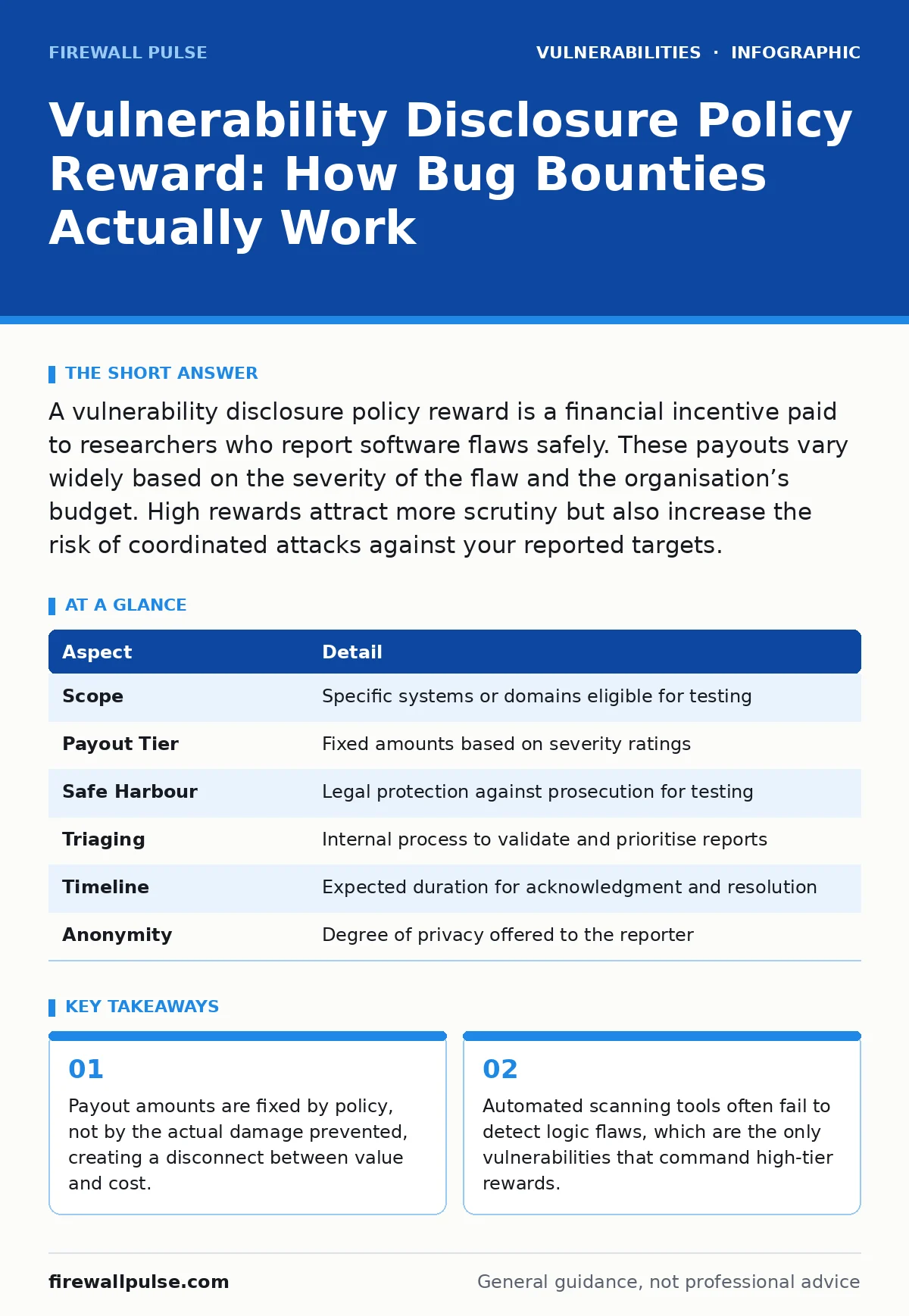
A vulnerability disclosure policy reward is a financial incentive paid to researchers who report software flaws safely. These payouts vary widely based on the severity of the flaw and the organisation’s budget. High rewards attract more scrutiny but also increase the risk of coordinated attacks against your reported targets.
The Mechanics of Vulnerability Disclosure Policy Reward
Imagine leaving a note on your neighbour’s door saying, "If you find my back door unlocked, I will pay you." This is the core function of a vulnerability disclosure policy reward. The organisation invites external researchers to test their systems for weaknesses. In return, they offer monetary compensation for valid reports. This arrangement turns potential attackers into paid defenders. The mechanism relies on trust. Researchers must believe the organisation will pay fairly. The organisation must believe the researcher will act ethically. This balance defines the entire programme.
| Aspect | Detail |
|---|---|
| Scope | Specific systems or domains eligible for testing |
| Payout Tier | Fixed amounts based on severity ratings |
| Safe Harbour | Legal protection against prosecution for testing |
| Triaging | Internal process to validate and prioritise reports |
| Timeline | Expected duration for acknowledgment and resolution |
| Anonymity | Degree of privacy offered to the reporter |
The reward structure acts as a market signal. High payouts suggest the organisation values security. Low payouts suggest security is a low priority. Researchers allocate their time accordingly. They target high-reward programmes because the return on investment is clearer. This creates a concentration of effort on specific vendors. It leaves other organisations with less scrutiny. The market dynamics of bug bounties are driven entirely by these financial incentives.
How Payout Tiers Determine Behaviour
Payout tiers are usually based on a severity score. Many programmes use the CVSS score to standardise these ratings. A critical flaw receives the highest payment. A low-severity issue receives little or nothing. This system has a hidden cost. Researchers ignore low-severity issues because they are not worth the effort. Consequently, minor flaws accumulate. These minor flaws can be chained together to create a critical breach. The reward structure inadvertently encourages neglect of small problems. You must define your tiers carefully to avoid this gap.
This scenario highlights a flaw in standard payout models. The financial incentive must exceed the researcher’s hourly rate for even minor issues. Otherwise, the blind spots grow. Some organisations offer non-monetary rewards for low-tier findings. Swag or public recognition can motivate some reporters. However, monetary rewards are the primary driver for professional researchers. You cannot rely on altruism for consistent coverage.
Who Actually Benefits From Rewards
The primary beneficiary is the organisation that publishes the policy. They gain access to a global workforce of testers. They discover flaws before malicious actors do. The secondary beneficiary is the researcher. They earn income for their skills. The tertiary beneficiary is the end user. They receive safer software. However, this model has edge cases. Large organisations with deep pockets attract more researchers. Small organisations struggle to compete. They may have fewer vulnerabilities because they have fewer features. But they also have less scrutiny. This creates an uneven security landscape.
Researchers also benefit from the learning process. Testing complex systems improves their skills. They gain reputation within the community. High-profile discoveries can lead to job offers. The reward is not just money. It is career capital. Organisations must recognise this. Offering public recognition alongside payment can boost participation. It also builds brand loyalty among researchers. This loyalty means they may test your systems even when the payout is low. Trust is a valuable currency in this ecosystem.
Common Misconceptions About Bug Bounties
Many organisations believe that a bug bounty replaces traditional security measures. This is incorrect. Bug bounties supplement existing controls. They do not replace vulnerability scanning or configuration hardening. Automated tools find common, known flaws efficiently. Human researchers find complex, logic-based flaws. The two methods are complementary. Relying solely on bounties leaves you exposed to automated attacks. Relying solely on scanning leaves you exposed to creative attacks. You need both approaches working in tandem.
Another misconception is that all reported vulnerabilities are valid. Researchers may submit false positives. They may misunderstand the scope. They may report features that are not flaws. The triage team must verify every report. This process is labour-intensive. It requires skilled security engineers. If you do not have the staff to triage, do not launch a programme. Untriaged reports waste time. They frustrate researchers. They damage your reputation. A slow response time is worse than no programme at all.
Some teams believe that paying researchers attracts more attacks. This is true, but misleading. You are attracting attention, not necessarily more damage. The alternative is hiding vulnerabilities. Hidden vulnerabilities remain until an attacker finds them. Then they are exploited publicly. Paying for disclosure brings the problem into the light. It allows you to fix it before exploitation. The visibility is a feature, not a bug.
Integrating With Existing Security Workflows
The vulnerability disclosure programme must integrate with your incident response. When a researcher reports a flaw, it triggers a workflow. The triage team validates it. The development team fixes it. The communication team updates the researcher. This chain must be smooth. Delays in any step reduce the programme’s effectiveness. Researchers expect timely updates. Silence causes frustration. Frustration leads to public disclosure. Public disclosure damages your reputation. You must treat researcher reports with the same urgency as internal findings.
Consider how this relates to n-day vulnerabilities. These are flaws for which patches are already available. Researchers may report these if your system is unpatched. This is a valid finding. It indicates a failure in your patch management process. You should accept these reports. They highlight operational gaps. Do not dismiss them as irrelevant. They point to weaknesses in your maintenance routines. Fixing them improves your overall posture.
What To Do About Reward Structures
Define your scope clearly. List every system and domain eligible for testing. Exclude internal networks. Exclude third-party services. Ambiguity leads to scope creep. It also leads to legal disputes. Be specific about what is in and what is out. Publish this list prominently. Update it regularly as your infrastructure changes. Researchers check the scope before testing. If your scope is unclear, they will skip you. Clarity attracts serious researchers.
Set realistic payout amounts. Research market rates for similar organisations. Do not underpay. It signals disrespect. Do not overpay. It wastes budget. Find a balance that reflects the severity of the flaw and your financial capacity. Consider offering bonuses for exceptional findings. This encourages deep research. It also rewards creativity. Fixed tiers provide predictability. Bonuses provide flexibility. Use both to manage costs and incentives.
Ensure your triage process is efficient. Use tools to automate initial checks. Dedicate staff to validate reports. Set service level agreements for response times. Acknowledge receipt within 24 hours. Provide a preliminary assessment within 3 days. Communicate progress regularly. Transparency builds trust. Trust builds a sustainable programme. A well-run programme becomes a competitive advantage. It demonstrates your commitment to security.
Addressing Specific Threat Vectors
While broad policies cover many issues, specific threats require specific attention. For instance, IoT device vulnerabilities often involve physical access or hardware flaws. Standard web policies may not cover these. You must define hardware testing rules carefully. Similarly, file upload vulnerabilities are common in web applications. They allow attackers to upload malicious scripts. Your policy should explicitly state whether file upload functionality is in scope. It should also define safe testing methods. Do not let researchers crash your servers during testing.
Dependency confusion attacks exploit package managers. They are not traditional code flaws. They are supply chain issues. Your policy should clarify if external dependency testing is allowed. If not, state it clearly. If yes, define the boundaries. PHP object injection is another specific flaw. It occurs when unserialised data is processed. Researchers should test for this if PHP is in your stack. Define the testing methods. Prevent damage to production databases. Provide a testing environment if possible. This reduces risk for both parties.
Key takeaways
- Payout amounts are fixed by policy, not by the actual damage prevented, creating a disconnect between value and cost.
- Automated scanning tools often fail to detect logic flaws, which are the only vulnerabilities that command high-tier rewards.
Frequently asked questions
Does a vulnerability disclosure policy reward guarantee that my software is secure?
No, a policy only incentivises the discovery of flaws by ethical researchers. It does not prevent malicious attacks or fix flaws that researchers do not find. Security requires multiple layers of defence.
How much should I pay for a critical vulnerability report?
Payouts vary by organisation size and industry, but critical findings often command the highest rewards. Research competitors in your sector to determine a competitive rate. The amount must reflect the severity and the effort required to find the flaw.
Can I sue a researcher if they accidentally break my system?
Most policies include a safe harbour clause that waives legal action for good-faith testing. However, researchers must adhere strictly to the defined scope and rules. Intentional damage or testing out of scope voids this protection.
Do I need a bug bounty if I already use vulnerability scanning?
Scanners find known, common flaws efficiently. Bug bounties find complex, logic-based flaws that scanners miss. They are complementary. Using both provides broader coverage than either method alone.
How this guide was produced: written by the Firewall Pulse editorial team with AI assistance, checked against the public references listed below, and reviewed when the facts change. See our editorial policy or report an error.