Payment Verification Procedures: Definition, Purpose and Core Mechanics
Payment verification acts as a friction layer that validates transaction intent before funds move, stopping automated fraud while preserving legitimate commerce flow.

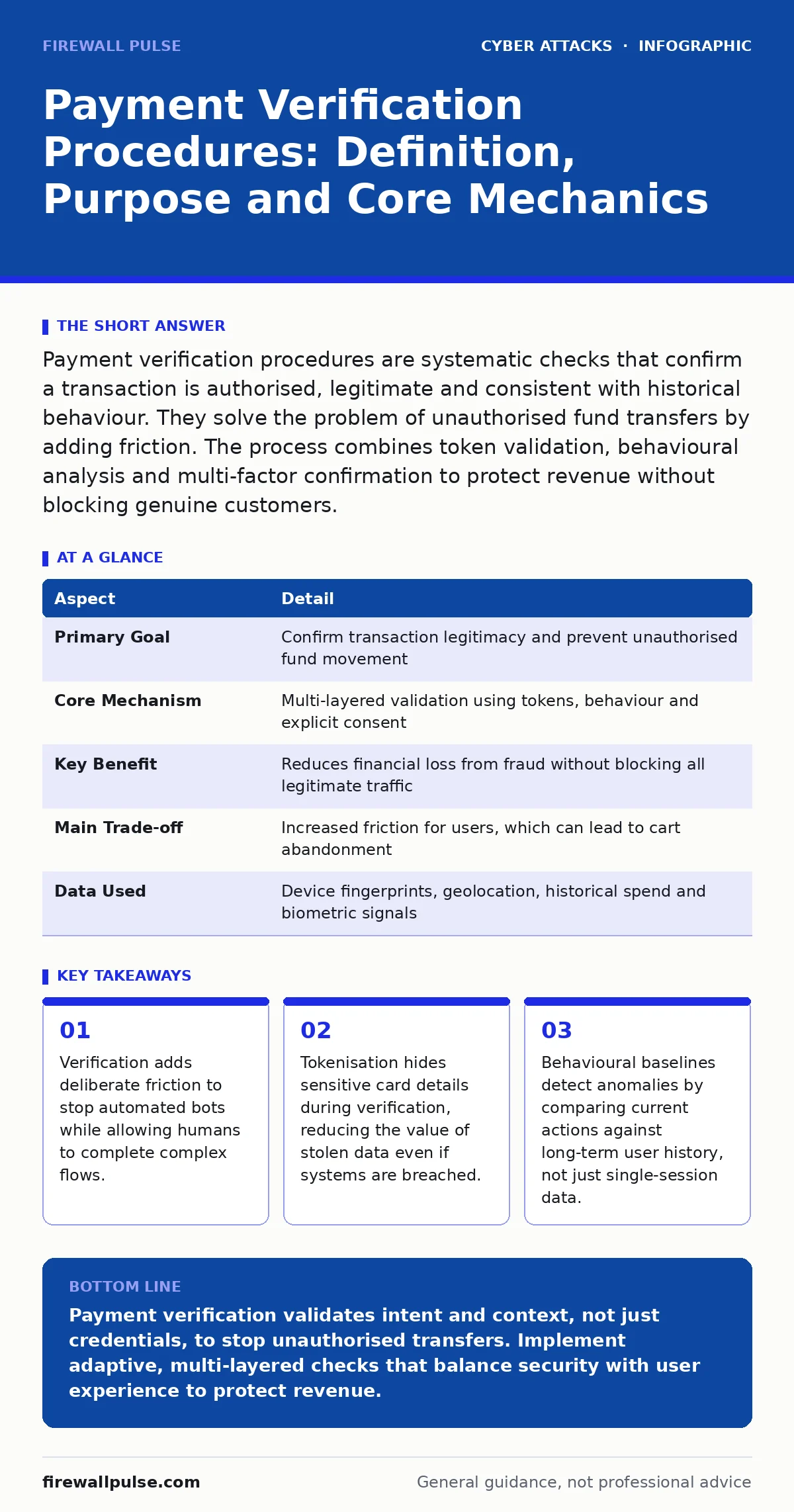
Payment verification procedures are systematic checks that confirm a transaction is authorised, legitimate and consistent with historical behaviour. They solve the problem of unauthorised fund transfers by adding friction. The process combines token validation, behavioural analysis and multi-factor confirmation to protect revenue without blocking genuine customers.
The Analogy of the Secure Gate
Imagine a high-security building where entry requires more than just a key. You present your badge, the guard checks your photo against your face, and they notice you are carrying a large package that is unusual for your role. The guard does not stop you immediately. They pause the process, ask for a brief explanation and verify your identity with a secondary code. This pause is the core of payment verification. It is not about blocking entry. It is about confirming that the person holding the key is who they claim to be and that their actions match their expected behaviour.
What Payment Verification Actually Is
Payment verification procedures are the technical and logical steps that validate a financial transaction before settlement occurs. The purpose is to ensure that the party requesting the transfer has the authority to do so and that the request is not the result of theft or coercion. This differs from simple authentication. Authentication proves who you are at a single point in time. Verification extends that proof across the entire transaction lifecycle. It checks whether the context of the purchase makes sense. It asks whether the amount, the merchant and the timing align with the account holder's established patterns.
| Aspect | Detail |
|---|---|
| Primary Goal | Confirm transaction legitimacy and prevent unauthorised fund movement |
| Core Mechanism | Multi-layered validation using tokens, behaviour and explicit consent |
| Key Benefit | Reduces financial loss from fraud without blocking all legitimate traffic |
| Main Trade-off | Increased friction for users, which can lead to cart abandonment |
| Data Used | Device fingerprints, geolocation, historical spend and biometric signals |
The Problem It Solves
The fundamental problem in digital commerce is the lack of physical presence. In a brick-and-mortar store, you hand over your card and your presence confirms intent. Online, a stolen card number is just data. Fraudsters can inject this data into payment forms without the owner's knowledge. Payment verification solves this by creating a digital equivalent of physical presence.
It forces the fraudster to replicate not just the card details but also the behavioural context. This is difficult for automated scripts. It is also difficult for humans who do not know the victim's habits. The procedure shifts the burden of proof from the merchant to the payer, ensuring that the payer actively confirms the action.
The Main Components of Verification
A robust verification system relies on three distinct layers. First, there is tokenisation. This process replaces sensitive card data with a unique, random string of characters. The merchant never sees the actual card number. Even if their database is breached, the stolen tokens are useless for other transactions. Second, there is behavioural analysis. The system tracks how you interact with the interface.
It measures typing speed, mouse movements and session duration. These signals create a baseline of normal activity. Third, there is step-up authentication. If the first two layers show anomalies, the system triggers a stronger check. This might involve a one-time code sent to a registered device or a biometric scan. This layer ensures that even if credentials are stolen, the attacker cannot complete the transaction without physical access to the user's device.
Where Verification Fits in Defence
Payment verification does not operate in isolation. It is a critical component of a broader security strategy. It sits between the initial access controls and the final settlement. If access controls fail, verification acts as a safety net. It complements measures like attack surface reduction by ensuring that exposed endpoints cannot be easily exploited for financial gain.
It also mitigates risks from social engineering. Even if a user is tricked by vishing or falls for a sophisticated phishing kit, the verification step can catch the anomaly. The fraudster may have the password, but they lack the behavioural context or the second factor. This layering ensures that a single point of failure does not lead to total compromise.
Common Misconceptions About Verification
Many organisations believe that verification is purely about blocking fraud. This is incorrect. Verification is also about maintaining trust. If a system is too aggressive, it blocks legitimate customers. This leads to revenue loss and brand damage. The goal is a balance. Another common mistake is assuming that verification happens only at checkout. In reality, verification should be continuous. It should monitor account changes, address updates and shipping modifications. Fraudsters often change shipping details to intercept goods. Static verification at the point of sale misses these mid-transaction changes. Dynamic verification tracks the entire lifecycle.
The Hidden Costs of Friction
Every verification step adds time to the user journey. This friction has a cost. Users abandon carts when asked to provide too much information. The challenge for security teams is to design invisible verification. This means using passive signals like device reputation and IP analysis in the background. Only when risk thresholds are crossed should active verification be triggered. This approach minimises disruption for trusted users while maximising scrutiny for suspicious activity. It requires careful tuning. Too little friction invites fraud. Too much friction kills sales. The optimal point shifts constantly as fraud tactics evolve.
Integration with Related Threats
Payment verification is particularly effective against specific attack vectors. It directly counters payroll diversion fraud by requiring explicit confirmation for any change in bank details. An attacker who compromises an employee's email cannot redirect funds without triggering a verification step that the employee must approve. It also mitigates the impact of malicious email attachments.
If malware steals credentials, the verification layer ensures that those credentials alone are insufficient for financial gain. Similarly, in the context of supply chain attacks, where a vendor's system is compromised to insert fraudulent invoices, verification checks can flag discrepancies in payment details or vendor accounts. By validating the integrity of the payment instruction, organisations can stop financial theft even when other defences are breached.
Key takeaways
- Verification adds deliberate friction to stop automated bots while allowing humans to complete complex flows.
- Tokenisation hides sensitive card details during verification, reducing the value of stolen data even if systems are breached.
- Behavioural baselines detect anomalies by comparing current actions against long-term user history, not just single-session data.
Payment verification validates intent and context, not just credentials, to stop unauthorised transfers. Implement adaptive, multi-layered checks that balance security with user experience to protect revenue.
Frequently asked questions
Does payment verification slow down legitimate transactions?
Passive verification methods run in the background and do not slow down transactions. Only high-risk transactions trigger active checks, which add a few seconds to the process.
Can payment verification stop all types of fraud?
No. It cannot stop fraud where the user willingly authorises the transaction, such as in social engineering cases where the victim is coerced into confirming the payment themselves.
How does verification differ from authentication?
Authentication confirms identity at a single point. Verification confirms the legitimacy of a specific action over time, using context and behaviour in addition to identity.
Is tokenisation part of payment verification?
Yes. Tokenisation is a foundational part of verification. It ensures that sensitive data is not exposed during the verification process, reducing the risk of data theft.
How this guide was produced: written by the Firewall Pulse editorial team with AI assistance, checked against the public references listed below, and reviewed when the facts change. See our editorial policy or report an error.