Man-in-the-Middle Attack Prevention Checklist for Secure Connections
Encrypting data at rest does not protect it while moving across networks, leaving sensitive information exposed to interception during transit.

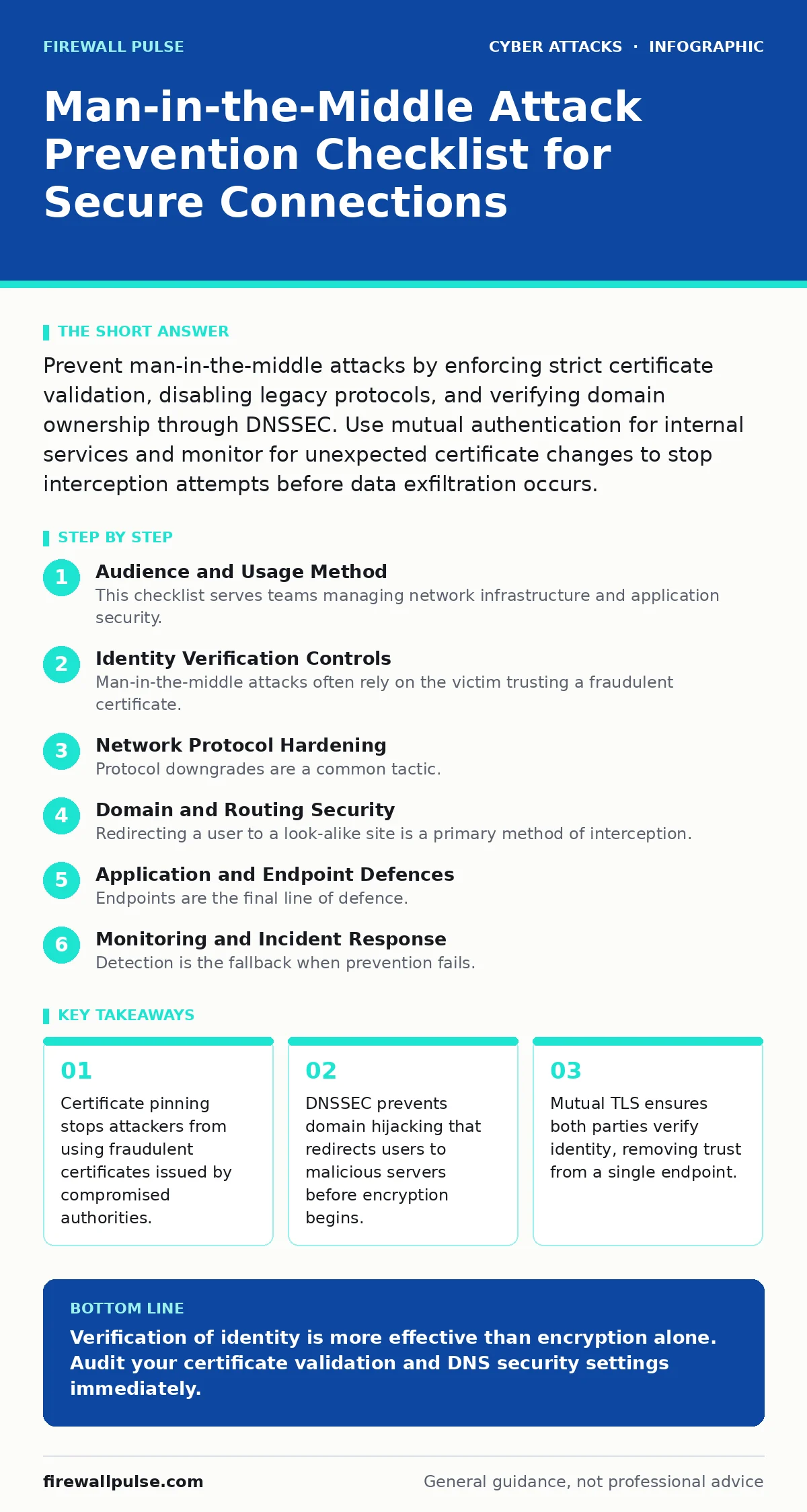
Prevent man-in-the-middle attacks by enforcing strict certificate validation, disabling legacy protocols, and verifying domain ownership through DNSSEC. Use mutual authentication for internal services and monitor for unexpected certificate changes to stop interception attempts before data exfiltration occurs.
Audience and Usage Method
This checklist serves teams managing network infrastructure and application security. Use it to audit current configurations against interception risks. Each item addresses a specific vector where an attacker could insert themselves between two communicating parties. Check off items as you verify controls. The goal is to reduce the surface area available for traffic manipulation.
Identity Verification Controls
- Enforce strict certificate validation: Browsers and clients must reject self-signed or mismatched certificates to prevent acceptance of forged endpoints.
- Implement certificate pinning for critical apps: This binds the application to specific certificates or public keys, ignoring all other certificates even if signed by trusted authorities.
- Rotate TLS certificates regularly: Short-lived certificates limit the window of opportunity for an attacker who has obtained a private key.
- Disable legacy SSL versions: Older protocols contain known vulnerabilities that allow attackers to downgrade connections and read unencrypted data.
Man-in-the-middle attacks often rely on the victim trusting a fraudulent certificate. Standard trust stores are large and occasionally compromised. Pinning adds a layer of trust that does not depend on the broader certificate authority ecosystem. This is particularly useful for mobile applications and internal tools that communicate with specific backend services.
Network Protocol Hardening
- Enforce HTTPS-only headers: Servers must redirect all HTTP traffic to HTTPS, preventing attackers from intercepting initial unencrypted requests.
- Disable weak cipher suites: Remove support for outdated encryption algorithms that computational power can break within hours.
- Use HTTP Strict Transport Security: This header instructs browsers to only connect via HTTPS for a specified duration, blocking downgrade attacks.
- Implement mutual TLS for internal services: Both client and server present certificates, ensuring that only authorised systems can communicate.
Protocol downgrades are a common tactic. An attacker forces a connection to use a weaker encryption standard that they can decrypt. By removing support for these weak standards entirely, you remove the option for the attacker. Mutual TLS is often overlooked in internal networks where trust is assumed. It provides concrete evidence of identity rather than relying on IP addresses, which can be spoofed.
Domain and Routing Security
- Deploy DNSSEC on public domains: This cryptographically signs DNS records, preventing attackers from redirecting users to malicious IP addresses.
- Monitor for DNS zone transfers: Restrict access to zone data to prevent attackers from mapping your infrastructure for targeted redirection.
- Use certificate transparency logs: Monitor public logs for unexpected certificate issuance related to your domains, indicating potential compromise.
- Validate API endpoints dynamically: Ensure applications verify the origin of requests at runtime, not just at deployment.
Redirecting a user to a look-alike site is a primary method of interception. DNSSEC ensures that the IP address returned for a domain is authentic. Without it, an attacker on the network path can alter DNS responses. This is distinct from clone phishing where the user is tricked into clicking a link. Here the link itself leads to the wrong server due to manipulated routing.
Application and Endpoint Defences
- Disable Java applets and ActiveX controls: These legacy components often bypass security checks and allow arbitrary code execution.
- Enforce code signing for all updates: Ensure that only software signed with your organisation's private key is installed, preventing malicious updates.
- Use sandboxing for untrusted content: Isolate processes that handle external data to limit the impact of any successful interception or injection.
- Audit third-party dependencies: Regularly check libraries and frameworks for known vulnerabilities that could be exploited during transit.
Endpoints are the final line of defence. Even if network controls fail, a hardened endpoint may resist exploitation. Code signing ensures that the software you run is what you expect. This relates closely to malicious email attachments where the payload is delivered via a different vector but requires execution. Preventing execution of unsigned code reduces the risk of man-in-the-middle injected scripts.
Monitoring and Incident Response
- Log all TLS handshake failures: Sudden increases in handshake failures may indicate an active interception attempt or misconfiguration.
- Alert on certificate changes in transit: Detect when a server presents a different certificate than expected, signalling a potential swap.
- Monitor for SSL stripping attempts: Identify tools or scripts attempting to downgrade connections from HTTPS to HTTP on the network.
- Review proxy configurations regularly: Ensure that transparent proxies do not inadvertently strip encryption or fail to validate certificates.
Detection is the fallback when prevention fails. Man-in-the-middle attacks are often silent. You may not notice until data is exfiltrated. Monitoring for anomalies in certificate usage provides early warning. This complements attack surface reduction strategies by focusing on the dynamic behaviour of connections rather than just static configuration.
Integrating with Broader Security
Preventing interception requires more than network controls. You must consider how users interact with services. OAuth consent phishing exploits trust in authentication flows, often bypassing network-level protections. Ensure that consent screens are verified and that tokens are transmitted securely. Similarly, brute force attacks can compromise accounts used in man-in-the-middle scenarios. Strong authentication reduces the likelihood of an attacker gaining the credentials needed to impersonate a user or service.
Consider deepfake scams as a social engineering variant. An attacker may use a deepfake to convince a user to disable security warnings, effectively bypassing technical controls. Technical prevention must be paired with user awareness. Payroll diversion fraud often results from successful interception of email communications. Ensuring that financial instructions are verified through out-of-band channels mitigates the impact of intercepted messages.
Key takeaways
- Certificate pinning stops attackers from using fraudulent certificates issued by compromised authorities.
- DNSSEC prevents domain hijacking that redirects users to malicious servers before encryption begins.
- Mutual TLS ensures both parties verify identity, removing trust from a single endpoint.
Verification of identity is more effective than encryption alone. Audit your certificate validation and DNS security settings immediately.
Frequently asked questions
Does using HTTPS prevent man-in-the-middle attacks?
HTTPS encrypts data in transit but does not prevent an attacker from presenting a fraudulent certificate. You must enforce strict certificate validation and pinning to truly mitigate these risks.
Can a VPN stop man-in-the-middle attacks?
A VPN encrypts traffic between the device and the VPN server, protecting against local network interception. It does not protect traffic between the VPN server and the final destination unless end-to-end encryption is also used.
How do I know if my certificates are compromised?
Monitor certificate transparency logs and implement certificate pinning in your applications. These methods alert you to unexpected certificate issuance or usage, indicating potential compromise.
Is mutual TLS difficult to implement?
Mutual TLS requires managing certificates for both clients and servers, which adds operational complexity. However, it provides stronger identity verification than single-sided TLS, reducing the risk of impersonation.
How this guide was produced: written by the Firewall Pulse editorial team with AI assistance, checked against the public references listed below, and reviewed when the facts change. See our editorial policy or report an error.