Chain of Custody in Cybersecurity: Meaning and Practical Definition
Digital evidence loses its legal weight if you cannot prove who touched it, when they touched it, and how the data remained unchanged during every handover.
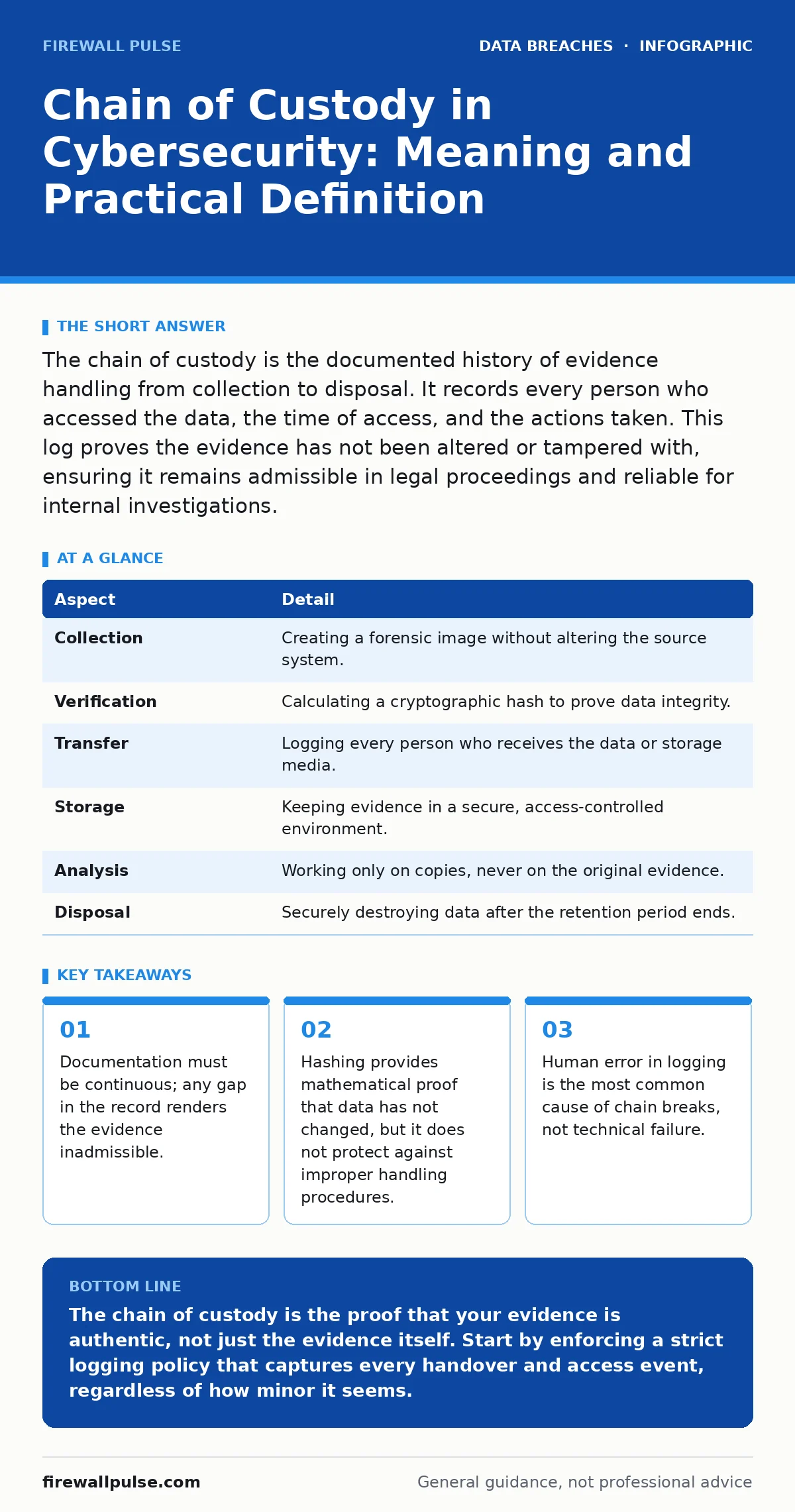
The chain of custody is the documented history of evidence handling from collection to disposal. It records every person who accessed the data, the time of access, and the actions taken. This log proves the evidence has not been altered or tampered with, ensuring it remains admissible in legal proceedings and reliable for internal investigations.
The Postman Analogy
Imagine sending a sealed letter to a court. The postmark proves when it was sent. The signature on the receipt proves who delivered it. If the envelope is torn, the recipient can argue someone read or altered the contents during transit. The chain of custody is the digital equivalent of that sealed envelope, the postmark, and the delivery receipt combined. It is not just about keeping data safe. It is about proving that the data you present is identical to the data you originally collected.
In physical security, you might use tamper-evident seals on a bag. In digital forensics, you cannot rely on physical seals. You must rely on cryptographic hashes and detailed logs. If you cannot account for every minute the evidence was in your possession, the chain is broken. A broken chain means the evidence is worthless in a dispute, regardless of what the data actually shows.
Where the Term Comes From
The concept originates from physical evidence handling in law enforcement. Police officers have long used evidence tags to track items like weapons or clothing found at a crime scene. Each tag records the item, the collector, the time, and the next person to receive it. This practice ensures that a defence attorney cannot claim the evidence was planted or contaminated.
Cybersecurity adopted this model because digital data is fragile. Unlike a physical gun, a file can be copied, modified, or deleted without leaving a physical trace. The "custody" in digital contexts refers to control over the bits, not just the storage medium. When you move data from a server to a forensic drive, you are transferring custody. That transfer must be recorded with the same rigour as handing over a physical weapon.
How It Works Day to Day
Day-to-day operations require a strict protocol for every interaction with evidence. The process begins the moment you decide to collect data. You must create a forensic image, which is an exact bit-for-bit copy of the source drive. You then calculate a hash value, such as SHA-256, for that image. This hash acts as a digital fingerprint.
| Aspect | Detail |
|---|---|
| Collection | Creating a forensic image without altering the source system. |
| Verification | Calculating a cryptographic hash to prove data integrity. |
| Transfer | Logging every person who receives the data or storage media. |
| Storage | Keeping evidence in a secure, access-controlled environment. |
| Analysis | Working only on copies, never on the original evidence. |
| Disposal | Securely destroying data after the retention period ends. |
Every time the evidence changes hands, you update the log. This includes moving a drive from a safe to a workbench. It includes connecting a drive to a write-blocker. It includes exporting a report. If you forget to log a step, you cannot prove the data remained unchanged during that interval. The log must be contemporaneous, meaning you write it down as you act, not after the fact.
The Hidden Cost of Hashing
Many teams believe that calculating a hash is sufficient to maintain integrity. This is a dangerous misconception. A hash proves the data has not changed, but it does not prove the data was handled correctly. Suppose you calculate a hash correctly, but then you leave the forensic drive on an unsecured desk overnight. The data is unchanged, so the hash matches. However, the chain of custody is broken because you cannot prove who accessed the desk.
This distinction matters in legal challenges. An adversary will not argue the data is wrong. They will argue you had the opportunity to alter it. Without a log showing continuous, controlled access, you cannot refute that claim. The hash is the lock on the door; the chain of custody is the log of who entered the room. You need both.
Common Mistakes in Practice
The most frequent error is treating the chain of custody as an administrative afterthought. Teams often focus on the technical tools, buying expensive forensic software, while neglecting the human process. They assume the software’s internal logs are sufficient. They are not. Software logs can be corrupted, deleted, or misconfigured. The chain of custody must be maintained in a separate, immutable record.
Another mistake is failing to account for cloud environments. In a traditional data centre, you physically hold the drive. In the cloud, you do not. You rely on the provider’s access logs. If you cannot pull a complete, tamper-proof audit trail from your cloud provider, your chain of custody is inherently weaker. You must integrate provider logs into your own custody record immediately upon collection.
This scenario highlights the need for strict policy. No one accesses evidence without logging it. No one works on original files. These are not suggestions; they are requirements for admissibility. Refer to our guide on role-based access control to understand how to restrict who can even attempt to access these logs.
See also: Stop Unauthorized Access: Practical Controls That Actually Work · Leaked Source Code: How to Contain and Neutralise the Threat
What People Get Wrong
People often confuse data privacy with chain of custody. Privacy is about keeping data secret. Custody is about proving data is authentic. You can have highly encrypted data with a broken chain of custody. You can also have unencrypted data with a perfect chain. The two concepts serve different purposes. Do not let strong encryption give you a false sense of security regarding procedural compliance.
Another misconception is that internal investigations do not require strict chains. They do. If you plan to terminate an employee based on digital evidence, that employee can sue for wrongful termination. They will challenge the evidence. If your chain is weak, you lose. The standard for internal HR actions is often lower than criminal court, but it is still high enough to require rigorous documentation.
Ensure your documentation covers the entire lifecycle. From the moment of detection to the final deletion of the data. Refer to our guide on backup strategies to see how retention policies intersect with evidence preservation. Also, consider third-party risk assessments when vendors handle your data, as their custody practices become your responsibility.
Maintaining the Record
The record itself must be secure. Use a dedicated system for logging custody events. This system should not be the same system you are investigating. If the investigation target is a server, do not log custody events on that server. Use a separate, secure logging server or a paper-based form that is later digitised and hashed.
Regular audits are necessary. Check the logs for gaps. Verify that hashes match at each handover. If a hash does not match, stop the investigation. The evidence is compromised. Document the failure and preserve the compromised state for analysis, but do not use it as primary evidence.
Refer to backup testing procedures to ensure your logging system is itself backed up and recoverable. If your custody logs are lost, the evidence is lost. Finally, understand the implications of unauthorized access to your logging system. If an attacker can modify your logs, they can forge a perfect chain of custody for their own malicious data.
Key takeaways
- Documentation must be continuous; any gap in the record renders the evidence inadmissible.
- Hashing provides mathematical proof that data has not changed, but it does not protect against improper handling procedures.
- Human error in logging is the most common cause of chain breaks, not technical failure.
The chain of custody is the proof that your evidence is authentic, not just the evidence itself. Start by enforcing a strict logging policy that captures every handover and access event, regardless of how minor it seems.
Frequently asked questions
Does the chain of custody apply to cloud data?
Yes, but it relies heavily on the cloud provider’s audit logs. You must integrate these logs into your own custody record to maintain a continuous chain.
What happens if I lose the hash value?
You can recalculate the hash if the data is intact. However, you cannot prove the data was unchanged between the original collection and the recalculation. The chain is broken.
Can I use automated tools for logging?
Automated tools help, but they must be configured correctly and their outputs must be preserved in an immutable format. Human oversight is still required to verify the process.
How long should I keep the chain of custody records?
Keep them for as long as the evidence is retained. Once the data is securely destroyed, you can typically destroy the logs, but check local legal requirements for record retention.
How this guide was produced: written by the Firewall Pulse editorial team with AI assistance, checked against the public references listed below, and reviewed when the facts change. See our editorial policy or report an error.