Difference between honeypot and honeytokens: low-cost detection
Honeytokens deploy zero-interaction traps in databases and code to detect breaches without the operational overhead of maintaining virtual systems.

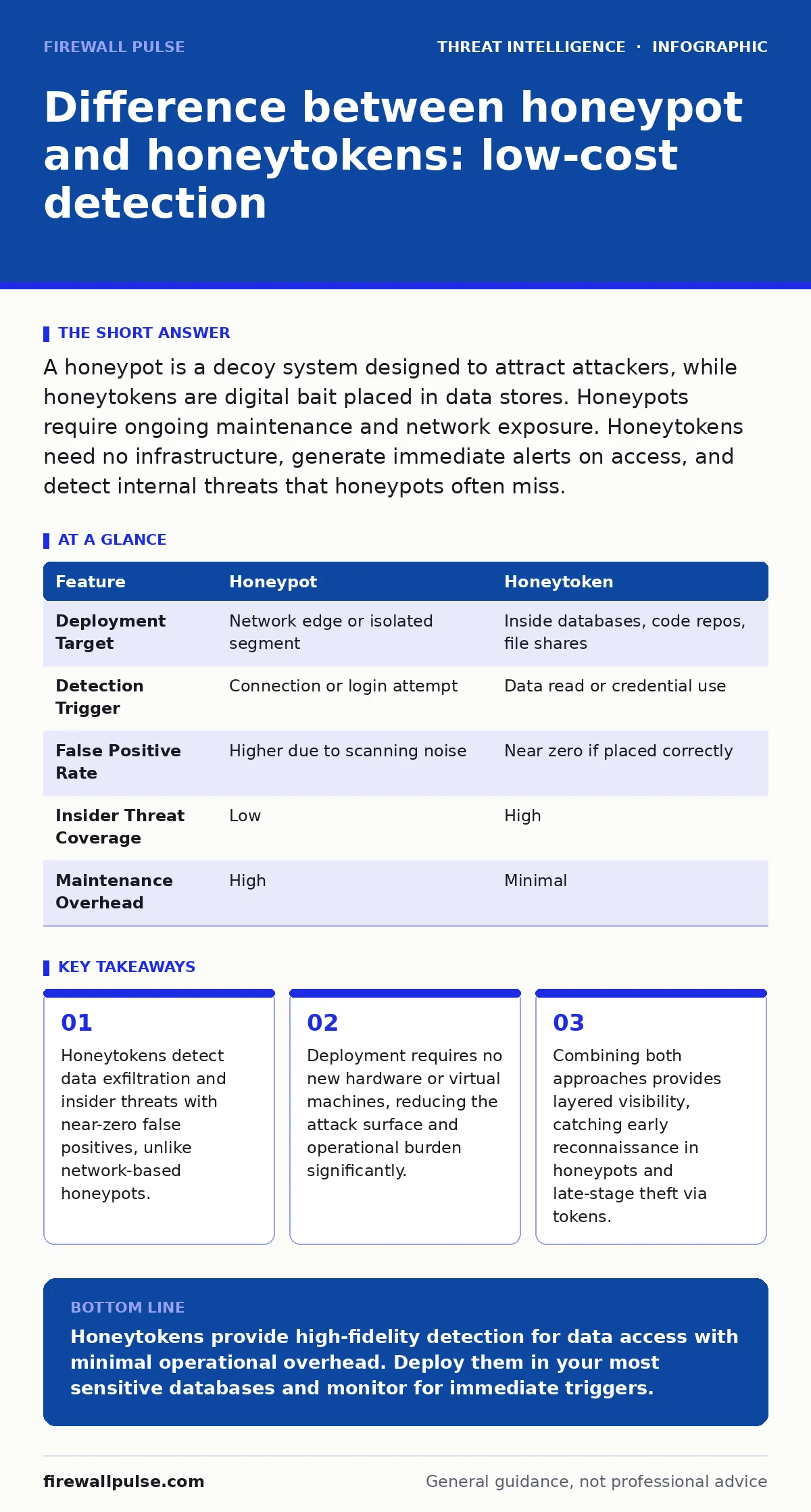
A honeypot is a decoy system designed to attract attackers, while honeytokens are digital bait placed in data stores. Honeypots require ongoing maintenance and network exposure. Honeytokens need no infrastructure, generate immediate alerts on access, and detect internal threats that honeypots often miss.
What is the difference between honeypot and honeytokens?
The difference between honeypot and honeytokens lies in their mechanism and deployment scope. A honeypot is a standalone system or service that mimics a real asset to lure attackers. It relies on interaction; the attacker must connect to the service for detection to occur. A honeytoken is a piece of digital bait, such as a fake database record or credential, embedded within legitimate assets. It relies on access; detection triggers when the token is read or used.
How do honeytokens operate within existing infrastructure?
Honeytokens function by placing deceptive data points inside systems that should never be accessed by normal users. You insert a fake credit card number into a production database or create a dormant user account with specific privileges. When any process or user queries that specific row or authenticates with that account, the system logs the event. This mechanism detects data access rather than network connection. It reveals who has privileged access to sensitive stores.
Why are honeytokens more effective against insider threats?
Insider threats often possess legitimate credentials and move laterally through authorised channels. Network-based honeypots fail here because insiders do not need to connect to decoy systems to steal data. They simply query the real database. Honeytokens sit inside the real data. Accessing them requires the same permissions as accessing legitimate records. This makes them invisible to normal operations but loud to malicious queries. They expose privilege abuse that network monitoring misses.
What are the operational costs of deploying honeytokens?
The operational cost of honeytokens is negligible compared to honeypots. Honeypots require patching, monitoring, and isolation to prevent attackers from using them as pivot points. They consume compute resources and demand constant tuning to mimic real services convincingly. Honeytokens require no compute resources. They are static data points. Once deployed, they generate no traffic and require no maintenance. The only cost is the initial configuration and alert integration.
| Feature | Honeypot | Honeytoken |
|---|---|---|
| Deployment Target | Network edge or isolated segment | Inside databases, code repos, file shares |
| Detection Trigger | Connection or login attempt | Data read or credential use |
| False Positive Rate | Higher due to scanning noise | Near zero if placed correctly |
| Insider Threat Coverage | Low | High |
| Maintenance Overhead | High | Minimal |
Where should you place honeytokens for maximum visibility?
Placement determines the effectiveness of your detection strategy. You must place tokens in locations that attackers target during the post-exploitation phase. Database tables containing sensitive information are prime targets. Insert fake rows with unique identifiers into customer tables. Place decoy credentials in configuration files or environment variables that scripts read. Embed fake API keys in version control repositories. The goal is to mirror the value of the real asset. If the real data is highly valuable, the token must appear equally valuable.
See also: Unified Kill Chain: The 10 Questions You Need Answered · Threat Intelligence Sharing: How Collective Data Stops Attacks
How do honeytokens integrate with detection engineering?
Detection engineering focuses on creating reliable signals from noisy data. Honeytokens provide high-fidelity signals because legitimate processes should never access them. When a token is triggered, it creates a clear indicator of compromise. You can feed these events directly into your security information and event management system. Create correlation rules that link token access to subsequent lateral movement or data exfiltration. This context helps distinguish between accidental script errors and malicious activity.
What are the risks of false positives with honeytokens?
False positives occur when legitimate applications access decoy data. This happens if developers hardcode database queries that return all rows, including the fake ones. It also happens if backup scripts copy entire tables without filtering. To mitigate this, ensure your application logic explicitly excludes honeytoken identifiers. Document the presence of tokens in your data dictionary. Train development teams to treat these records as immutable and inaccessible. Regular audits of query logs help identify accidental access patterns.
Can honeytokens detect advanced persistent threats?
Advanced persistent threats often operate with extreme caution, avoiding noisy activities. They may spend months living off the land, using legitimate tools. Honeytokens detect them when they finally attempt to harvest data. Since APTs often target specific high-value records, a well-placed token in those records will trigger an alert. This extends your mean time to detect by catching the theft itself, not just the initial intrusion. It provides visibility into the final stage of the kill chain.
How do honeytokens complement threat intelligence sharing?
When a honeytoken triggers, the associated metadata reveals the attacker's technique. This data can be sanitised and shared with industry partners. It provides concrete evidence of targeting specific data types. This enriches your threat intelligence platforms with real-world indicators of compromise. It helps organisations anticipate which data assets are under attack. Sharing these insights improves collective defence against common data theft patterns.
Key takeaways
- Honeytokens detect data exfiltration and insider threats with near-zero false positives, unlike network-based honeypots.
- Deployment requires no new hardware or virtual machines, reducing the attack surface and operational burden significantly.
- Combining both approaches provides layered visibility, catching early reconnaissance in honeypots and late-stage theft via tokens.
Honeytokens provide high-fidelity detection for data access with minimal operational overhead. Deploy them in your most sensitive databases and monitor for immediate triggers.
Frequently asked questions
Do honeytokens work against automated scanners?
Automated scanners typically probe network ports and services, not specific database rows. Honeytokens are invisible to network scanners unless the scanner successfully breaches the application layer and queries the data.
Can attackers detect the presence of honeytokens?
Sophisticated attackers may look for anomalies in data distribution. If fake records have unrealistic patterns or missing fields, they might be spotted. Ensure decoy data matches the statistical distribution of real data.
How long do honeytokens last before they become ineffective?
Honeytokens remain effective indefinitely as long as they are not accessed legitimately. Rotating them periodically helps maintain their integrity and prevents accidental inclusion in backups.
Do I need special software to deploy honeytokens?
No, you can implement honeytokens using standard database management tools and scripting. The key is integrating the access logs with your monitoring system, not the deployment tool itself.
How this guide was produced: written by the Firewall Pulse editorial team with AI assistance, checked against the public references listed below, and reviewed when the facts change. See our editorial policy or report an error.