Unified Kill Chain: The 10 Questions You Need Answered
The Unified Kill Chain exposes how traditional models miss the critical window where attackers operate inside trusted network segments before exfiltrating data.

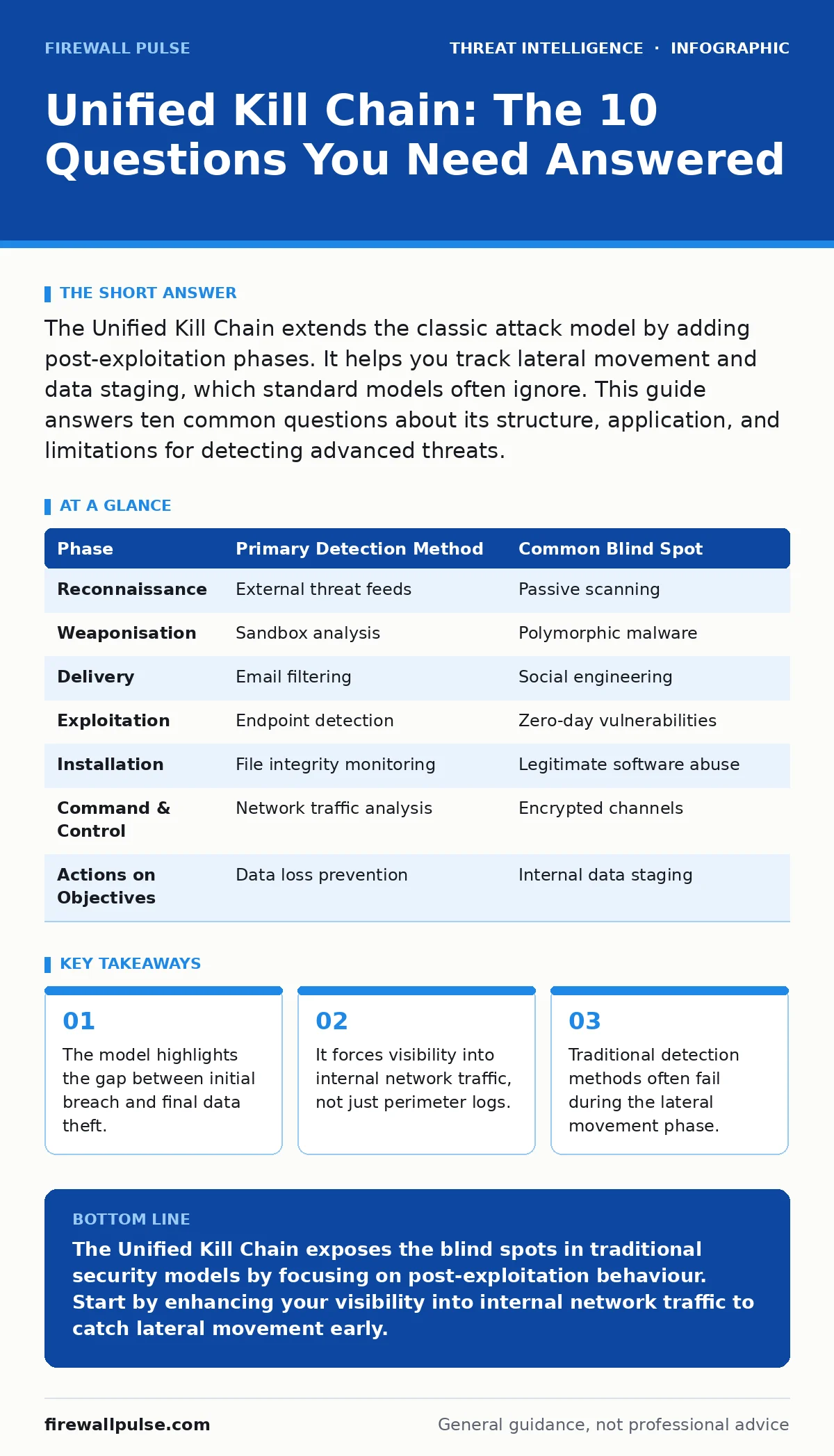
The Unified Kill Chain extends the classic attack model by adding post-exploitation phases. It helps you track lateral movement and data staging, which standard models often ignore. This guide answers ten common questions about its structure, application, and limitations for detecting advanced threats.
What distinguishes the Unified Kill Chain from the classic model?
The Unified Kill Chain adds specific phases for post-exploitation activities that the original seven-stage model treats as a single step. While the classic model ends at actions on objectives, this framework breaks down how an attacker moves laterally and stages data. This distinction matters because most security tools focus heavily on the initial entry and the final exfiltration.
Why does the lateral movement phase receive special attention?
Lateral movement is where most advanced threats evade detection for extended periods. Attackers use this phase to reach high-value targets that are not directly exposed to the internet. If you only monitor perimeter traffic, you will miss the internal pivots that lead to critical asset compromise. This is why internal network visibility becomes a primary requirement for this model.
How does the model handle living-off-the-land attacks?
Living-off-the-land attacks use legitimate system tools to perform malicious actions, making them hard to distinguish from normal activity. The Unified Kill Chain helps by focusing on the behaviour sequence rather than just the tool signature. You look for unusual combinations of standard commands that indicate an attacker is trying to map the environment. See our guide on living-off-the-land attacks for deeper technical examples of this behaviour.
Can this framework improve mean time to detect?
Yes, by providing more granular stages, you can set alerts for earlier indicators of compromise. Instead of waiting for data exfiltration, you can trigger investigations when suspicious lateral movement begins. This reduces the window of opportunity for the attacker to achieve their goals. Understanding how to measure this is key, as discussed in our overview of mean time to detect.
What is the role of threat intelligence platforms in this context?
Threat intelligence platforms provide the context needed to link disparate events across the kill chain stages. They help correlate an initial phishing attempt with subsequent internal scanning activity. Without this correlation, each event looks like an isolated incident rather than a coordinated campaign. Integrating these feeds ensures you are looking at the full picture, not just fragments.
See also: Prevent Living-of-the-Land Attacks: Stop Native Tool Abuse · Tenant isolation: why shared infrastructure needs strict boundaries
Does the model apply to insider threats?
The model applies partially, but it requires adaptation for insider scenarios. Insiders often skip the initial reconnaissance and weaponisation phases because they already have access. You must adjust your detection logic to focus on abnormal access patterns rather than external entry points. This shift in perspective is vital for covering gaps in traditional perimeter-based security.
How do SOC playbooks change when using this framework?
SOC playbooks must include specific procedures for investigating lateral movement and data staging. You cannot rely solely on automated blocking, as many of these actions use legitimate protocols. Analysts need clear steps to isolate compromised hosts without disrupting business operations. Well-structured SOC playbooks ensure consistent response times during complex investigations.
What is the hidden cost of implementing this visibility?
The hidden cost is the operational overhead of analysing internal network traffic. Monitoring every internal connection generates massive amounts of data that require careful filtering. You need robust data storage and processing capabilities to handle the volume without losing critical signals. This often requires significant investment in infrastructure before you see returns.
How does this relate to network detection and response?
Network detection and response tools are the primary mechanism for observing the post-exploitation phases. They analyse traffic flows to identify anomalies that host-based sensors might miss. This layer is critical for catching attackers who have already bypassed endpoint protection. For a deeper dive into this technology, refer to our section on network detection and response.
Is the Unified Kill Chain effective against cyber espionage?
It is highly effective because espionage groups operate slowly and carefully over long periods. The model’s focus on persistence and lateral movement aligns perfectly with their tactics. You can detect their slow progression through the environment before they reach their final objective. This proactive stance is crucial for defending against sophisticated cyber espionage operations.
| Phase | Primary Detection Method | Common Blind Spot |
|---|---|---|
| Reconnaissance | External threat feeds | Passive scanning |
| Weaponisation | Sandbox analysis | Polymorphic malware |
| Delivery | Email filtering | Social engineering |
| Exploitation | Endpoint detection | Zero-day vulnerabilities |
| Installation | File integrity monitoring | Legitimate software abuse |
| Command & Control | Network traffic analysis | Encrypted channels |
| Actions on Objectives | Data loss prevention | Internal data staging |
How do you share intelligence without revealing internal weaknesses?
Threat intelligence sharing allows you to benefit from other organisations' experiences. However, you must sanitise the data to remove any details about your specific infrastructure. This protects your internal layout while still contributing to the broader security community. Proper handling of shared data is a core principle of effective threat intelligence sharing.
What is the biggest mistake teams make with this model?
The biggest mistake is treating the phases as strictly linear. Attackers frequently jump back and forth between stages, such as returning to reconnaissance after a failed exploitation attempt. Your detection logic must account for this non-linear behaviour to avoid false negatives. Rigid adherence to a step-by-step view leaves gaps in your defence.
How does attacker reconnaissance fit into the post-breach phase?
Even after entry, attackers perform internal reconnaissance to map the network. They scan for vulnerable systems and high-value assets to plan their next move. This internal scanning looks different from external probes and requires specific detection rules. Understanding attacker reconnaissance tactics helps you identify these internal mapping efforts early.
Key takeaways
- The model highlights the gap between initial breach and final data theft.
- It forces visibility into internal network traffic, not just perimeter logs.
- Traditional detection methods often fail during the lateral movement phase.
The Unified Kill Chain exposes the blind spots in traditional security models by focusing on post-exploitation behaviour. Start by enhancing your visibility into internal network traffic to catch lateral movement early.
Frequently asked questions
Is the Unified Kill Chain a replacement for the MITRE ATT&CK framework?
No, they serve different purposes. The Kill Chain provides a high-level view of the attack lifecycle, while MITRE ATT&CK offers detailed tactics and techniques. Use them together for a complete defence strategy.
Can small organisations implement this model effectively?
Yes, but they should prioritise the most critical phases. Focus on detecting lateral movement and data staging rather than trying to monitor every single stage with equal intensity.
How this guide was produced: written by the Firewall Pulse editorial team with AI assistance, checked against the public references listed below, and reviewed when the facts change. See our editorial policy or report an error.