Threat Intelligence Platforms: 8 Practices for Actionable Data
Raw indicator feeds degrade detection quality; you must filter intelligence by operational context to reduce noise and analyst fatigue.
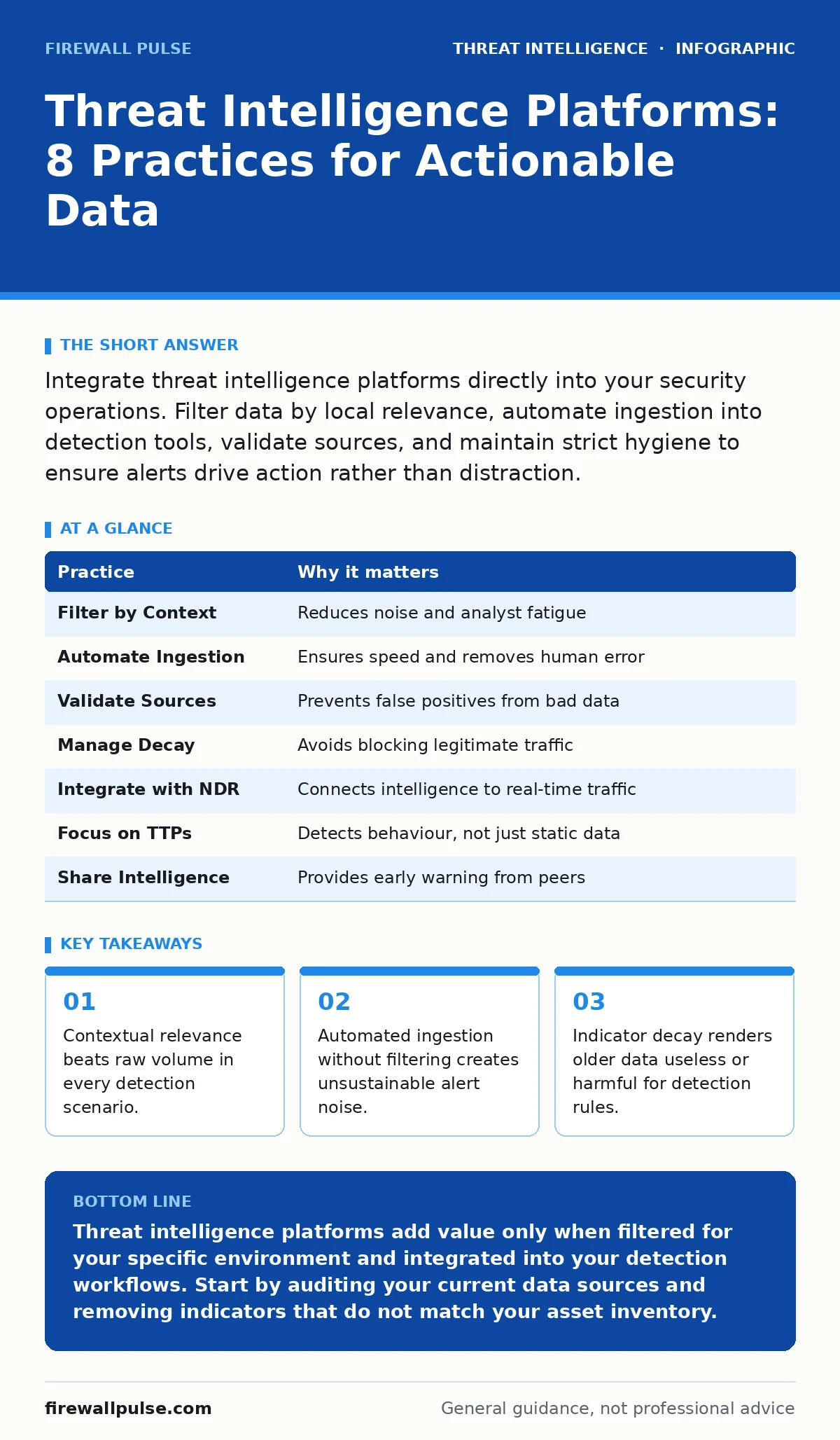
Integrate threat intelligence platforms directly into your security operations. Filter data by local relevance, automate ingestion into detection tools, validate sources, and maintain strict hygiene to ensure alerts drive action rather than distraction.
1. Filter by Local Asset Context
A threat intelligence platform aggregates data from global sources. Most of this data describes threats that target industries, geographies, or technologies you do not use. Ingesting all available indicators creates a high false-positive rate. Your analysts will ignore alerts that consistently prove to be irrelevant.
You must map intelligence to your specific attack surface. If you do not run Microsoft Exchange, indicators related to Exchange exploitation add only noise. Define your asset inventory clearly within the platform. Set filters to exclude indicators that do not match your known hosts, domains, or network ranges.
2. Automate Ingestion via Standard Protocols
Manual copy-pasting of indicators into firewalls or endpoints is slow and error-prone. It also fails to scale as threat volume increases. Modern security tools support standard formats for machine-readable data. The Open Source Intelligence (OSINT) community has standardised these formats to allow interoperability.
Use the Open Cybersecurity Alliance Format (STIX) and Trusted Automated eXchange of Intelligence Information (TAXII) protocols. These standards allow your platform to push data directly to your detection systems. This automation ensures that new threats are available for blocking or alerting within minutes, not days. It also removes human error from the ingestion process.
3. Validate Source Provenance
Not all intelligence sources are equal. Some platforms aggregate data from unverified blogs or low-quality feeds. Relying on unverified sources can lead to blocking legitimate traffic. This is known as a false positive and can disrupt business operations.
Inspect the reputation and methodology of each data source. Prefer sources that provide context about how they collected the data. Look for sources that share their collection methodology openly. This transparency allows you to assess the reliability of the indicator. You can then weight the data accordingly in your detection logic.
4. Manage Indicator Decay
Indicators of Compromise (IoCs) such as IP addresses and domains have a limited lifespan. Attackers frequently rotate infrastructure to evade detection. An IP address used for malicious activity today may be reassigned to a legitimate user tomorrow. Blocking a reassigned IP causes service disruption for innocent users.
You must enforce a time-to-live (TTL) policy for all ingested indicators. Automatically remove or review indicators after a set period, such as thirty days. For high-confidence indicators, you may extend this period, but you must review them manually. This practice keeps your blocklists accurate and reduces the risk of collateral damage.
5. Integrate with Network Detection and Response
Intelligence is useless if it sits isolated in a dashboard. You need it to trigger actions in your network defences. Network detection and response systems monitor traffic for anomalous behaviour. They can use intelligence to prioritise alerts.
Integrate your platform with your network monitoring tools. When a device communicates with a known malicious domain, the integration should raise an immediate alert. It should also provide the analyst with the context from the intelligence platform. This context includes the attacker’s tactics, techniques, and procedures (TTPs). It helps the analyst understand the severity of the event quickly.
See also: Build a Security Operations Center: A Practical Implementation Plan · Unified Kill Chain: The 10 Questions You Need Answered
6. Focus on TTPs Over Indicators
Indicators are static snapshots of an attack. TTPs describe the behaviour of the attacker. Behavioural data remains relevant longer than specific IP addresses or file hashes. An attacker may change their infrastructure, but their method of accessing the system often remains the same.
Prioritise intelligence that describes TTPs. Map these techniques to frameworks like the Unified Kill Chain. This mapping helps you understand where the attack occurs in the lifecycle. You can then build detection rules based on behaviour rather than static values. This approach improves your mean time to detect sophisticated attacks that use clean infrastructure.
7. Participate in Threat Intelligence Sharing
Isolating your security operations limits your visibility. Sharing anonymised threat data with trusted peers provides early warning. It also helps you understand trends affecting your specific industry. This collective knowledge improves the accuracy of your own detection capabilities.
Join industry-specific information sharing and analysis centres (ISACs). Contribute your own anonymised data to the community. This reciprocity ensures you receive high-quality, relevant intelligence in return. Ensure you have legal and privacy safeguards in place before sharing any data. Anonymisation is critical to protect your organisation’s sensitive information.
8. Measure Operational Impact
You cannot improve what you do not measure. Many teams ingest intelligence but fail to track its value. You need to know if the intelligence leads to action. Did an alert from the platform lead to a blocked attack? Did it help you investigate an incident faster?
Track metrics such as the number of alerts generated by intelligence. Track the time saved in investigation due to context. Use these metrics to justify the cost of the platform. Adjust your filtering and source selection based on this performance data.
| Practice | Why it matters |
|---|---|
| Filter by Context | Reduces noise and analyst fatigue |
| Automate Ingestion | Ensures speed and removes human error |
| Validate Sources | Prevents false positives from bad data |
| Manage Decay | Avoids blocking legitimate traffic |
| Integrate with NDR | Connects intelligence to real-time traffic |
| Focus on TTPs | Detects behaviour, not just static data |
| Share Intelligence | Provides early warning from peers |
| Measure Impact | Proves value and guides improvement |
9. Align with Attacker Reconnaissance
Attackers spend significant time observing your organisation before striking. This phase is known as attacker reconnaissance. They look for exposed services, employee data, and technology stacks. Your intelligence platform can help you detect this early activity.
Configure your platform to monitor for mentions of your domain in threat forums. Watch for scans against your external IP ranges. Detecting reconnaissance allows you to harden your defences before an attack occurs. It shifts your posture from reactive to proactive.
Key takeaways
- Contextual relevance beats raw volume in every detection scenario.
- Automated ingestion without filtering creates unsustainable alert noise.
- Indicator decay renders older data useless or harmful for detection rules.
Threat intelligence platforms add value only when filtered for your specific environment and integrated into your detection workflows. Start by auditing your current data sources and removing indicators that do not match your asset inventory.
Frequently asked questions
How do I choose between a commercial platform and open-source tools?
Commercial platforms offer ease of use and support, while open-source tools offer flexibility and lower cost. Choose based on your team’s technical capacity and budget.
Can threat intelligence replace security analysts?
No. Intelligence provides data and context, but analysts provide the judgment and investigation skills. Automation handles routine tasks, but human expertise is needed for complex decisions.
How often should I review my intelligence sources?
Review sources quarterly. Assess their relevance, accuracy, and timeliness. Remove sources that consistently provide low-quality or irrelevant data.
What is the difference between CTI and OTI?
Cyber Threat Intelligence (CTI) focuses on digital threats, while Operational Threat Intelligence (OTI) focuses on physical or immediate operational risks. Most platforms specialise in CTI.
How this guide was produced: written by the Firewall Pulse editorial team with AI assistance, checked against the public references listed below, and reviewed when the facts change. See our editorial policy or report an error.