Detection Engineering Lifecycle: Build, Tune and Maintain Alerts
Detection engineering transforms raw telemetry into reliable signals by treating alerts as code that requires continuous validation and iterative refinement.

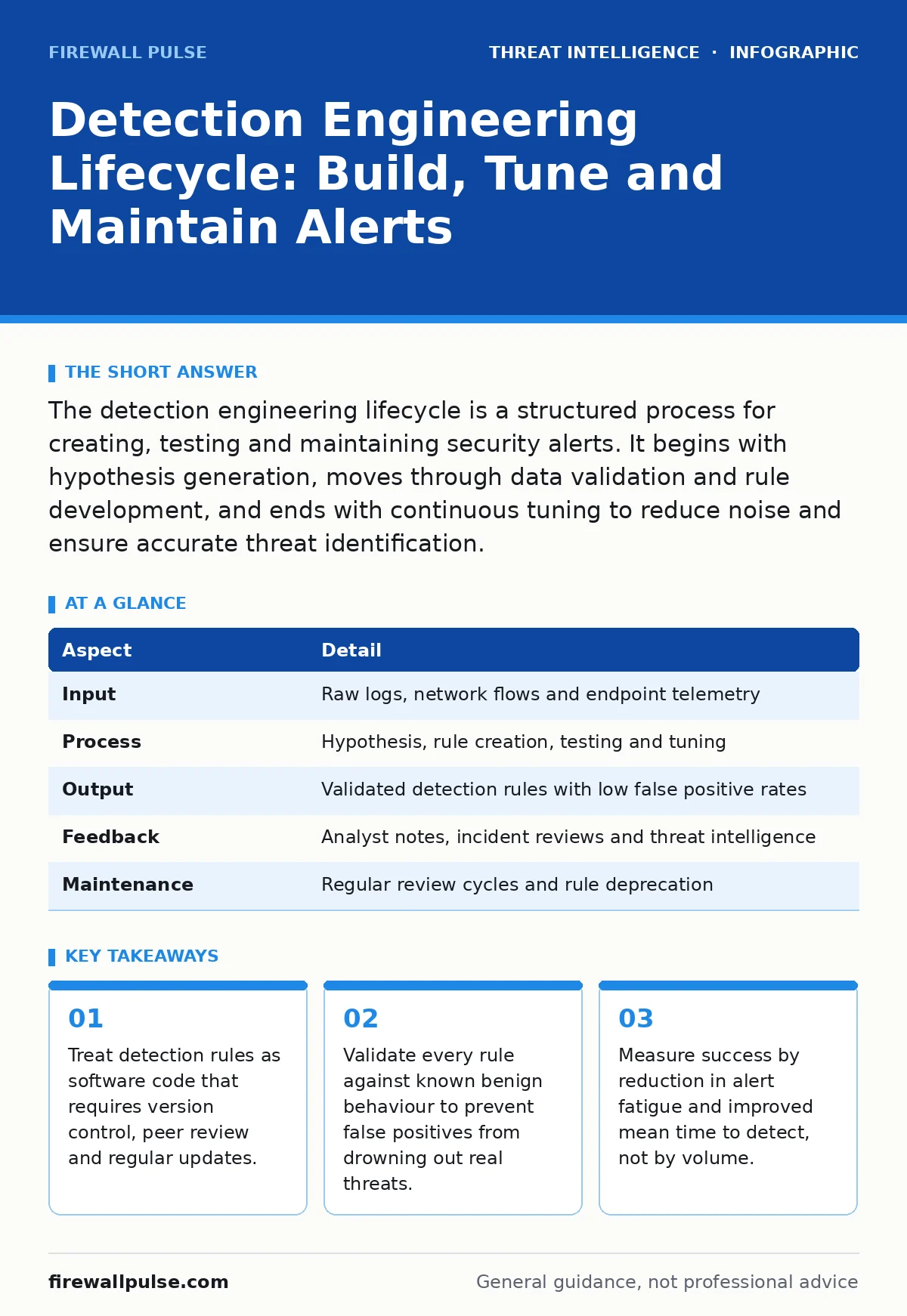
The detection engineering lifecycle is a structured process for creating, testing and maintaining security alerts. It begins with hypothesis generation, moves through data validation and rule development, and ends with continuous tuning to reduce noise and ensure accurate threat identification.
Why Analogies Fail in Security Operations
Imagine a lighthouse keeper who shines a beam at every cloud. Most clouds are harmless, but the keeper cannot distinguish them from storms. The keeper burns out quickly, ignoring the few real threats because the noise is overwhelming. Security teams face this same problem with raw telemetry. Without a structured approach, you generate thousands of alerts that mean nothing. Detection engineering solves this by applying engineering discipline to alert creation. It ensures every signal has a clear purpose and a known accuracy rate.
| Aspect | Detail |
|---|---|
| Input | Raw logs, network flows and endpoint telemetry |
| Process | Hypothesis, rule creation, testing and tuning |
| Output | Validated detection rules with low false positive rates |
| Feedback | Analyst notes, incident reviews and threat intelligence |
| Maintenance | Regular review cycles and rule deprecation |
What Is the Detection Engineering Lifecycle
The detection engineering lifecycle is the systematic process of designing, building and maintaining security detections. It treats alerts not as static configurations but as dynamic assets that degrade over time. The cycle starts with a hypothesis about how an attacker might behave. You then identify the data sources that can prove or disprove that hypothesis. Next, you write the logic to flag that behaviour. You test the logic against historical data to check for accuracy. Finally, you deploy the rule and monitor its performance. This loop repeats continuously as threats and environments change.
How Detection Engineering Works in Practice
You begin by selecting a specific threat technique to detect. You choose a technique from a public framework like the Unified Kill Chain or MITRE ATT&CK. You then map that technique to available data sources. Not all systems log the same events. You must verify that your endpoints, network devices and applications emit the necessary telemetry. Once you confirm data availability, you write the detection logic. This logic defines what constitutes a match. You then run this logic against a safe dataset of past events. This step reveals how often the rule triggers on normal activity. If the false positive rate is high, you refine the logic or exclude benign sources. Only after validation do you deploy the rule to production.
Who Benefits From Structured Detection
Security operations teams gain the most from this discipline. They spend less time triaging false alarms and more time investigating real incidents. Threat hunters use validated detections to start their investigations. They trust the baseline and can focus on anomalies. Incident responders rely on accurate detections to contain breaches quickly. Poor detections delay response and allow attackers to perform lateral movement. By improving detection quality, you reduce the mean time to detect. This metric measures how long it takes to spot a breach. Lower times mean less damage. Leadership benefits from clearer risk reporting. They see fewer noisy alerts and more actionable intelligence.
Common Mistakes in Detection Design
Many teams skip the testing phase. They write a rule and deploy it immediately. This creates alert fatigue. Analysts ignore the alerts because most are false positives. Another mistake is ignoring data quality. You cannot detect what you do not log. If your endpoints do not record process creation, you cannot detect suspicious processes. You must ensure logging is comprehensive before writing rules. Teams also fail to maintain their detections. Rules become obsolete as software updates or business processes change. A rule that worked last year may break today. Regular reviews prevent this drift. You must treat detections as living code, not set-and-forget configurations.
See also: Implement Network Detection and Response: A Practical Step-by-Step Approach · Unified Kill Chain: The 10 Questions You Need Answered
Integrating Threat Intelligence Sharing
External data improves your internal detections. Threat intelligence sharing allows you to learn from other organisations. You can incorporate indicators of compromise into your rules. However, raw indicators are often noisy. You must contextualise them. An IP address might be malicious in one context but benign in another. Use threat intelligence to inspire new detection hypotheses. Do not just paste indicators into your system. Understand the attacker’s goal. Build rules that detect the behaviour associated with the intelligence. This approach makes your detections more resilient to attacker changes.
Maintaining Detections Over Time
Detections decay. Software updates change event codes. Business applications change their behaviour. You must schedule regular reviews. Check each rule for performance. Is it still relevant? Is it generating too many false positives? Is it missing known attacks? Deprecate rules that no longer add value. This keeps your detection stack lean and effective. Document your changes. Version control helps you track why a rule changed. This documentation aids in troubleshooting and audits. Continuous improvement is the goal. The detection engineering lifecycle is not a one-time project. It is an ongoing practice that requires discipline and resources.
The Hidden Cost of Poor Engineering
The cost of bad detections is not just wasted time. It is missed attacks. When analysts are overwhelmed by noise, they become desensitised. They stop looking closely at alerts. This blindness allows attackers to persist. Attackers using living-off-the-land attacks exploit this gap. These attacks use legitimate system tools, making them hard to spot. If your detections are noisy, you will miss these subtle signs. Good detection engineering reduces this risk. It ensures that when an alert fires, it is likely real. This trust allows your team to act quickly and effectively.
What People Usually Get Wrong
People often confuse detection engineering with tool configuration. They think buying a better platform solves the problem. It does not. The platform is just a container. The value comes from the logic inside. Another error is focusing only on external threats. Internal mistakes and misconfigurations cause most incidents. Your detections must cover insider risks too. Finally, teams often ignore the human element. Detection engineering requires collaboration between analysts, engineers and threat hunters. Silos break the lifecycle. You need shared ownership of the detection rules.
Key takeaways
- Treat detection rules as software code that requires version control, peer review and regular updates.
- Validate every rule against known benign behaviour to prevent false positives from drowning out real threats.
- Measure success by reduction in alert fatigue and improved mean time to detect, not by volume.
Frequently asked questions
How does detection engineering differ from threat hunting?
Detection engineering builds automated alerts for known patterns. Threat hunting involves manually searching for hidden threats that evade automated rules. They complement each other.
Can small teams implement this lifecycle?
Yes. Start with a few high-value detections. Focus on quality over quantity. Use simple tools to manage the process. Consistency matters more than scale.
What data sources are most important?
Endpoint logs, network flows and identity logs are critical. Ensure these sources are comprehensive and reliable. Without good data, no detection logic will work.
How often should you review detections?
Review detections quarterly at minimum. Increase frequency for high-risk rules. Immediate review is needed after major system changes or incidents.
How this guide was produced: written by the Firewall Pulse editorial team with AI assistance, checked against the public references listed below, and reviewed when the facts change. See our editorial policy or report an error.