Fast Flux DNS: How Attackers Hide Malware and How to Stop It
Fast flux networks obscure malicious infrastructure by rotating IP addresses faster than standard reputation systems can block them, creating a moving target for defenders.

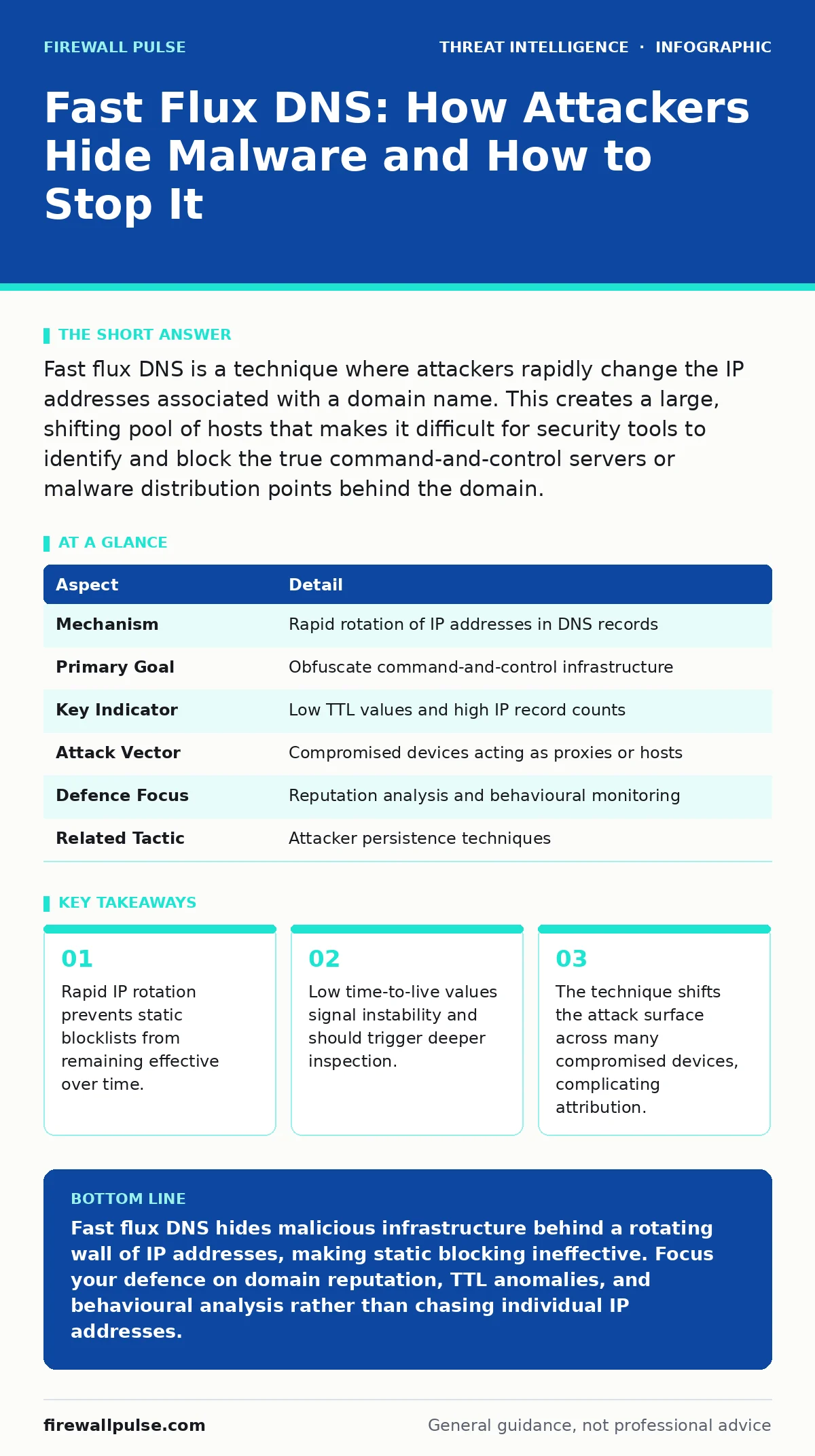
Fast flux DNS is a technique where attackers rapidly change the IP addresses associated with a domain name. This creates a large, shifting pool of hosts that makes it difficult for security tools to identify and block the true command-and-control servers or malware distribution points behind the domain.
The Moving Target Analogy
Imagine trying to deliver a letter to a house that changes its street address every hour. You arrive at the first address, find no one home, and by the time you check the next, the house has moved again. Fast flux DNS operates on this principle of constant movement. It ensures that no single point of failure exists for the attacker while denying defenders a stable target to block.
This technique turns the Domain Name System into a weaponised obfuscation layer. The DNS translates human-readable domain names into numerical IP addresses that computers use to locate each other. By manipulating these records, attackers decouple the domain name from any single physical server.
At a Glance
| Aspect | Detail |
|---|---|
| Mechanism | Rapid rotation of IP addresses in DNS records |
| Primary Goal | Obfuscate command-and-control infrastructure |
| Key Indicator | Low TTL values and high IP record counts |
| Attack Vector | Compromised devices acting as proxies or hosts |
| Defence Focus | Reputation analysis and behavioural monitoring |
| Related Tactic | Attacker persistence techniques |
How Fast Flux DNS Works
The core mechanism relies on two settings: the Time-to-Live (TTL) value and the number of IP addresses returned. The TTL tells resolvers how long to cache a DNS record before asking for it again. Attackers set this value extremely low, often just seconds or minutes. This forces systems to query the authoritative nameserver constantly.
Each query returns a different, or rotating, set of IP addresses. These addresses belong to a large pool of compromised computers, IoT devices, or virtual machines. When a victim’s device connects to the domain, it is directed to one of these rotating hosts. If security teams block one IP, the domain simply points to another within seconds.
This creates a distributed network. The actual malicious server, often called the command-and-control node, sits behind this shield of fluxing IPs. The outer layer absorbs the blocks and scans, protecting the inner core. This structure is resilient because taking down one node does not disrupt the service.
Common Forms and Evolution
There are two primary architectures: single-level and double-level. In single-level fast flux, the domain points directly to the rotating IPs of compromised hosts. These hosts may act as proxies, forwarding traffic to the real server, or they may host the malware payload themselves. This form is simpler but leaves the compromised devices exposed to direct traffic.
Double-level fast flux adds another layer of indirection. The domain points to a set of rotating nameservers, not just IPs. These nameservers then point to the rotating web servers. This separates the resolution layer from the hosting layer. It makes tracking the infrastructure significantly harder because you must map the nameserver rotation first, then the web server rotation.
Both forms rely on the sheer volume of compromised devices. This is why attacker reconnaissance is a prerequisite. The attacker must first identify and infect a large number of vulnerable systems to build the flux pool. Without this base, the technique collapses under its own weight.
What People Usually Get Wrong
A common misconception is that fast flux is a type of Distributed Denial of Service attack. It is not. A DDoS aims to overwhelm a target with traffic. Fast flux aims to hide a target from detection. While both use botnets, the intent and mechanics differ entirely. Confusing the two leads to misallocated defensive resources.
Another error is assuming that high IP counts are always malicious. Large legitimate services, such as content delivery networks, also return multiple IPs for load balancing and redundancy. However, legitimate services usually have stable, high TTL values and consistent geographical distribution. Fast flux networks exhibit erratic TTLs and random, often geographically disparate, IP assignments.
Defenders also underestimate the role of network detection and response. Traditional perimeter firewalls struggle with fast flux because the traffic often appears to come from residential IP ranges. These ranges are often whitelisted or treated as low risk. The malicious traffic blends in with normal user browsing, evading simple signature-based detection.
See also: Implement Network Detection and Response: A Practical Step-by-Step Approach · Stop Attacker Reconnaissance: Practical Network Hiding Tactics
Reducing the Risk
Effective defence requires moving beyond static IP blocking. Since the IPs change, the domain name and the behavioural pattern become the primary indicators. You must monitor DNS query patterns for anomalies. Look for domains that resolve to an unusually high number of unique IPs over a short period.
Implement DNS reputation filtering. This checks domain names against global threat intelligence feeds that track known malicious domains. Even if the IP changes, the domain name often remains the same until it is fully burned. Integrating with threat intelligence platforms allows your security tools to recognise these domains regardless of their current IP address.
Analyse the TTL values. Configure your DNS monitoring to flag queries with extremely low TTLs. While not proof of malice on its own, a low TTL combined with a high IP count is a strong indicator of fast flux behaviour. This helps prioritise investigation efforts.
Integration with Broader Security
Fast flux networks are rarely standalone. They are part of a larger attack lifecycle. Understanding this context helps in detection. These networks are often used to establish attacker persistence techniques, ensuring that even if one communication channel is cut, others remain open.
They also facilitate cyber espionage by providing anonymous channels for data exfiltration. The rotating nature of the infrastructure makes it difficult for investigators to trace the data back to a specific origin. This is why threat intelligence sharing is valuable. Insights from other organisations about new fast flux domains can help you update your defences before you are targeted.
When analysing these attacks, consider the Unified Kill Chain framework. Fast flux operates primarily in the weaponisation and delivery phases, but its resilience supports the installation and action phases. By disrupting the DNS resolution, you can break the chain before the payload executes. However, this requires rapid detection and automated response capabilities.
The Hidden Cost of Rotation
The speed of rotation has a hidden cost for defenders: data volume. Every time a resolver queries a fast flux domain, it generates log entries. In a high-volume environment, this can create significant noise. Security information and event management systems may struggle to process this volume in real-time.
This noise can obscure other, more subtle attacks. The sheer number of DNS queries can also impact network performance. Recursive resolvers may become overloaded if they are constantly fetching new records for low-TTL domains. This can lead to slower internet speeds for legitimate users.
Therefore, tuning your monitoring thresholds is critical. You must balance sensitivity with operational stability. Too sensitive, and you drown in alerts. Too insensitive, and you miss the early signs of a fast flux network. Regular review of your DNS analytics baselines is necessary to maintain this balance.
Key takeaways
- Rapid IP rotation prevents static blocklists from remaining effective over time.
- Low time-to-live values signal instability and should trigger deeper inspection.
- The technique shifts the attack surface across many compromised devices, complicating attribution.
Fast flux DNS hides malicious infrastructure behind a rotating wall of IP addresses, making static blocking ineffective. Focus your defence on domain reputation, TTL anomalies, and behavioural analysis rather than chasing individual IP addresses.
Frequently asked questions
Can I block fast flux DNS at the firewall level?
You can block specific IP addresses, but they will change rapidly. It is more effective to block the malicious domain names at the DNS resolver level or use a secure DNS service that filters known threats.
How do I distinguish fast flux from a Content Delivery Network?
CDNs typically have high TTL values and stable IP sets for specific regions. Fast flux networks have very low TTLs and frequently changing, random IP sets that do not follow geographic logic.
Is fast flux DNS illegal?
The technique itself is a method of obfuscation. It is illegal when used to distribute malware, facilitate fraud, or support other cybercrimes. Using it for legitimate privacy purposes is rare and often technically impractical.
Do all malware families use fast flux DNS?
No. Many malware families use static domains or peer-to-peer networks. Fast flux is common in botnets and large-scale malware distribution campaigns where resilience against takedowns is a priority.
How this guide was produced: written by the Firewall Pulse editorial team with AI assistance, checked against the public references listed below, and reviewed when the facts change. See our editorial policy or report an error.