Implement Network Detection and Response: A Practical Step-by-Step Approach
Most network detection failures stem from treating traffic as noise rather than context, missing the subtle behavioural shifts that precede a breach.

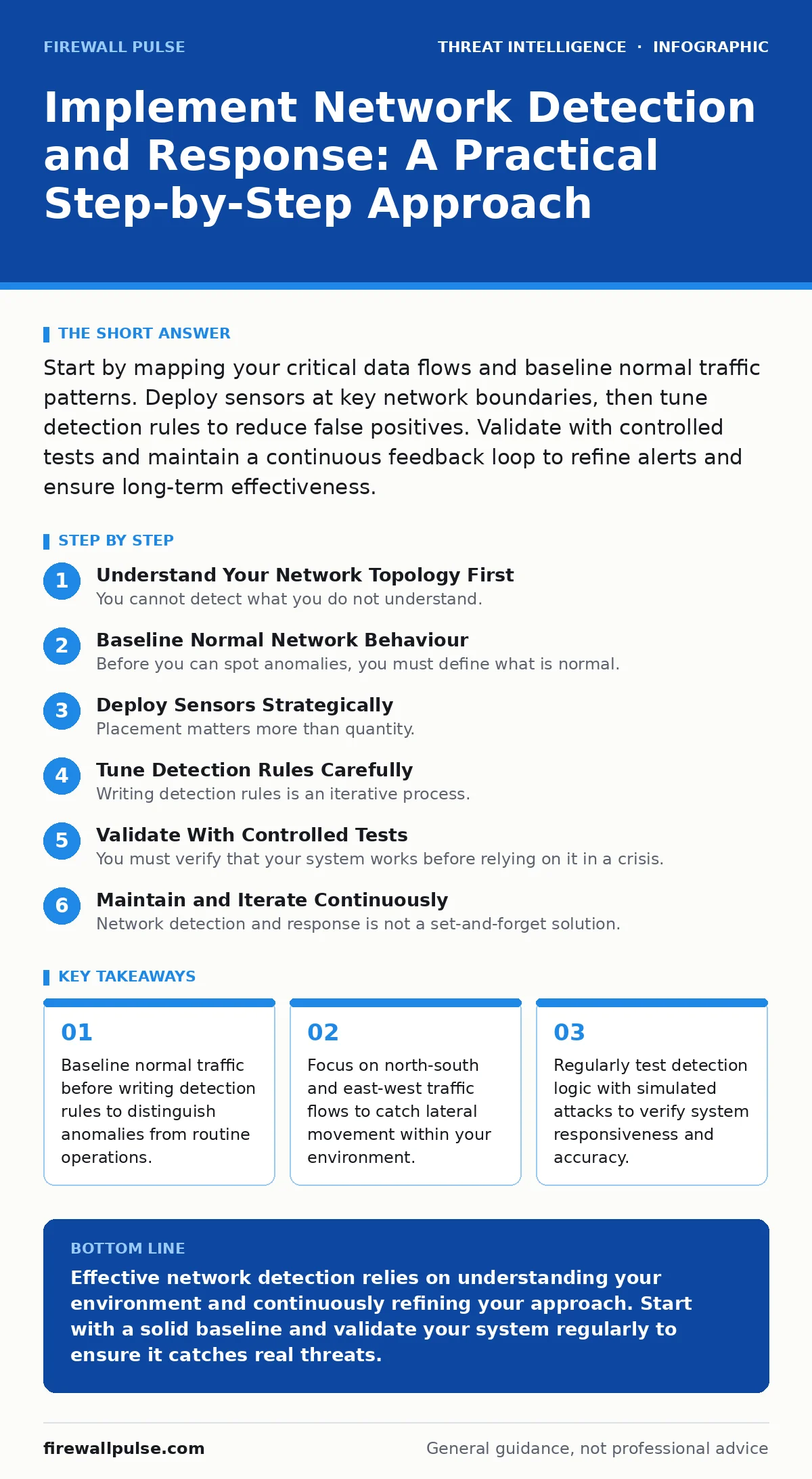
Start by mapping your critical data flows and baseline normal traffic patterns. Deploy sensors at key network boundaries, then tune detection rules to reduce false positives. Validate with controlled tests and maintain a continuous feedback loop to refine alerts and ensure long-term effectiveness.
Understand Your Network Topology First
You cannot detect what you do not understand. Many teams jump straight into deploying sensors without mapping their network architecture. This leads to blind spots where malicious activity goes unnoticed. Start by documenting your network segments, subnets, and critical assets. Identify where sensitive data resides and how it moves. This map becomes the foundation for your detection strategy.
Consider the difference between north-south and east-west traffic. North-south traffic flows between your internal network and the internet. East-west traffic moves between internal systems. Attackers often hide in east-west traffic once they breach the perimeter. Understanding these flows helps you place sensors where they matter most.
Baseline Normal Network Behaviour
Before you can spot anomalies, you must define what is normal. Collect traffic data over a period of weeks to establish a baseline. Look at protocols, ports, volume, and timing. This baseline acts as a reference point for your detection engine. Without it, every unusual packet looks like an alert, drowning your team in noise.
Focus on behavioural patterns rather than static signatures. Signatures identify known threats, but they miss new or modified attacks. Behavioural analysis looks for deviations from the norm. For instance, a server suddenly sending large amounts of data at 3 AM is abnormal, even if the protocol is standard HTTP. This approach catches novel threats that signature-based tools ignore.
Deploy Sensors Strategically
Placement matters more than quantity. You do not need to mirror every port in your network. Focus on chokepoints where traffic converges. These include internet gateways, data centre interconnects, and cloud on-ramps. Use network taps or port mirroring to capture traffic without impacting performance. Ensure your sensors can handle peak bandwidth without dropping packets.
Avoid placing sensors in isolated segments with little traffic. These areas generate few alerts and waste resources. Instead, prioritize segments that host critical infrastructure or handle sensitive data. This targeted approach ensures you capture the most valuable intelligence while managing costs and complexity.
Step 1: Map Critical Data Flows
Identify the paths your most sensitive data takes across the network. Document the source, destination, and protocols used. This map helps you decide where to place sensors for maximum visibility. You should include both on-premises and cloud environments in this mapping.
How to tell it worked: You have a visual diagram showing all critical data paths. You can explain to a colleague how data moves from a user device to a database server.
Step 2: Install Sensors at Chokepoints
Deploy your detection sensors at the identified chokepoints. Configure them to capture full packet data or metadata, depending on your storage capacity. Ensure they are connected securely and monitored for health. Test the connection to verify data is flowing to your analysis platform.
How to tell it worked: The sensors are actively streaming data to your central console. You see real-time traffic metrics for each sensor location.
Step 3: Establish a Traffic Baseline
Let the sensors run for a few weeks without active detection rules. Use this time to collect data and establish a baseline of normal activity. Analyse the data to identify common patterns, peak times, and typical protocol usage. This baseline will be the foundation for your detection logic.
How to tell it worked: You have a documented baseline of normal traffic patterns. You can identify what constitutes a deviation from this norm.
Tune Detection Rules Carefully
Writing detection rules is an iterative process. Start with broad rules to catch obvious threats, then refine them to reduce false positives. A high false positive rate leads to alert fatigue, where your team ignores warnings. Tune your rules by excluding known good traffic and focusing on specific behavioural indicators.
Use threat intelligence sharing to inform your rule creation. Incorporate indicators of compromise from trusted sources. However, always validate these indicators against your own environment. Blindly importing rules can cause disruptions if they do not fit your specific context.
Validate With Controlled Tests
You must verify that your system works before relying on it in a crisis. Use controlled tests to simulate various attack scenarios. These tests should mimic real-world tactics, such as port scanning, data exfiltration, and lateral movement. Observe how your system detects and alerts on these activities.
Refer to SOC playbooks for structured testing procedures. These playbooks provide step-by-step instructions for simulating attacks and evaluating response. Ensure your tests cover both north-south and east-west traffic. This comprehensive approach ensures no major attack vector is missed.
See also: Implement Mean Time to Detect: A Step-by-Step Rollout Plan · Build a Security Operations Center: A Practical Implementation Plan
Maintain and Iterate Continuously
Network detection and response is not a set-and-forget solution. You must continuously monitor performance and update rules. Review alerts regularly to identify trends and adjust thresholds. Engage with your team to gather feedback on alert quality and usability.
Stay informed about emerging threats and tactics. Update your detection logic to address new risks. Consider integrating with other security tools for a holistic view. This continuous improvement ensures your system remains effective against evolving threats.
Verification Checklist
- Network topology is fully documented and up-to-date.
- Sensors are deployed at all critical chokepoints.
- Baseline of normal traffic behaviour is established.
- Detection rules are tuned to minimise false positives.
- Controlled tests have validated detection capabilities.
- Maintenance schedule is defined and followed.
Key takeaways
- Baseline normal traffic before writing detection rules to distinguish anomalies from routine operations.
- Focus on north-south and east-west traffic flows to catch lateral movement within your environment.
- Regularly test detection logic with simulated attacks to verify system responsiveness and accuracy.
Effective network detection relies on understanding your environment and continuously refining your approach. Start with a solid baseline and validate your system regularly to ensure it catches real threats.
Frequently asked questions
How do I distinguish between normal network fluctuations and actual threats?
Establish a detailed baseline of normal traffic patterns and use behavioural analysis to identify significant deviations from this norm.
What is the role of threat intelligence in network detection?
Threat intelligence provides indicators of compromise and context about emerging threats, helping you fine-tune your detection rules.
How often should I update my detection rules?
Review and update rules regularly, ideally weekly, to address new threats and reduce false positives based on recent alert data.
Can network detection replace endpoint protection?
No, network detection complements endpoint protection by monitoring traffic patterns, but it does not replace the need for host-based security measures.
How this guide was produced: written by the Firewall Pulse editorial team with AI assistance, checked against the public references listed below, and reviewed when the facts change. See our editorial policy or report an error.