Why is shadow IT dangerous? Real risks and how to manage them
Unauthorised software bypasses network defences, exposing sensitive data to unpatched vulnerabilities and creating blind spots in your security monitoring.

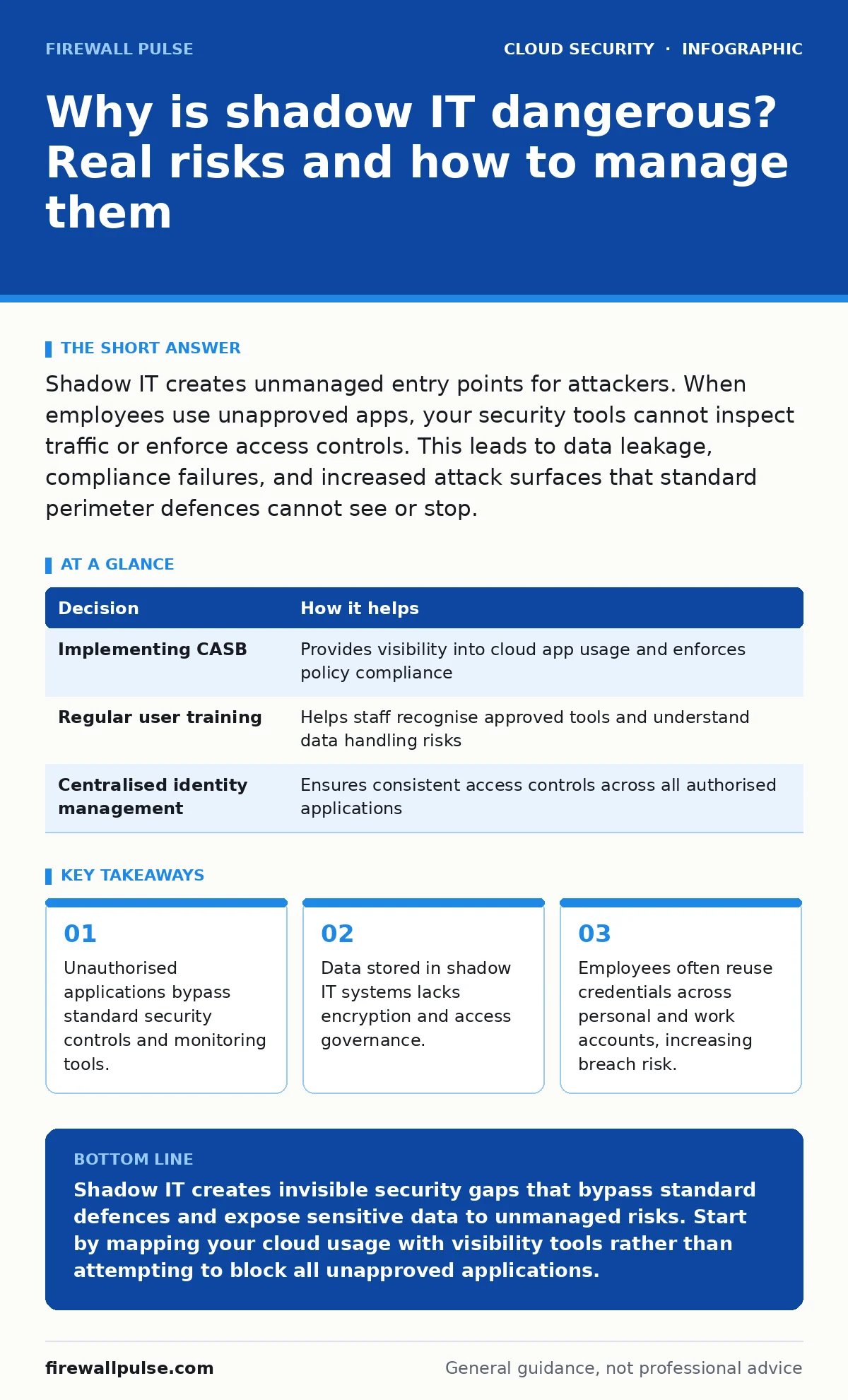
Shadow IT creates unmanaged entry points for attackers. When employees use unapproved apps, your security tools cannot inspect traffic or enforce access controls. This leads to data leakage, compliance failures, and increased attack surfaces that standard perimeter defences cannot see or stop.
Why is shadow IT dangerous
Shadow IT refers to any hardware, software, or service used by employees without the knowledge or approval of the organisation’s IT department. The danger lies not in the technology itself, but in the lack of governance. When tools operate outside your control, you cannot apply security patches, enforce encryption, or monitor for suspicious activity. This creates invisible gaps in your defence perimeter. Attackers target these blind spots because they know your security operations teams are not watching them. The risk escalates when these tools handle sensitive customer data or intellectual property. Without visibility, you cannot assess the threat level or respond to incidents effectively.
The hidden costs of unmanaged tools
Organisations often focus on the immediate convenience of shadow IT while ignoring the long-term operational costs. Support teams waste hours troubleshooting issues with software they did not install or approve. Licensing costs multiply when multiple departments buy similar tools independently. More critically, the security team loses the ability to enforce consistent policies. If an employee uses a cloud storage service for file sharing, that data may reside in a region with different privacy laws. This creates legal liability that is difficult to trace. The cost of remediation after a breach far exceeds the cost of proper provisioning. You pay for inefficiency and risk simultaneously.
Data exposure and loss prevention failure
Data loss prevention (DLP) systems are designed to scan and block sensitive information leaving the corporate network. Shadow IT bypasses these systems entirely. When employees upload files to unapproved cloud services, the data leaves your protected environment without inspection. Malicious actors can exploit this exfiltration path to steal trade secrets or personal information.
The absence of encryption at rest and in transit within these unmanaged tools further compounds the risk. Even if the service provider claims to be secure, you have no way to verify their claims. You are trusting a third party with your data without any contractual or technical guarantees. This trust deficit is a primary driver of data breaches.
| Decision | How it helps |
|---|---|
| Implementing CASB | Provides visibility into cloud app usage and enforces policy compliance |
| Regular user training | Helps staff recognise approved tools and understand data handling risks |
| Centralised identity management | Ensures consistent access controls across all authorised applications |
Identity and access management gaps
Most shadow IT tools rely on individual user accounts rather than enterprise identity providers. This means multi-factor authentication (MFA) and single sign-on (SSO) are often absent. Employees frequently reuse passwords across personal and professional accounts. If one service suffers a credential leak, attackers can try those same credentials on other platforms.
This technique, known as credential stuffing, is highly effective against unmanaged applications. Without SSO, you cannot enforce least privilege access or revoke permissions instantly when an employee leaves. Each unmanaged account is a potential backdoor into your organisation’s data ecosystem. The lack of centralised control makes incident response slow and incomplete.
Compliance and regulatory breaches
Many industries operate under strict regulatory frameworks that mandate specific data handling procedures. Shadow IT makes compliance audits nearly impossible. You cannot prove that sensitive data is protected if you do not know where it is stored. Violations can result in significant fines and reputational damage.
Even if the shadow IT tool is not the direct cause of a breach, the inability to demonstrate control over data flows is a compliance failure. Auditors require evidence of risk assessment and mitigation. Unapproved tools provide no such evidence. The organisation remains liable for any data mishandling, regardless of whether the employee intended to cause harm. Compliance is a continuous process, not a one-time checklist.
See also: Cloud IAM Policies: The Hidden Lever for Security Control
The false sense of security
Security teams often assume that network perimeter defences are sufficient. Firewalls and intrusion detection systems monitor traffic entering and leaving the corporate network. However, modern employees use personal devices and cellular data to access cloud services. This traffic never touches the corporate firewall. It goes directly to the internet service provider and then to the cloud provider.
Your network security tools are completely blind to this activity. This creates a false sense of security. You believe your perimeter is tight, but data is flowing freely through unmonitored channels. Attackers exploit this assumption by targeting the endpoints and cloud services directly. The perimeter is no longer the boundary; the identity is.
Moving from detection to governance
Addressing shadow IT requires a shift from pure prohibition to intelligent governance. Blocking all unapproved tools frustrates employees and drives them to more covert methods. Instead, focus on visibility and risk assessment. Use cloud access security brokers (CASB) to identify which applications are in use. Categorise these tools by risk level.
Low-risk tools may be acceptable with basic monitoring. High-risk tools handling sensitive data must be replaced with approved alternatives. Educate employees on the risks without punishing them for using helpful tools. Create a streamlined process for requesting new software. If the approved tool is cumbersome, the shadow IT problem will persist. Governance must be as easy as the shadow alternative.
Integrating security into daily workflows
Security controls must be integrated into the tools employees already use. If security adds friction, users will find ways around it. Embed data loss prevention and encryption directly into approved collaboration platforms. Use identity providers to enforce consistent access policies across all applications. Regularly review cloud audit logs to detect anomalies in user behaviour. Monitor for unusual data access patterns that might indicate a compromised account. Automate where possible to reduce the burden on security teams. The goal is to make the secure path the easiest path. When security is seamless, compliance becomes a byproduct of normal operations rather than a separate burden.
Key takeaways
- Unauthorised applications bypass standard security controls and monitoring tools.
- Data stored in shadow IT systems lacks encryption and access governance.
- Employees often reuse credentials across personal and work accounts, increasing breach risk.
Shadow IT creates invisible security gaps that bypass standard defences and expose sensitive data to unmanaged risks. Start by mapping your cloud usage with visibility tools rather than attempting to block all unapproved applications.
Frequently asked questions
How do I find shadow IT in my organisation?
Use network traffic analysis and cloud access security brokers to identify unapproved applications and services being accessed by employees.
Should I block all shadow IT immediately?
Blocking immediately can disrupt business operations. Assess the risk first, then replace high-risk tools with approved alternatives while educating users.
What is the biggest risk of shadow IT?
The biggest risk is data exposure. Unmanaged tools often lack proper encryption and access controls, making sensitive data vulnerable to theft.
Can shadow IT help with compliance?
Shadow IT hinders compliance. It creates unmonitored data flows that violate regulatory requirements for data protection and audit trails.
How this guide was produced: written by the Firewall Pulse editorial team with AI assistance, checked against the public references listed below, and reviewed when the facts change. See our editorial policy or report an error.