Why is a syn flood attack detectable? The mechanics of detection
SYN flood attacks leave a distinct half-open connection signature that allows defenders to distinguish them from legitimate traffic without inspecting packet contents.

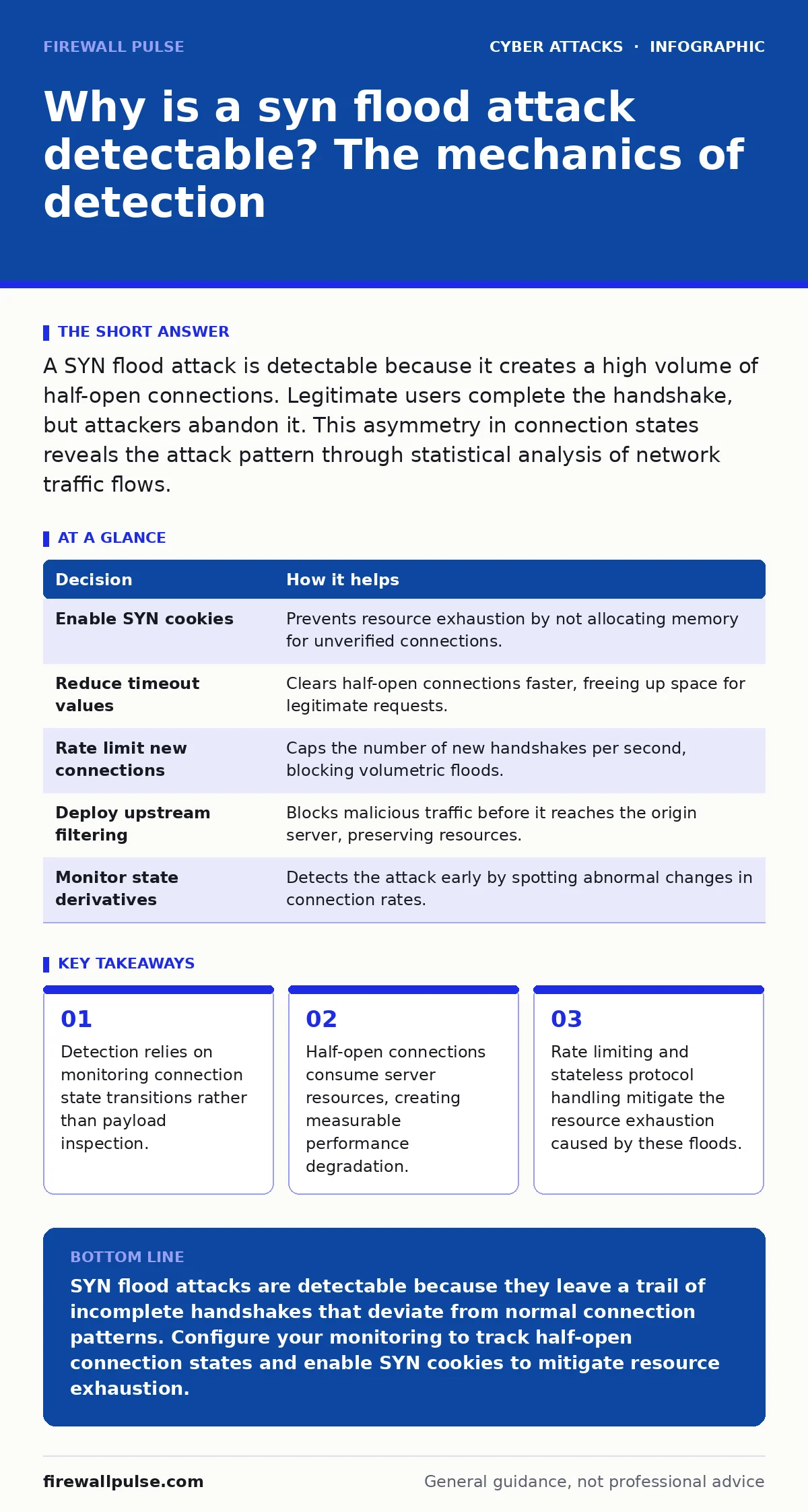
A SYN flood attack is detectable because it creates a high volume of half-open connections. Legitimate users complete the handshake, but attackers abandon it. This asymmetry in connection states reveals the attack pattern through statistical analysis of network traffic flows.
Why is a syn flood attack detectable
Why is a syn flood attack detectable? The answer lies in the incomplete nature of the TCP handshake. A standard connection requires three steps: a SYN request, a SYN-ACK response, and a final ACK completion. A SYN flood attack sends only the first step. The server waits for the missing final step. This waiting state is visible to monitoring tools. The attack is detectable because the ratio of started connections to completed connections breaks normal patterns.
The detection mechanism does not require decrypting traffic. It relies on the state machine of the TCP protocol. When you monitor the number of sockets in the SYN-RECEIVED state, you see a spike. Legitimate traffic rarely leaves connections in this state for long. This structural flaw in the attack method makes it easier to spot than attacks that mimic complete traffic flows.
The mechanics of half-open connections
The TCP handshake establishes a reliable connection between two devices. The client sends a SYN packet to initiate the link. The server responds with a SYN-ACK packet, allocating memory to track the pending connection. The client must then send an ACK packet to finalise the session. This three-way handshake ensures both parties are ready to exchange data.
In a SYN flood attack, the attacker sends many SYN packets but never sends the final ACK. The server keeps the half-open connection alive, waiting for the missing piece. Each half-open connection consumes a small amount of kernel memory. Thousands of these connections exhaust the server's connection table. This resource consumption is the primary side effect that signals an attack is underway.
Statistical anomalies in traffic patterns
Normal network traffic follows predictable statistical distributions. Most users complete the handshake quickly. These timeouts occur at a low, consistent baseline rate. You can establish this baseline by observing traffic over a period of stable operation.
A SYN flood introduces a sudden deviation from this baseline. The rate of SYN packets exceeds the rate of ACK packets significantly. The time-to-live values in the packets may also show variance, indicating spoofed source addresses from multiple networks. Monitoring tools calculate the derivative of connection counts. A sharp upward slope in half-open connections triggers an alert. This statistical approach avoids false positives from busy but legitimate services.
Resource exhaustion as a secondary signal
The server operating system allocates a fixed amount of memory for each pending connection. This memory holds the state information needed to complete the handshake. When an attacker floods the server with SYN packets, the memory fills up. New legitimate requests cannot be processed because the connection table is full.
This exhaustion manifests as increased latency for legitimate users. Response times rise as the server struggles to manage the queue. Application logs may show timeout errors for valid clients. These performance metrics serve as a secondary detection layer. If the statistical anomaly is missed, the operational impact becomes visible. Combining traffic analysis with application performance monitoring provides a stronger detection signal.
The cost of looking inside packets
Deep packet inspection examines the contents of network traffic. This method can identify known attack signatures or malicious payloads. However, it is computationally expensive. Inspecting every packet in a high-volume attack slows down the network equipment. The very act of inspection can become a bottleneck.
Relying solely on content inspection fails against SYN floods. The packets themselves are structurally valid. They contain no malicious code or unusual headers. The attack is volumetric and structural, not content-based. Detecting it requires looking at the behaviour of the connection state, not the data inside the packet. This distinction saves processing power and reduces latency for legitimate traffic.
See also: Stop Attacker Reconnaissance: Practical Network Hiding Tactics
Contrast in operational response
Team A uses automated metrics to detect the anomaly. Their system recognises the spike in half-open connections and adjusts defences immediately. They do not need to identify the specific attacker. They simply mitigate the effect of the flood. Team B relies on user complaints and application logs. By the time they notice the issue, the server is already overwhelmed. Their reactive approach leads to prolonged downtime.
Decision matrix for mitigation strategies
| Decision | How it helps |
|---|---|
| Enable SYN cookies | Prevents resource exhaustion by not allocating memory for unverified connections. |
| Reduce timeout values | Clears half-open connections faster, freeing up space for legitimate requests. |
| Rate limit new connections | Caps the number of new handshakes per second, blocking volumetric floods. |
| Deploy upstream filtering | Blocks malicious traffic before it reaches the origin server, preserving resources. |
| Monitor state derivatives | Detects the attack early by spotting abnormal changes in connection rates. |
Implementing stateless defence mechanisms
SYN cookies are a defence mechanism that eliminates the need to store state for half-open connections. When a server receives a SYN packet, it calculates a unique cookie value based on the packet details. It sends this value back in the SYN-ACK packet. It does not allocate memory. When the client replies with the ACK, the server verifies the cookie. If valid, it establishes the connection.
This method renders the attack ineffective. The attacker cannot complete the handshake without solving the cryptographic cookie. The server remains lightweight because it holds no state for unverified connections. This approach is standard in many operating systems. It provides a baseline level of protection against resource exhaustion. It does not stop the traffic, but it stops the impact.
What to do with detection knowledge
Knowing that SYN floods are detectable through state analysis changes your monitoring strategy. You should prioritise metrics that track connection states over generic bandwidth usage. Set alerts for sudden increases in SYN-RECEIVED connections. Combine these alerts with rate-limiting rules that activate automatically. This proactive stance reduces the window of exposure.
You must also consider the broader context of network security. A SYN flood may be a distraction for other attacks. Ensure your zero trust security model verifies every request, regardless of its origin. Do not assume that traffic from known IP ranges is safe. Implement attack surface reduction techniques to minimise the number of exposed services. This limits the targets available for volumetric attacks.
Integrating with broader defence
A SYN flood attack is a layer 3 or layer 4 attack. It targets the transport layer of the network stack. Defending against it requires network-level controls. However, you must also protect against application-layer threats. Brute force attacks often accompany volumetric attacks to overwhelm authentication systems. Ensure your login mechanisms have rate limits and account lockout policies.
Phishing remains a primary vector for initial access. OAuth consent phishing and clone phishing are common methods used to steal credentials. These attacks do not rely on network flooding. They rely on user deception. A holistic security strategy addresses both technical vulnerabilities and human factors. Your security operations centers should correlate network alerts with identity logs. This correlation helps distinguish between a standalone DDoS and a multi-vector attack.
Handling edge cases and false positives
High-traffic legitimate events can mimic SYN floods. A popular product launch or a viral social media post can cause a spike in new connections. If your detection threshold is too low, you may block legitimate users. This is a false positive. You must tune your thresholds based on historical data. Understand the normal peak load of your services.
Another edge case involves mobile networks. Clients on cellular data may experience higher latency or packet loss. This can lead to incomplete handshakes. Your system should account for geographic and network-type variations. Do not treat all timeouts equally. Use machine learning models to adapt to changing traffic patterns. This reduces the risk of blocking valid users during network congestion.
Key takeaways
- Detection relies on monitoring connection state transitions rather than payload inspection.
- Half-open connections consume server resources, creating measurable performance degradation.
- Rate limiting and stateless protocol handling mitigate the resource exhaustion caused by these floods.
SYN flood attacks are detectable because they leave a trail of incomplete handshakes that deviate from normal connection patterns. Configure your monitoring to track half-open connection states and enable SYN cookies to mitigate resource exhaustion.
Frequently asked questions
Can a SYN flood attack be hidden from detection?
It is difficult to hide because the attack relies on the TCP handshake mechanics. While attackers can spoof source addresses, the resulting state anomalies remain visible to network monitoring tools.
Do firewalls stop SYN flood attacks?
Standard firewalls filter traffic based on rules. They can rate-limit connections but do not inherently stop the attack. Specialised DDoS mitigation services or SYN cookies are more effective at handling the volume.
What is the difference between a SYN flood and a ping flood?
A SYN flood targets the TCP handshake process to exhaust server resources. A ping flood uses ICMP echo requests to consume bandwidth. They target different layers of the network stack.
How do SYN cookies protect the server?
SYN cookies allow the server to respond to connection requests without allocating memory. The server only commits resources after the client proves it received the response by completing the handshake.
How this guide was produced: written by the Firewall Pulse editorial team with AI assistance, checked against the public references listed below, and reviewed when the facts change. See our editorial policy or report an error.