Warning Signs of Payment Card Theft You Must Spot Early
Transaction logs often reveal payment card theft through tiny timing anomalies that appear normal to the human eye but break automated patterns.

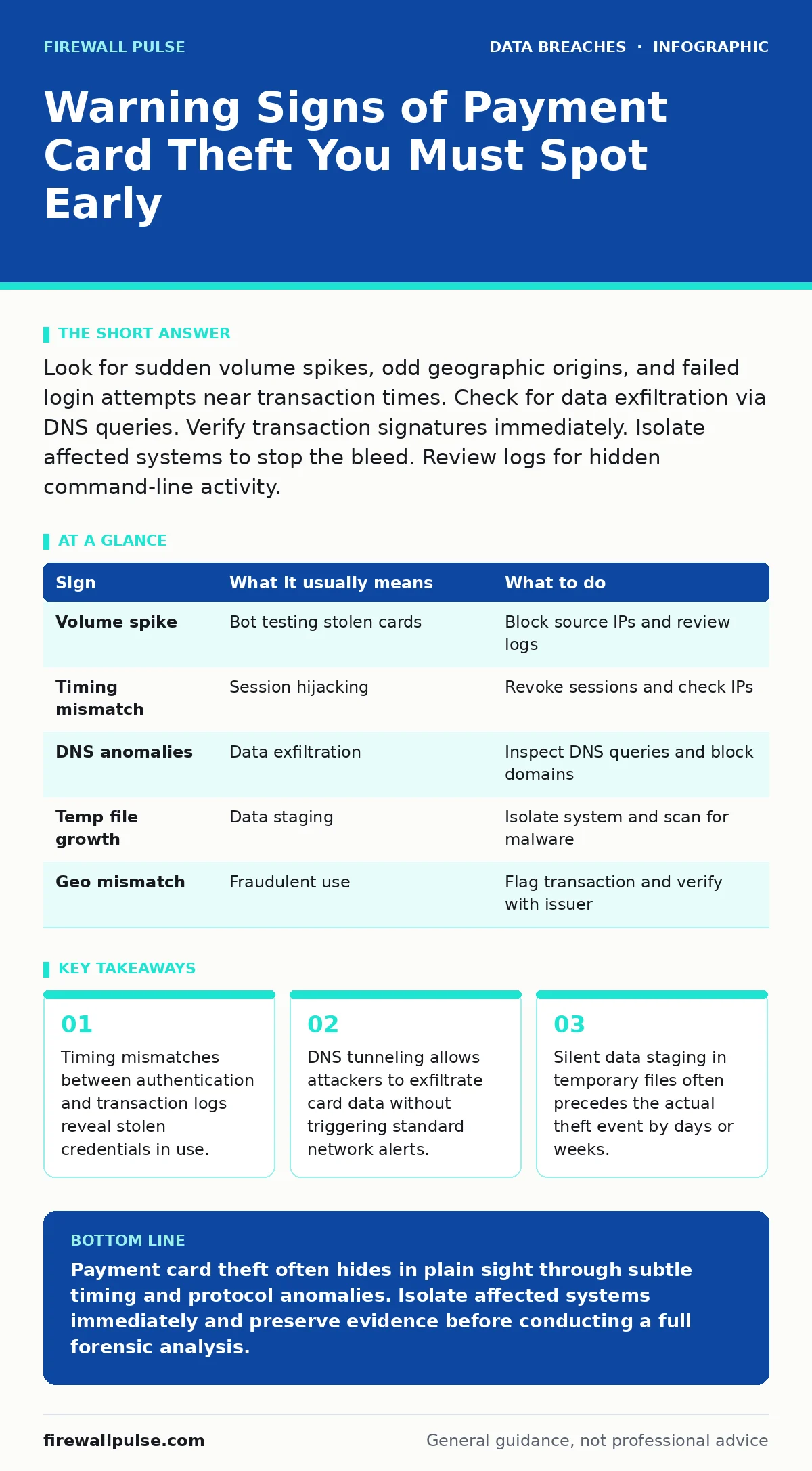
Look for sudden volume spikes, odd geographic origins, and failed login attempts near transaction times. Check for data exfiltration via DNS queries. Verify transaction signatures immediately. Isolate affected systems to stop the bleed. Review logs for hidden command-line activity.
The Obvious Alarm Bells
You will usually see the loud signals first. These are the signs that trigger immediate alarms in most security information and event management systems. They are easy to spot because they violate basic operational norms.
Sudden spikes in transaction volume are a primary indicator. If your processing servers handle twice the normal load at 3:00 am, something is wrong. This often signals a botnet using stolen card details to test validity.
Failed authentication attempts preceding successful transactions are another clear sign. Attackers often try multiple passwords or PINs before finding one that works. Your logs will show a cluster of failures followed by a single success.
Geographic anomalies also stand out. If a card issued in London is used to make a purchase in a country where your customers never shop, flag it. These mismatches are rare in legitimate business operations.
The Silent Indicators
The signs that are easy to miss are far more dangerous. They blend into the noise of normal system activity. You must look for subtle deviations rather than loud alarms.
Timing mismatches between different log sources are a hidden red flag. Suppose a user logs in at 10:00 am, but a transaction occurs at 10:05 am from a different IP address. This gap suggests session hijacking or credential stuffing.
DNS query patterns can reveal data theft. Attackers encode stolen card data into domain name requests. This technique, known as DNS tunneling, looks like normal web browsing to basic filters. You need deep packet inspection to see the encoded data.
Temporary file creation is another silent sign. Attackers often stage stolen data in temporary directories before exfiltrating it. These files may have generic names and small sizes, making them easy to overlook during routine audits.
Decoding the Data Exfiltration
Data exfiltration rarely happens in one large transfer. Attackers break data into small chunks to avoid detection. This method is called low-and-slow exfiltration.
You should monitor outbound traffic for unusual protocols. If your servers start sending data to unknown external endpoints, investigate immediately. This often indicates that card data has already been stolen.
Check for encryption changes in outbound traffic. If a server that usually sends plain text suddenly starts sending encrypted data, an attacker may be masking their activity. This deviation is a strong sign of compromise.
Immediate Containment Steps
When you spot a sign, act quickly. Speed is critical in limiting the damage. Do not wait for full confirmation before taking initial steps.
Isolate the affected system from the network. This stops the attacker from moving laterally to other servers. Keep the system powered on to preserve memory evidence.
Revoke all active sessions for the affected accounts. This forces attackers to re-authenticate, which may fail if you have changed credentials. Monitor these accounts closely for new login attempts.
Review related systems for similar signs. Attackers often compromise multiple systems in a single campaign. One sign in one system may indicate a broader breach.
Investigating the Root Cause
After containment, you must understand how the theft occurred. This helps you prevent future incidents. Focus on the initial entry point.
Check for unpatched vulnerabilities. Attackers often exploit known flaws in software. Ensure all systems are up to date with the latest security patches.
Review access controls. Ensure that only authorised personnel can access payment data. Implement role-based access control to limit exposure. This reduces the risk of insider threats.
Examine third-party connections. Attackers often target weaker partners to gain access to your network. Conduct regular third-party risk assessments to identify weak links.
See also: Stop Unauthorized Access: Practical Controls That Actually Work · Leaked Source Code: How to Contain and Neutralise the Threat
Preventing Future Incidents
Prevention requires a layered approach. No single measure is enough. You must combine technical controls with process improvements.
Implement end-to-end encryption for card data. This ensures that data is unreadable if stolen. Use strong key management practices to protect encryption keys.
Monitor for unusual behaviour continuously. Set up alerts for deviations from normal patterns. This helps you catch attacks early, before data is exfiltrated.
Train staff to recognise phishing attempts. Social engineering is a common entry point. Employees must know how to identify and report suspicious emails.
| Sign | What it usually means | What to do |
|---|---|---|
| Volume spike | Bot testing stolen cards | Block source IPs and review logs |
| Timing mismatch | Session hijacking | Revoke sessions and check IPs |
| DNS anomalies | Data exfiltration | Inspect DNS queries and block domains |
| Temp file growth | Data staging | Isolate system and scan for malware |
| Geo mismatch | Fraudulent use | Flag transaction and verify with issuer |
Maintaining Evidence Integrity
If you suspect a breach, preserve evidence correctly. This is vital for legal and forensic purposes. Follow strict chain of custody procedures.
Document every action you take. Record timestamps and personnel involved. This creates a reliable record of your response.
Create forensic images of affected systems. Do not modify original data. Use write-blockers to prevent accidental changes.
Consult legal counsel early. They can advise on notification requirements and liability. This helps you manage the aftermath effectively.
Key takeaways
- Timing mismatches between authentication and transaction logs reveal stolen credentials in use.
- DNS tunneling allows attackers to exfiltrate card data without triggering standard network alerts.
- Silent data staging in temporary files often precedes the actual theft event by days or weeks.
Payment card theft often hides in plain sight through subtle timing and protocol anomalies. Isolate affected systems immediately and preserve evidence before conducting a full forensic analysis.
Frequently asked questions
How do I detect DNS tunneling without expensive tools?
Monitor for unusually long domain names or high volumes of DNS queries to single domains. These patterns often indicate data exfiltration.
What is the first step after spotting a suspicious transaction?
Isolate the affected system from the network to prevent further data loss. Do not power it off, as this destroys memory evidence.
Can role-based access control stop payment card theft?
It limits exposure by ensuring only authorised users can access data. This reduces the risk of insider threats and lateral movement by attackers.
How often should I review third-party risk assessments?
Review them regularly, especially after major changes in your vendor's security posture. Continuous monitoring is more effective than annual reviews.
How this guide was produced: written by the Firewall Pulse editorial team with AI assistance, checked against the public references listed below, and reviewed when the facts change. See our editorial policy or report an error.