Cyber Espionage Explained: How Silent Theft Works and How to Stop It
Espionage rarely involves dramatic break-ins; it relies on slow, patient data exfiltration that mimics normal network traffic to avoid detection.
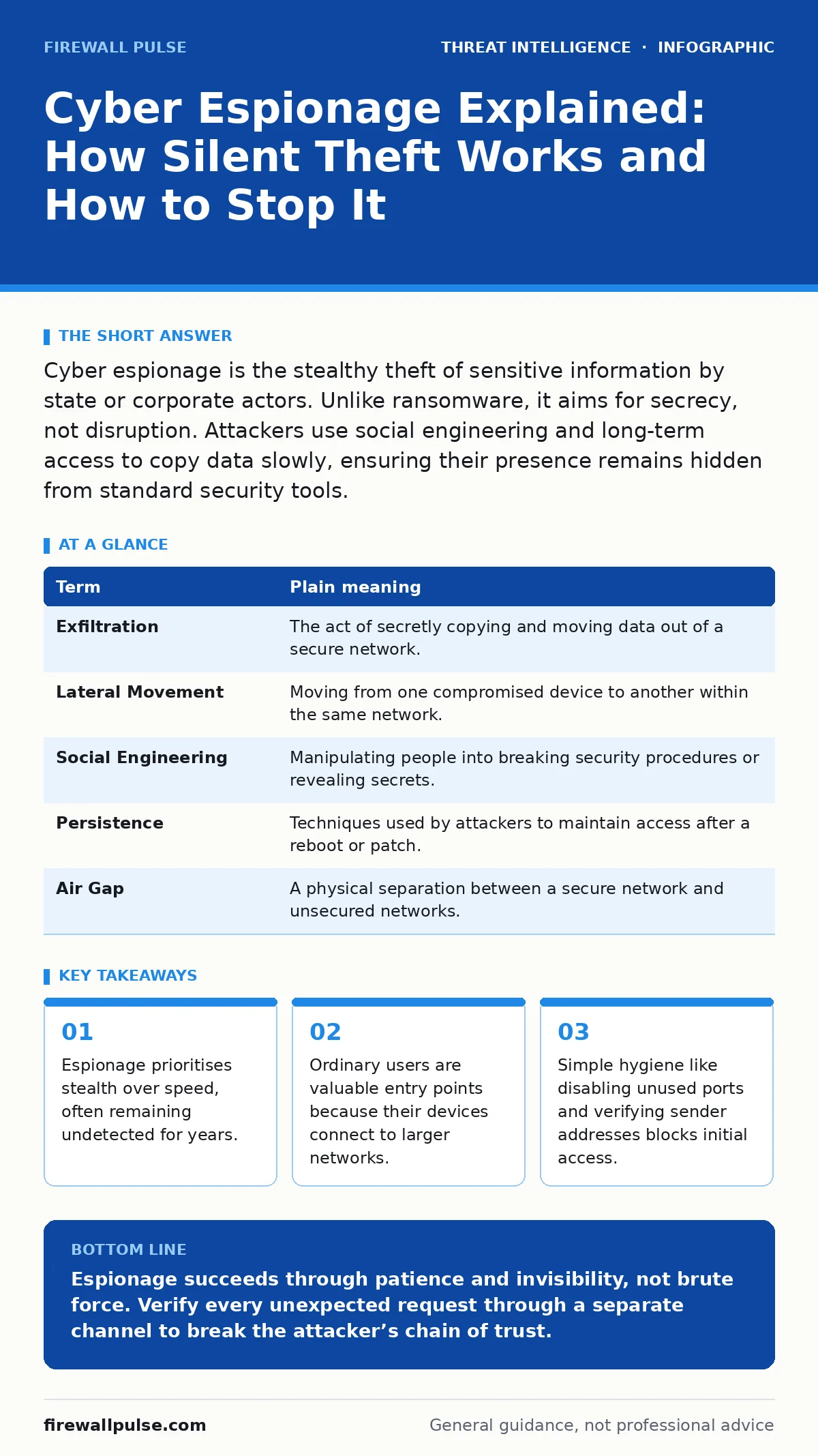
Cyber espionage is the stealthy theft of sensitive information by state or corporate actors. Unlike ransomware, it aims for secrecy, not disruption. Attackers use social engineering and long-term access to copy data slowly, ensuring their presence remains hidden from standard security tools.
The Library Heist Analogy
Imagine a vast library containing millions of books. A common thief might smash a window, grab several encyclopaedias, and run. Security cameras would catch them immediately. They are loud, fast, and easily stopped.
Now imagine a different person. They buy a library card. They visit once a week. They check out one obscure technical manual, read it carefully, and return it. Over five years, they reconstruct the entire library’s secret archive, one page at a time.
This is how cyber espionage works. It is not about breaking in; it is about belonging. The attacker does not want to trigger alarms. They want to blend in with the regular noise of daily operations so that their data theft looks like normal work.
Defining the Silent Threat
To understand this threat, you must separate it from common malware. Ransomware locks your files and demands payment. It is disruptive by design. Espionage is the opposite. The attacker wants you to keep working normally so they can keep watching.
They often target organisations that hold intellectual property, government secrets, or financial records. However, they rarely attack the main server directly. Instead, they look for a weak link in the chain. That link is often an ordinary user who clicks a link or opens an attachment.
This approach relies on attacker reconnaissance, where the adversary spends months learning how your team communicates and what software you use. They study your public footprint to find the path of least resistance.
Why Ordinary Users Matter
You might assume you are too small to be a target. This is a dangerous misconception. Espionage groups often target mid-level employees or contractors because they have access to internal networks but less rigorous security training than executives.
Suppose you receive an email that looks like a routine invoice. You open the attachment. It contains a hidden script that installs a tool allowing remote access. You do not notice anything wrong. Your computer continues to function. But now, the attacker has a foothold.
They use this foothold to move laterally. They move from your device to a shared drive, then to a server. This process is known as living-off-the-land attacks, where they use legitimate system tools to hide their malicious activity.
The Cost of Stealth
The danger of espionage is not just the loss of data. It is the time it takes to discover the breach. Standard antivirus software looks for known bad signatures. It scans for viruses and trojans. It does not look for unusual behaviour that mimics normal activity.
An attacker who copies one kilobyte of data every hour will not trigger bandwidth alerts. They stay below the threshold of suspicion. This patience allows them to build a detailed map of your network.
This is why mean time to detect is a critical metric. The longer an attacker stays hidden, the more damage they can do. They may install backdoors that survive system updates, ensuring they can return even if you patch the original vulnerability.
Mini Glossary
| Term | Plain meaning |
|---|---|
| Exfiltration | The act of secretly copying and moving data out of a secure network. |
| Lateral Movement | Moving from one compromised device to another within the same network. |
| Social Engineering | Manipulating people into breaking security procedures or revealing secrets. |
| Persistence | Techniques used by attackers to maintain access after a reboot or patch. |
| Air Gap | A physical separation between a secure network and unsecured networks. |
See also: Implement Mean Time to Detect: A Step-by-Step Rollout Plan · Fast Flux DNS: How Attackers Hide Malware and How to Stop It
Simple Safety Habits
You can reduce your risk by adopting habits that disrupt the attacker’s need for stealth. These steps are simple but effective because they target the initial entry points.
- Verify the sender. Do not trust the display name in an email. Check the actual email address. If it looks slightly off, delete it. Attackers often use addresses that mimic colleagues or trusted vendors.
- Disable unused ports. If you do not need USB ports, disable them via group policy or physically block them. This prevents attackers from inserting malicious hardware or copying data via a thumb drive.
- Use hardware keys. Passwords can be stolen or phished. Hardware security keys provide physical proof of identity. They are much harder to compromise remotely.
Detecting the Invisible
Standard defenses are not enough. You need tools that look for behaviour, not just signatures. Network detection and response systems monitor traffic patterns. They can spot the slow, steady flow of data that indicates exfiltration.
You should also consider threat intelligence sharing. By participating in industry groups, you learn about new tactics before they hit your network. This allows you to update your rules proactively.
Advanced Defences
For deeper protection, organisations use YARA rules. These are pattern-matching tools that can identify specific malware strains or suspicious code structures. They allow security teams to find hidden files that antivirus might miss.
Another concern is fast flux DNS, a technique used by attackers to hide their command-and-control servers. By rapidly changing IP addresses, they make it hard to block their infrastructure. Your security team must monitor for unusual DNS queries.
Finally, understand the Unified Kill Chain. This framework helps you map every stage of an attack. By identifying gaps in your defences at each stage, you can stop attackers before they reach their goal.
The Human Factor
Technology alone cannot stop espionage. The attacker’s best tool is human error. They exploit trust, curiosity, and urgency. They craft messages that feel personal and immediate.
You must cultivate a culture of healthy scepticism. If a request feels wrong, it probably is. Take the time to verify through a secondary channel. Call the colleague instead of replying to the email.
This hesitation is your strongest defence. It breaks the attacker’s momentum. They rely on speed and automation. Your careful verification forces them to slow down and adapt, increasing the risk of detection.
Key takeaways
- Espionage prioritises stealth over speed, often remaining undetected for years.
- Ordinary users are valuable entry points because their devices connect to larger networks.
- Simple hygiene like disabling unused ports and verifying sender addresses blocks initial access.
Espionage succeeds through patience and invisibility, not brute force. Verify every unexpected request through a separate channel to break the attacker’s chain of trust.
Frequently asked questions
Can I be targeted if I work for a small company?
Yes. Small companies often serve as stepping stones to larger partners or suppliers with higher value data.
Does using a VPN protect me from espionage?
A VPN encrypts your traffic but does not prevent you from downloading malware or being phished. It hides your location, not your actions.
How do attackers stay hidden for so long?
They use legitimate system tools and mimic normal user behaviour, making their activity indistinguishable from daily work without advanced monitoring.
What is the first sign of an espionage attack?
Often there is no visible sign. Indicators may include slight performance drops, unexpected network connections, or files being accessed at odd hours.
How this guide was produced: written by the Firewall Pulse editorial team with AI assistance, checked against the public references listed below, and reviewed when the facts change. See our editorial policy or report an error.