7 Mistakes That Leave You Open to Supply Chain Attacks
Most supply chain breaches occur because organisations trust external software without verifying the integrity of the build process or limiting access rights.

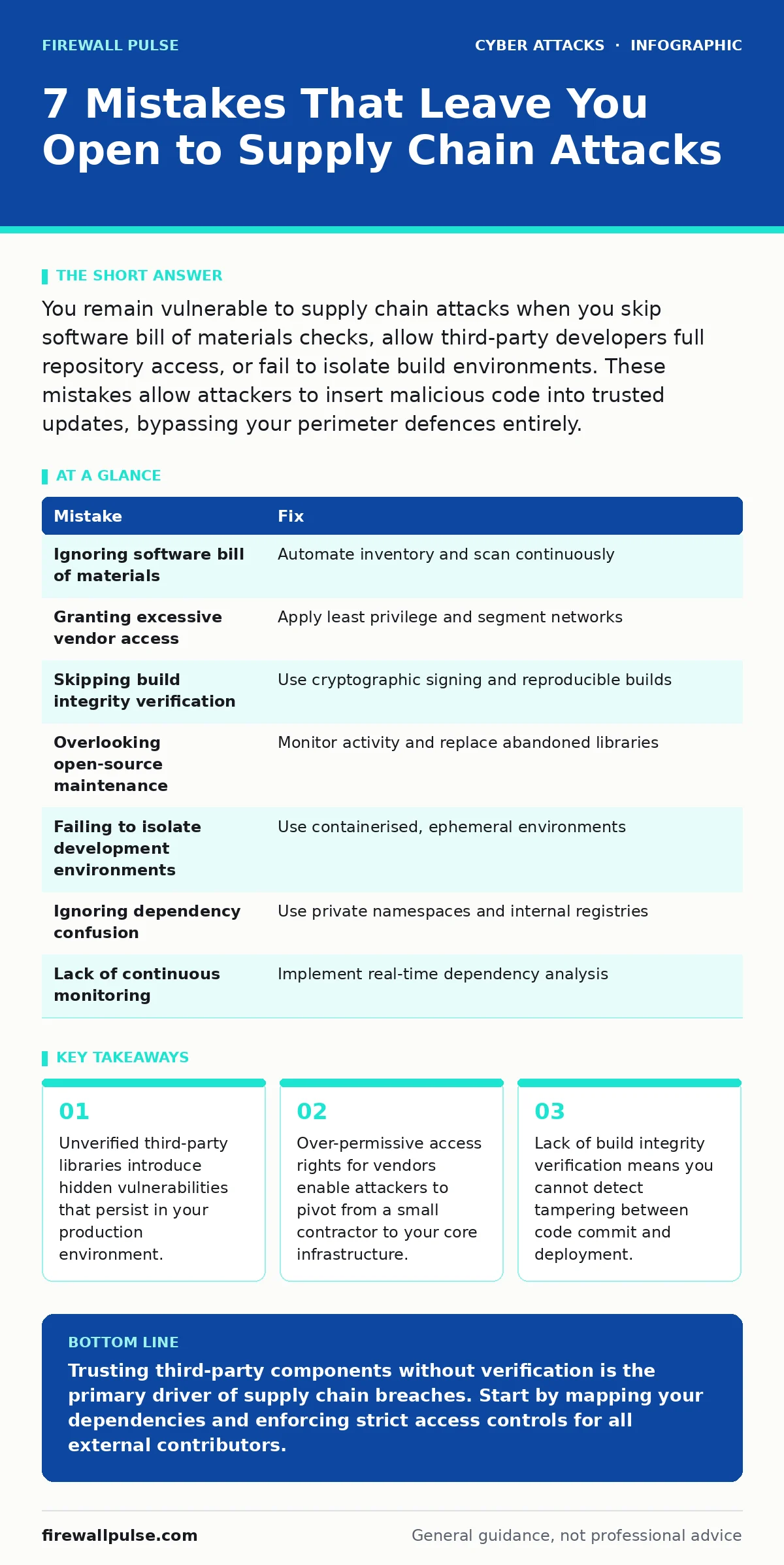
You remain vulnerable to supply chain attacks when you skip software bill of materials checks, allow third-party developers full repository access, or fail to isolate build environments. These mistakes allow attackers to insert malicious code into trusted updates, bypassing your perimeter defences entirely.
Mistake 1: Ignoring software bill of materials
You fail to maintain a current record of every component in your software stack. A software bill of materials lists all third-party libraries, open-source modules and dependencies used in your applications. Without this inventory, you cannot determine which systems require patching when a vulnerability is disclosed in a widely used library.
Why it hurts:
Attackers target popular, unmaintained libraries because a single compromise affects thousands of downstream users. If you do not know you are using a vulnerable component, you cannot apply a fix. This blind spot turns a minor dependency into a critical entry point for malware that masquerades as a legitimate update.
The fix:
Implement automated scanning tools that generate and update your software bill of materials continuously. Integrate these checks into your development pipeline so that any new dependency is vetted before merging. This practice aligns with broader attack surface reduction strategies by ensuring you only expose known, safe components to your users.
Mistake 2: Granting excessive vendor access
You provide third-party developers and support staff with the same network permissions as internal engineers. This includes access to source code repositories, build servers and deployment pipelines. Convenience often drives this decision, but it removes the boundary between trusted internal operations and external influence.
Why it hurts:
A compromised vendor credential becomes a direct bridge into your core systems. Attackers exploit weak authentication on vendor devices to pivot into your environment. This bypasses your perimeter defences entirely, as the traffic originates from a trusted source. The breach appears legitimate to standard monitoring systems.
The fix:
Apply the principle of least privilege strictly to all external accounts. Use just-in-time access that expires after a defined period. Isolate vendor workstations in separate network segments that cannot communicate with production servers. This segmentation limits the blast radius if a vendor account is compromised through phishing or brute force attacks.
Mistake 3: Skipping build integrity verification
You trust that the code you committed is the code that runs in production. This assumption ignores the risk of tampering during the compilation and packaging phase. Build servers are high-value targets because compromising them allows an attacker to modify binaries without changing the source code visible to reviewers.
Why it hurts:
Malicious code inserted during the build process is invisible to source code reviews. The resulting binary passes standard security checks because the source appears clean. This technique allows attackers to persist in your environment long after you have scanned your repositories for known vulnerabilities.
The fix:
Use cryptographic signing for all build artifacts. Verify these signatures before deploying any software to production. Implement reproducible builds, where the same source code always produces the exact same binary. This ensures that any unexpected change in the output triggers an immediate alert.
Mistake 4: Overlooking open-source maintenance
You rely on popular open-source libraries but do not monitor their maintenance status. Many widely used projects are maintained by single volunteers who may abandon the project. When maintenance ceases, security patches stop arriving, leaving your application exposed to newly discovered vulnerabilities.
Why it hurts:
Abandoned software becomes a liability. Attackers scan for applications using known, unpatched libraries. Once they identify a vulnerable component, they can exploit it remotely. This risk grows as your software ages, making legacy code a persistent threat that requires active management rather than passive trust.
The fix:
Monitor the maintenance activity of all third-party dependencies. Replace abandoned libraries with actively maintained alternatives. Contribute to or sponsor critical projects to ensure their continued security. This proactive approach prevents you from inheriting the technical debt and security risks of unmaintained code.
Mistake 5: Failing to isolate development environments
You allow developers to run production-like environments on their local machines without strict controls. This practice enables rapid development but introduces the risk of credential leakage and malware infection. Local machines are often less secure than server infrastructure, lacking rigorous patching and monitoring.
Why it hurts:
A developer’s infected laptop can introduce malware into the build pipeline. Credentials stored locally can be harvested and used to access production systems. This vector is particularly dangerous because it bypasses network-level defences that assume internal traffic is safe. The breach originates from within your trusted perimeter.
The fix:
Use containerised or virtualised development environments that are ephemeral and isolated. Do not allow direct access to production credentials from local machines. Implement strict egress filtering to prevent infected devices from communicating with external command and control servers. This reduces the risk of credential theft and lateral movement.
See also: How Email Filtering Works: The Hidden Stages Before Inbox Delivery · What Does Zero Trust Security Mean: The Architecture of Continuous Verification
Mistake 6: Ignoring dependency confusion
You host internal packages in the same namespace as public repositories without proper access controls. Attackers can exploit this by publishing malicious packages with the same name as your internal ones. If your build system checks public repositories first, it may download the malicious version instead of the legitimate internal package.
Why it hurts:
This technique allows attackers to inject code into your build process without needing to compromise your internal systems. The malicious package appears legitimate because it shares the same name as an internal component. This bypasses standard access controls and can execute arbitrary code during the build phase.
The fix:
Rename internal packages to use private namespaces that cannot be guessed. Configure build systems to check internal repositories before public ones. Use private package registries that require authentication for any download. This prevents attackers from hijacking your dependency resolution process.
Mistake 7: Lack of continuous monitoring
You rely on periodic security audits rather than continuous monitoring of your supply chain. Static assessments provide a snapshot in time but miss dynamic changes introduced by new dependencies or updates. The supply chain is constantly evolving, requiring ongoing vigilance to detect anomalies.
Why it hurts:
New vulnerabilities emerge daily. A system that was secure last month may be vulnerable today due to a newly disclosed flaw in a dependency. Without continuous monitoring, you remain exposed until the next audit cycle. This delay gives attackers ample time to exploit known weaknesses in your software stack.
The fix:
Implement continuous monitoring tools that analyse your dependencies in real-time. Alert on any changes to critical libraries or unexpected access patterns. Integrate these alerts into your security operations centres for rapid response. This ensures that you detect and remediate threats before they can be exploited.
| Mistake | Fix |
|---|---|
| Ignoring software bill of materials | Automate inventory and scan continuously |
| Granting excessive vendor access | Apply least privilege and segment networks |
| Skipping build integrity verification | Use cryptographic signing and reproducible builds |
| Overlooking open-source maintenance | Monitor activity and replace abandoned libraries |
| Failing to isolate development environments | Use containerised, ephemeral environments |
| Ignoring dependency confusion | Use private namespaces and internal registries |
| Lack of continuous monitoring | Implement real-time dependency analysis |
Key takeaways
- Unverified third-party libraries introduce hidden vulnerabilities that persist in your production environment.
- Over-permissive access rights for vendors enable attackers to pivot from a small contractor to your core infrastructure.
- Lack of build integrity verification means you cannot detect tampering between code commit and deployment.
Trusting third-party components without verification is the primary driver of supply chain breaches. Start by mapping your dependencies and enforcing strict access controls for all external contributors.
Frequently asked questions
How do I detect if a library has been compromised?
Monitor for unexpected changes in library hashes or signatures. Look for sudden spikes in downloads or new, unverified maintainers. Compare the current binary against known good versions.
What is the difference between direct and transitive dependencies?
Direct dependencies are libraries you explicitly import. Transitive dependencies are libraries required by those libraries. Both pose risks, but transitive dependencies are harder to track and often overlooked.
Can open-source software be secure?
Yes, if it is actively maintained and regularly audited. The key is to treat open-source components with the same scrutiny as proprietary software, verifying their integrity and monitoring for updates.
How often should I update my software bill of materials?
It should be updated automatically with every build or deployment. Manual updates are prone to error and delay. Automation ensures your inventory always reflects the current state of your software.
How this guide was produced: written by the Firewall Pulse editorial team with AI assistance, checked against the public references listed below, and reviewed when the facts change. See our editorial policy or report an error.