SOAR Explained: Automating Security Operations Without Breaking Things
Automation amplifies existing process flaws, turning a slow manual error into a rapid, widespread outage that requires immediate architectural review.

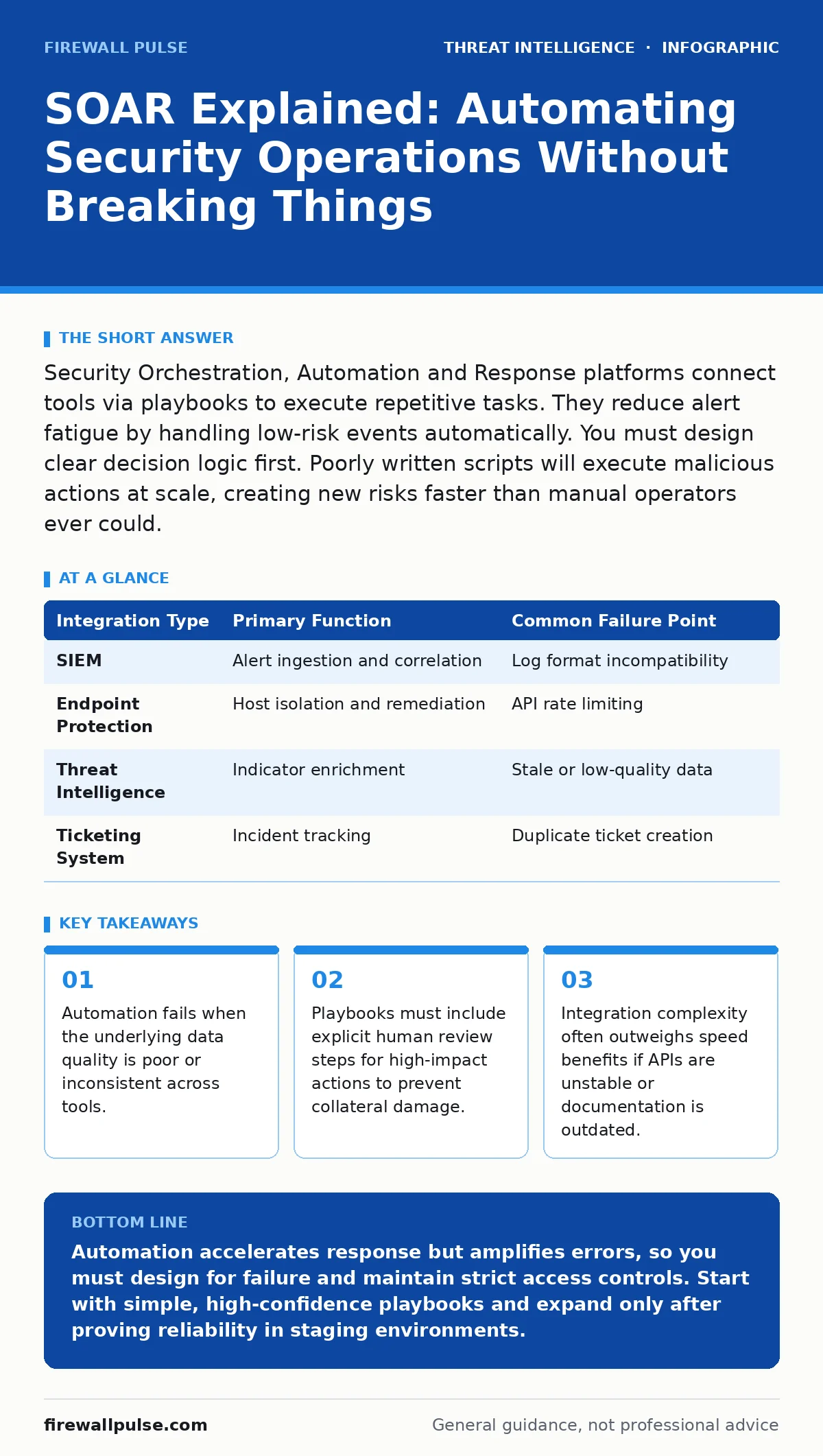
Security Orchestration, Automation and Response platforms connect tools via playbooks to execute repetitive tasks. They reduce alert fatigue by handling low-risk events automatically. You must design clear decision logic first. Poorly written scripts will execute malicious actions at scale, creating new risks faster than manual operators ever could.
What is SOAR and how does it differ from SIEM?
Security Orchestration, Automation and Response platforms connect disparate security tools to execute predefined workflows, whereas Security Information and Event Management systems primarily collect and correlate log data. A SIEM tells you what happened; a SOAR acts on that information. The SIEM aggregates logs from endpoints, firewalls and servers into a centralised repository for analysis. The SOAR takes an alert from that repository and triggers a sequence of actions, such as isolating a host or querying a threat intelligence database. You use SIEM for visibility and SOAR for action.
Does SOAR replace security analysts or change their role?
SOAR removes repetitive triage tasks but increases the demand for logic design and exception handling. Analysts shift from clicking through alerts to reviewing automated decisions and managing complex incidents. This change requires new skills in scripting and workflow design. You stop investigating every single phishing email. Instead, you investigate why the automation failed to categorise a specific variant correctly. The role becomes more engineering-focused and less operational.
How do playbooks handle ambiguous or uncertain alerts?
Playbooks must include explicit branching logic for uncertainty, often defaulting to human review when confidence scores are low. An automated system cannot guess intent. It follows rules. If a rule states "block IP if threat score exceeds 80", the system blocks it. If the score is 79, the playbook should assign the ticket to an analyst. Ambiguity breaks automation. You must define thresholds for automated action versus manual intervention clearly. This prevents over-blocking legitimate traffic or under-reacting to genuine threats.
What are the hidden costs of implementing SOAR?
Integration maintenance, content licensing and workflow design time consume significant resources beyond the initial platform cost. Each connected tool requires an API connection that needs testing and updating when the vendor changes their interface. You pay for every action the system performs, whether it is a simple lookup or a complex isolation sequence. Hidden costs include the engineering hours spent debugging failed API calls. The platform is cheap; the content and integration work are expensive.
How does SOAR interact with threat intelligence sharing?
SOAR platforms ingest indicators from external feeds and internal repositories to enrich alerts in real time. They compare observed activity against known malicious patterns. This integration allows for faster containment of recognised threats. You can automate the blocking of domains associated with fast flux DNS networks. The system checks the observed domain against a list of known bad actors. If there is a match, the playbook executes a block rule immediately. This reduces the time between detection and mitigation.
| Integration Type | Primary Function | Common Failure Point |
|---|---|---|
| SIEM | Alert ingestion and correlation | Log format incompatibility |
| Endpoint Protection | Host isolation and remediation | API rate limiting |
| Threat Intelligence | Indicator enrichment | Stale or low-quality data |
| Ticketing System | Incident tracking | Duplicate ticket creation |
See also: Build a Security Operations Center: A Practical Implementation Plan · How Breach Notification Letters Work: The Hidden Mechanics
Can automation exacerbate privilege escalation attacks?
Yes, if playbooks grant excessive permissions to automated service accounts or execute commands without sufficient validation. An attacker who compromises a service account used by the SOAR platform can trigger malicious playbooks. These playbooks might create new admin users or disable security controls. You must apply least privilege principles to automation accounts. Never allow an automated script to modify firewall rules or create administrative users without multi-factor verification. Automation amplifies access, making credential theft more dangerous.
How do you handle false positives in automated responses?
False positives cause unnecessary disruption and erode trust in the automation system, requiring constant tuning of detection rules. If a playbook blocks a legitimate server, business operations suffer. You must implement rollback mechanisms in every playbook. If an automated action causes an outage, the system must be able to reverse it automatically. Include feedback loops where analysts can flag false positives. This data feeds back into the detection engineering process to refine future rules. Reducing noise is a continuous effort.
What is the role of YARA rules in SOAR workflows?
YARA rules identify and describe families of malware files by matching specific patterns, which SOAR platforms can use to automate file analysis. When a SIEM detects a suspicious file, the SOAR can download it to a sandbox and run YARA scans. If a match occurs, the playbook can automatically quarantine the file and block related hashes. This integrates static analysis into your automated response chain. You do not need to manually inspect every suspicious binary. The system uses pattern matching to make rapid decisions.
How do you measure the success of a SOAR programme?
Success is measured by mean time to respond, reduction in manual effort and the accuracy of automated actions, not just the number of alerts processed. Track how many incidents are resolved without human intervention. Measure the time saved per incident. If analysts are spending more time fixing automation errors than investigating threats, the programme is failing. Regular audits of playbook effectiveness are necessary to maintain efficiency.
How does SOAR support strategic threat intelligence?
SOAR platforms aggregate operational data that feeds into broader strategic assessments, helping leaders understand long-term trends. While SOAR handles immediate incidents, the data it collects reveals patterns in attack techniques. You can analyse which tactics are most common and adjust defensive strategies accordingly. This connects tactical response to strategic planning. The automation provides the raw data; the analysts interpret it to inform future security investments. This bridge between operation and strategy is vital for mature programmes.
Key takeaways
- Automation fails when the underlying data quality is poor or inconsistent across tools.
- Playbooks must include explicit human review steps for high-impact actions to prevent collateral damage.
- Integration complexity often outweighs speed benefits if APIs are unstable or documentation is outdated.
Automation accelerates response but amplifies errors, so you must design for failure and maintain strict access controls. Start with simple, high-confidence playbooks and expand only after proving reliability in staging environments.
Frequently asked questions
Does SOAR require coding skills?
Basic implementation often uses visual drag-and-drop interfaces, but advanced customisation and integration debugging require scripting knowledge in languages like Python or PowerShell.
Can SOAR replace a threat hunting team?
No, SOAR automates known response patterns, whereas threat hunting involves proactive investigation of novel threats that existing rules do not yet detect.
How often should playbooks be reviewed?
Review playbooks quarterly or whenever connected tools update their APIs, ensuring logic remains valid and permissions align with current security policies.
Is SOAR suitable for small teams?
Small teams benefit most from basic automation of repetitive tasks, but complex orchestration may require more engineering resources than available initially.
How this guide was produced: written by the Firewall Pulse editorial team with AI assistance, checked against the public references listed below, and reviewed when the facts change. See our editorial policy or report an error.