YARA Rules: Pattern Matching for Malware Detection
YARA rules allow you to find specific malware variants by matching structural patterns rather than relying on volatile file hashes or network signatures.

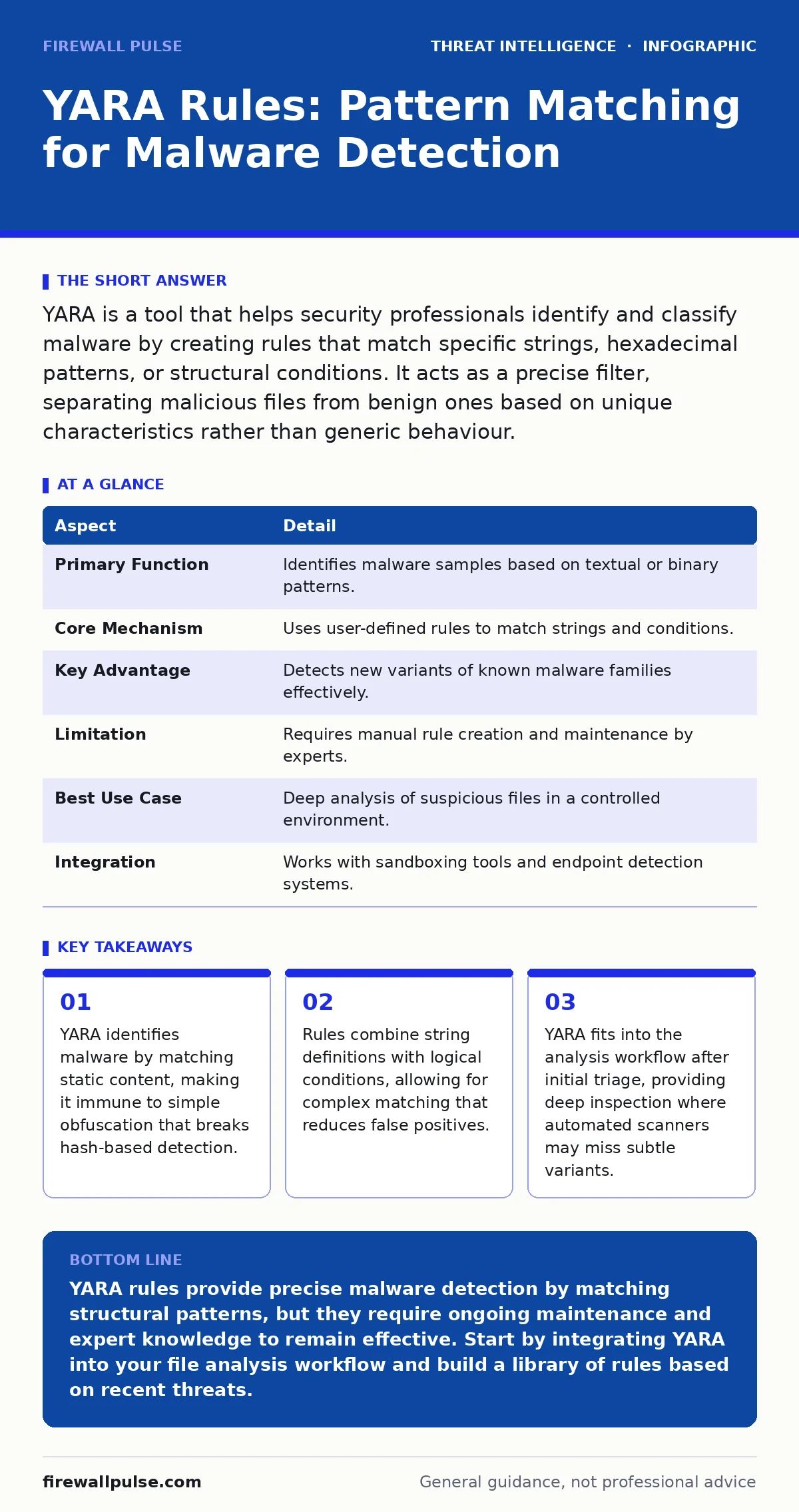
YARA is a tool that helps security professionals identify and classify malware by creating rules that match specific strings, hexadecimal patterns, or structural conditions. It acts as a precise filter, separating malicious files from benign ones based on unique characteristics rather than generic behaviour.
The Needle in the Haystack
Imagine you are looking for a specific letter in a room full of books. You do not know the exact title, but you know the author uses a particular phrase on every third page. You scan the pages for that phrase. If you find it, you have found the book. This is how YARA works. It does not look at the whole file at once. It looks for specific patterns inside the data.
Most automated security tools rely on file hashes. A hash is a unique fingerprint of a file’s exact contents. If an attacker changes even one byte of the malware, the hash changes. The old rule no longer matches. This is why hash-based detection fails against polymorphic malware. YARA solves this by looking for structural similarities. It finds the "phrase" even if the "book" has been rewritten.
| Aspect | Detail |
|---|---|
| Primary Function | Identifies malware samples based on textual or binary patterns. |
| Core Mechanism | Uses user-defined rules to match strings and conditions. |
| Key Advantage | Detects new variants of known malware families effectively. |
| Limitation | Requires manual rule creation and maintenance by experts. |
| Best Use Case | Deep analysis of suspicious files in a controlled environment. |
| Integration | Works with sandboxing tools and endpoint detection systems. |
Anatomy of a Rule
A YARA rule is a text file that defines what you are looking for. It has three main parts. The header defines the rule’s name and metadata. The strings section lists the patterns to match. The condition section defines the logic for when the rule triggers.
The header is simple. It starts with the keyword rule followed by a unique name. You can add tags here to categorise the rule. This helps you organise your library. For example, you might tag a rule with malware or ransomware. This metadata does not affect the matching logic. It helps you manage the rules later.
The strings section is the heart of the rule. You define text strings, hexadecimal sequences, or regular expressions. A text string is a simple sequence of characters. A hexadecimal string allows you to match binary data that does not have a text representation. Regular expressions allow for complex pattern matching. You assign each string a variable name. This name is used in the condition section.
The condition section uses boolean logic. It combines the string variables with operators like and, or, and not. It can also check file properties, such as the file size or the presence of specific sections in a PE file. This logic determines when the rule fires. A well-written condition is specific enough to avoid false positives but broad enough to catch variants.
Where It Fits in Defence
YARA is not a standalone defence. It is an analysis tool. It sits between initial detection and deep investigation. When your network detection and response system flags suspicious activity, you often get a file sample. YARA helps you determine what that file is. It answers the question: "Is this file malicious, and if so, what family does it belong to?"
This is different from antivirus software. Antivirus uses a large database of known signatures. YARA uses rules you write or receive from threat intelligence sharing platforms. This gives you control over what you detect. You can write rules for internal threats that commercial vendors do not know about. This is vital for protecting against targeted attacks.
YARA also helps with attacker persistence techniques. Attackers often use living-off-the-land attacks, which means they use legitimate system tools to hide their activity. YARA can identify these tools when they are modified or used in unusual ways. By matching specific modifications to legitimate binaries, you can detect these subtle signs of compromise.
The Hidden Cost of Precision
Writing good YARA rules is hard. It requires deep knowledge of malware structure. You must understand how compilers work, how obfuscation hides strings, and how packers compress code. If you do not understand these mechanics, your rules will fail. They will either miss the malware or flag too many benign files.
This is the hidden cost of YARA. It shifts the burden from the tool to the analyst. You must spend time analysing malware to write effective rules. This is not a set-and-forget solution. It requires continuous effort. You must update your rules as malware evolves. If an attacker changes their encryption routine, your rule will stop working. You must analyse the new variant and update the rule.
This effort pays off in reduced noise. Generic detection methods generate many false positives. YARA rules, when written correctly, are very precise. They reduce the number of alerts you must investigate. This improves your mean time to detect because you spend less time filtering false alarms. However, this precision comes at the cost of coverage. You only detect what you have written rules for.
Common Mistakes to Avoid
Many teams make the same mistakes when writing YARA rules. The most common error is using strings that are too common. For example, matching on the word "password" will flag many legitimate files. You must choose strings that are unique to the malware. This often means looking at binary data or specific combinations of strings.
Another mistake is ignoring file structure. Malware often hides in specific sections of a file. If you only match on raw strings, you may miss the malware if it is packed or encrypted. You should use YARA’s ability to check file headers and sections. This adds another layer of verification. It ensures the file has the structure expected of the malware family.
Finally, do not rely on YARA alone. It is a static analysis tool. It cannot see behaviour. A file may match a YARA rule but be benign. Or a file may not match any rule but be malicious. You must combine YARA with dynamic analysis. Run the file in a sandbox to see what it does. This combination of static and dynamic analysis provides the most complete picture.
See also: Implement Mean Time to Detect: A Step-by-Step Rollout Plan · Unified Kill Chain: The 10 Questions You Need Answered
Integrating with SOC Playbooks
YARA rules should be part of your SOC playbooks. When an alert triggers, your playbook should include steps to run relevant YARA rules. This ensures consistent analysis. It also helps junior analysts learn what to look for. Over time, your library of rules becomes a knowledge base for your team.
You can automate this process. Integrate YARA with your sandboxing tools. When a file is submitted for analysis, the sandbox runs your YARA rules automatically. The results are included in the report. This speeds up the analysis process. It also ensures that no file escapes your custom detection logic.
This integration supports threat intelligence sharing. You can share your YARA rules with other organisations. They can use your rules to detect the same threats. In return, they can share their rules with you. This collective defence makes it harder for attackers to hide. It turns individual analysis into a community effort.
The Future of Pattern Matching
Malware authors are aware of YARA. They use techniques to evade it. They obfuscate strings, encrypt payloads, and use packers. This means your rules must evolve. You must look beyond simple string matching. You must use YARA’s advanced features, such as regular expressions and file module checks.
You should also consider using YARA in conjunction with other tools. Machine learning models can identify suspicious files based on behaviour. YARA can then confirm the specific malware family. This hybrid approach combines the strengths of both methods. It provides broader coverage and higher precision.
The key is to stay adaptable. Do not rely on a single method of detection. Use YARA as one part of a layered defence. Combine it with network monitoring, endpoint detection, and user behaviour analytics. This ensures that you can detect threats even if one method fails.
Key takeaways
- YARA identifies malware by matching static content, making it immune to simple obfuscation that breaks hash-based detection.
- Rules combine string definitions with logical conditions, allowing for complex matching that reduces false positives.
- YARA fits into the analysis workflow after initial triage, providing deep inspection where automated scanners may miss subtle variants.
YARA rules provide precise malware detection by matching structural patterns, but they require ongoing maintenance and expert knowledge to remain effective. Start by integrating YARA into your file analysis workflow and build a library of rules based on recent threats.
Frequently asked questions
Can YARA detect encrypted malware?
YARA can detect encrypted malware if you write rules that match the encryption routine or the file structure, but it cannot decrypt the payload itself.
How often should I update my YARA rules?
You should update your rules whenever you encounter new malware variants or when attackers change their obfuscation techniques to evade existing rules.
Is YARA suitable for real-time scanning?
YARA can be used for real-time scanning, but it is resource-intensive. It is better suited for targeted analysis of suspicious files rather than scanning all traffic.
Can I share YARA rules with other organisations?
Yes, sharing YARA rules is a common practice in threat intelligence sharing. It helps organisations protect against common threats and improves collective defence.
How this guide was produced: written by the Firewall Pulse editorial team with AI assistance, checked against the public references listed below, and reviewed when the facts change. See our editorial policy or report an error.