What Does Zero Trust Security Mean: The Architecture of Continuous Verification
Zero trust security eliminates the concept of a safe internal network by requiring every access request to be verified regardless of its origin.

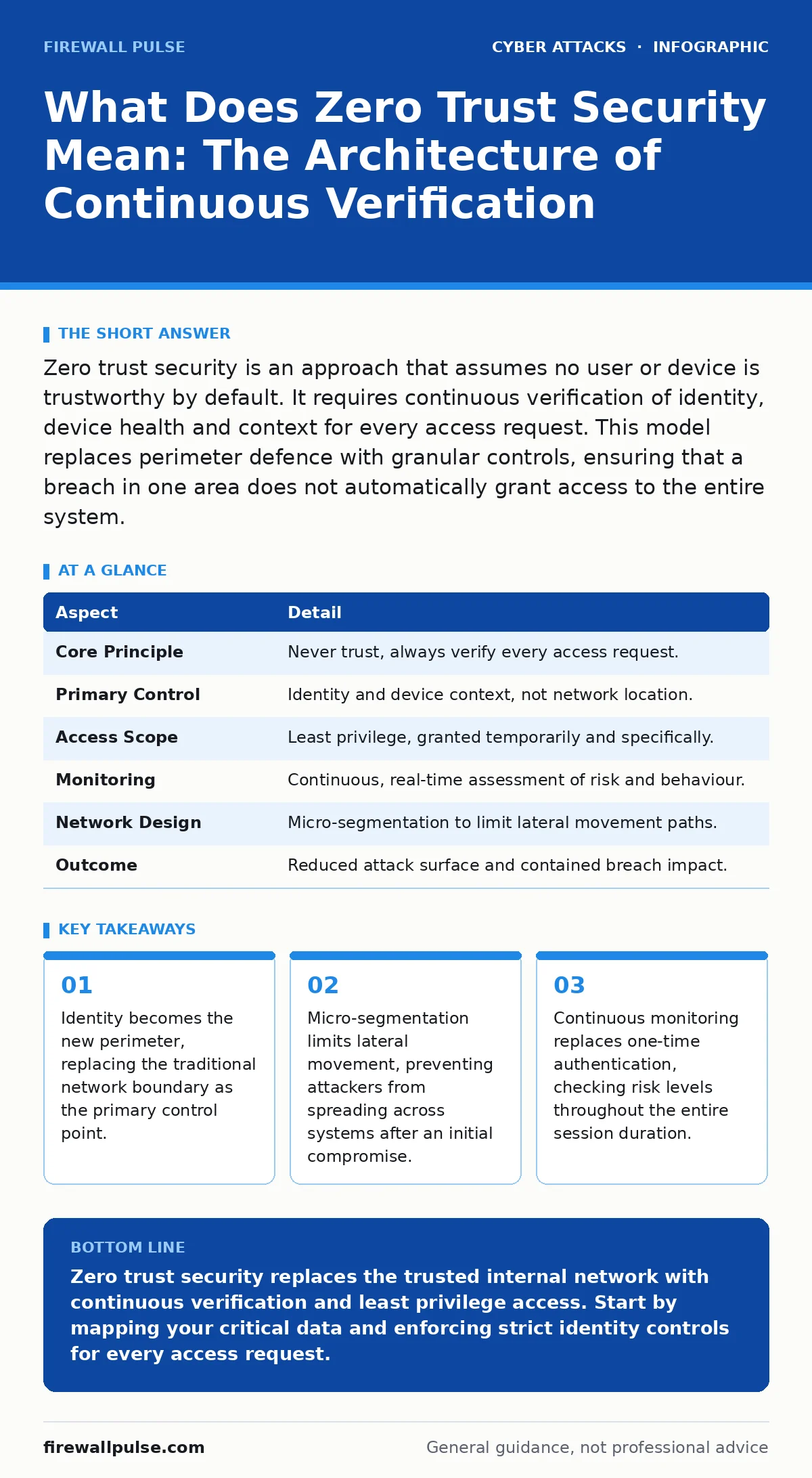
Zero trust security is an approach that assumes no user or device is trustworthy by default. It requires continuous verification of identity, device health and context for every access request. This model replaces perimeter defence with granular controls, ensuring that a breach in one area does not automatically grant access to the entire system.
What Does Zero Trust Security Mean
What does zero trust security mean in practical terms? It means abandoning the assumption that traffic inside your network is safe. Traditional models treat the internal network as a trusted zone, allowing free movement once an entity passes the outer firewall. Zero trust flips this logic. It treats every packet, every user and every device as potentially hostile until proven otherwise. This shift forces verification at every step of the interaction, not just at the entry point.
The core philosophy is simple: never trust, always verify. You do not grant blanket access to a system or a subnet. Instead, you grant the minimum level of access required for a specific task, for a specific duration, and only under specific conditions. If those conditions change, access is revoked immediately. This approach reduces the blast radius of any single failure, whether it is a stolen credential or a misconfigured server.
| Aspect | Detail |
|---|---|
| Core Principle | Never trust, always verify every access request. |
| Primary Control | Identity and device context, not network location. |
| Access Scope | Least privilege, granted temporarily and specifically. |
| Monitoring | Continuous, real-time assessment of risk and behaviour. |
| Network Design | Micro-segmentation to limit lateral movement paths. |
| Outcome | Reduced attack surface and contained breach impact. |
How Zero Trust Works in Practice
Zero trust operates through a cycle of verification, authorisation and monitoring. When a user requests access to an application, the system does not just check if the password is correct. It evaluates multiple signals. These signals include the user’s identity, the health of their device, their location and the sensitivity of the data they are trying to reach. If any signal indicates risk, access is denied or restricted.
Imagine a remote worker accessing a financial database from a personal laptop. The system checks the user’s credentials and confirms they are valid. It then checks the device. It sees the laptop lacks the required encryption software. Even though the user is who they say they are, the system denies access because the device does not meet the security policy. This decision happens in milliseconds, without human intervention.
This process relies on strong identity management. You must know who the user is, what device they are using and what they are trying to do. This requires integrating identity providers with endpoint management tools. The system must be able to revoke access instantly if a device is lost or if suspicious behaviour is detected. This continuous validation prevents attackers from using stolen credentials to move freely through the environment.
Who Zero Trust Affects
Zero trust affects every part of an organisation that handles data. It changes how employees work, how developers deploy code and how third-party partners interact with your systems. For employees, it means more frequent authentication prompts and stricter controls on what they can access. This can feel restrictive at first, but it protects them from having their accounts hijacked.
For security teams, zero trust shifts the focus from perimeter defence to internal monitoring. You spend less time tuning firewalls and more time managing identities and policies. This requires a different skill set. You need to understand identity protocols and risk-based decision engines. It also affects third-party vendors. They must meet your security standards to access your systems, which often means enforcing strict access controls for external users.
The impact extends to software development. Developers must design applications with zero trust principles in mind. This means building in authentication and authorisation checks at the application layer, not just at the network layer. It encourages a culture of security by design, where every component is responsible for its own security. This approach reduces the risk of supply chain attacks, where a compromised component introduces vulnerabilities into the wider system.
Common Misconceptions About Zero Trust
Many organisations misunderstand what zero trust is. They think it is a product they can buy and install. It is not. It is an architecture and a mindset. You cannot achieve zero trust by purchasing a single tool. It requires integrating multiple technologies and changing how you manage access. Another common mistake is assuming zero trust eliminates the need for a firewall. Firewalls still have a role, but they are no longer the primary defence.
Some believe zero trust is only for large enterprises. Small organisations benefit just as much. In fact, they may benefit more because they have fewer resources to recover from a breach. Zero trust limits the damage a attacker can do, regardless of the organisation size. It is scalable and can be implemented in phases. You do not need to overhaul your entire infrastructure overnight. You can start with critical assets and expand from there.
Another misconception is that zero trust hinders productivity. Properly implemented, it is transparent to the user. Single sign-on and seamless authentication methods can make the experience smoother than traditional password-based access. The key is to balance security with usability. If the process is too cumbersome, users will find ways to bypass it, creating greater risk. This is where understanding session cookie theft becomes relevant, as stolen sessions can bypass some authentication checks if not properly validated.
Implementing Zero Trust Step by Step
Implementing zero trust requires a structured approach. Start by mapping your data and assets. You cannot protect what you do not know you have. Identify your critical data, where it lives and who needs access to it. This inventory forms the foundation of your security policies. Next, identify your users and devices. Ensure you have visibility into all endpoints and users accessing your systems.
Then, segment your network. Break down large subnets into smaller zones. This limits the ability of an attacker to move laterally. Use micro-segmentation to control traffic between these zones. Next, enforce least privilege access. Grant users only the access they need to perform their jobs. Remove unnecessary permissions regularly. Finally, monitor and respond. Use tools to detect anomalies and respond to threats in real time. This continuous loop of verification and monitoring is what makes zero trust effective.
- Map your data and assets to understand what you are protecting.
- Identify all users and devices that access your systems.
- Segment your network to limit lateral movement.
- Enforce least privilege access for all users and services.
- Monitor activity and respond to threats in real time.
This process takes time. It requires coordination across IT, security and business units. You must communicate the changes to users and provide training. Consider how smishing attempts might target employees who are confused by new access procedures. Clear communication helps prevent social engineering attacks that exploit uncertainty.
See also: Phishing Infrastructure Prevention Checklist for Network Defenders · Why is a syn flood attack detectable? The mechanics of detection
The Role of Monitoring and Response
Zero trust is not a set-and-forget solution. It requires continuous monitoring. You must watch for changes in risk levels. If a user’s behaviour changes, or if a device shows signs of compromise, you must adjust access accordingly. This requires sophisticated analytics and automation. You cannot rely on manual reviews for every access request.
Integration with security operations centers is vital for effective monitoring. These centres provide the expertise and tools needed to analyse large volumes of data. They can identify patterns that indicate a breach. Without this capability, zero trust policies may be too static to respond to dynamic threats. You need a system that can adapt to new risks as they emerge. This adaptability is what keeps your defence effective over time.
Beyond the Perimeter
Zero trust extends beyond your internal network. It applies to cloud services, remote workers and third-party partners. You must apply the same verification principles to all access points. This means treating cloud environments with the same scrutiny as on-premises systems. It also means ensuring that remote connections are secure and monitored.
The rise of remote work has made this even more critical. Employees access systems from various locations and devices. Zero trust ensures that this flexibility does not come at the cost of security. It provides a consistent level of protection, regardless of where the user is. This consistency is key to maintaining a strong security posture in a distributed workforce.
Consider the risks of OAuth consent phishing, where attackers trick users into granting malicious applications access to their accounts. Zero trust mitigates this by limiting the scope of access and monitoring for unusual consent grants. It ensures that even if a user is tricked, the damage is contained.
Key takeaways
- Identity becomes the new perimeter, replacing the traditional network boundary as the primary control point.
- Micro-segmentation limits lateral movement, preventing attackers from spreading across systems after an initial compromise.
- Continuous monitoring replaces one-time authentication, checking risk levels throughout the entire session duration.
Zero trust security replaces the trusted internal network with continuous verification and least privilege access. Start by mapping your critical data and enforcing strict identity controls for every access request.
Frequently asked questions
Does zero trust replace firewalls?
No, firewalls remain useful for controlling traffic between network segments. Zero trust adds an additional layer of verification at the identity and application levels, focusing on who is accessing what rather than just where the traffic is coming from.
Is zero trust suitable for small businesses?
Yes, zero trust principles are scalable and beneficial for organisations of all sizes. Small businesses can start with basic identity management and least privilege access, gradually adding more sophisticated controls as their needs grow.
How does zero trust handle remote workers?
Zero trust is ideal for remote work as it verifies access based on identity and device health, not location. It ensures that remote users are subject to the same security checks as on-site employees, maintaining consistent protection.
What is the biggest challenge in implementing zero trust?
The biggest challenge is cultural change and integration. It requires shifting from a perimeter-based mindset to an identity-centric one, which involves updating policies, training staff and integrating multiple security tools.
How this guide was produced: written by the Firewall Pulse editorial team with AI assistance, checked against the public references listed below, and reviewed when the facts change. See our editorial policy or report an error.