Vishing Attack Meaning: How Voice Phishing Works and How to Stop It
Voice phishing exploits psychological urgency rather than software flaws, making technical controls alone insufficient for defence against social engineering.
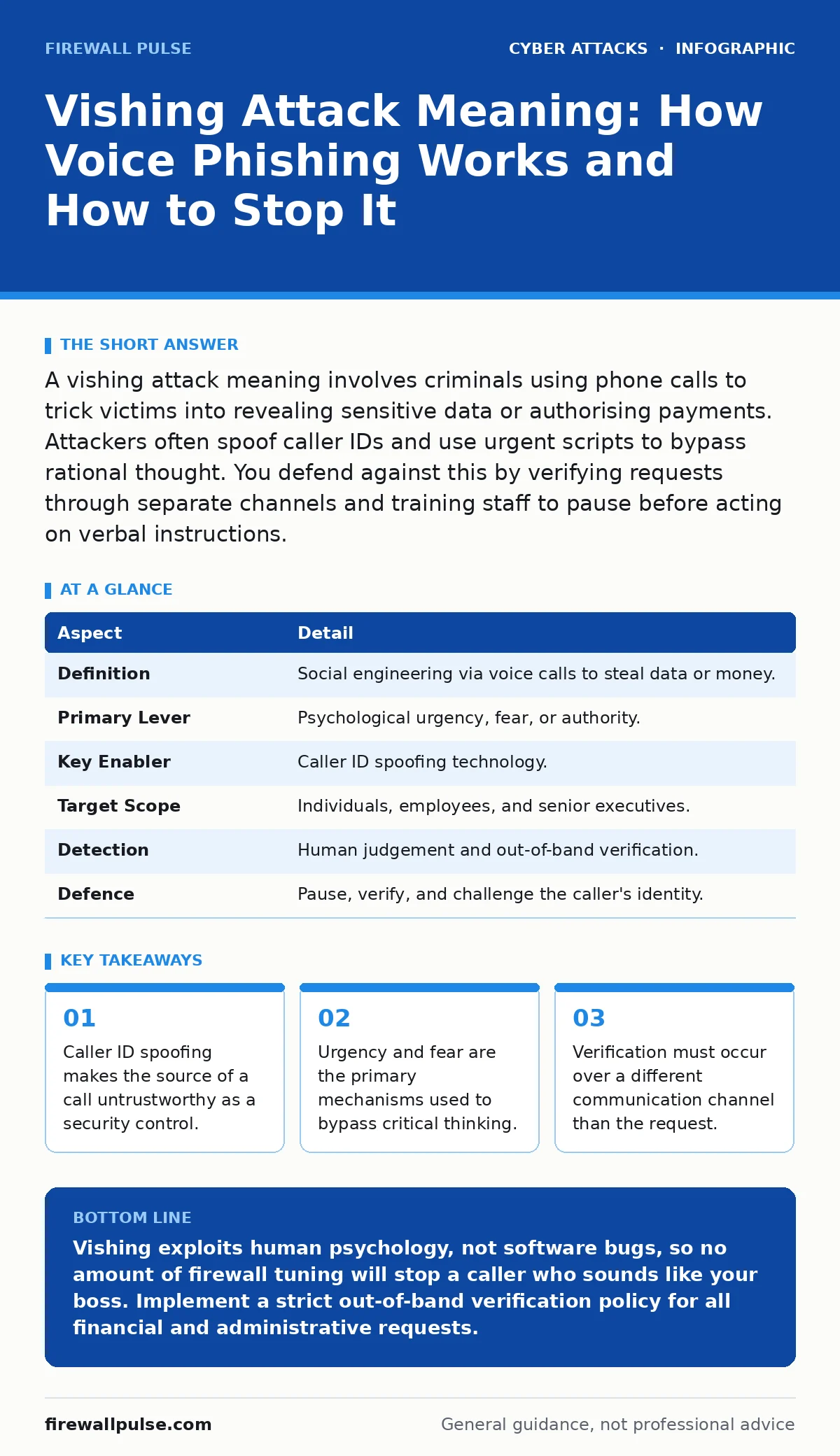
A vishing attack meaning involves criminals using phone calls to trick victims into revealing sensitive data or authorising payments. Attackers often spoof caller IDs and use urgent scripts to bypass rational thought. You defend against this by verifying requests through separate channels and training staff to pause before acting on verbal instructions.
Understanding the Vishing Attack Meaning
Imagine receiving a call from your bank telling you your account is frozen. The caller ID shows your bank's number. The caller demands immediate verification of your PIN to restore access. This is vishing. The term combines voice and phishing. It describes social engineering conducted over the telephone.
| Aspect | Detail |
|---|---|
| Definition | Social engineering via voice calls to steal data or money. |
| Primary Lever | Psychological urgency, fear, or authority. |
| Key Enabler | Caller ID spoofing technology. |
| Target Scope | Individuals, employees, and senior executives. |
| Detection | Human judgement and out-of-band verification. |
| Defence | Pause, verify, and challenge the caller's identity. |
The vishing attack meaning centres on human interaction. Unlike malware, it does not require a software vulnerability. It requires trust. Attackers manipulate that trust by mimicking known entities. They use pre-recorded messages or live agents. The goal is always information or authorisation.
How Voice Phishing Manipulates Trust
Attackers rely on cognitive bias. They create scenarios where delaying the response has negative consequences. Your brain prioritises speed over accuracy in these moments. The attacker uses this gap. They often claim to be from IT, tax authorities, or banks. They assert authority to silence questions.
Suppose a caller claims to be from your cloud provider. They say your service will terminate in ten minutes. They ask for your login credentials to "verify" your account. This is not a technical exploit. It is a psychological one. The caller exploits your fear of disruption. You act before you think.
The attacker knows you are likely logged into your email. They may already know your name, job title, and recent projects. They use this public data to build credibility. They do not need to hack your server. They only need to hack your expectations.
The Role of Caller ID Spoofing
Caller ID spoofing is the technical backbone of vishing. It allows the caller to mask their true number. They replace it with a number that looks legitimate. This could be a local number. It could be your employer's switchboard. It could even be a number you recently called.
This technique breaks the first line of defence. You cannot reject a call based on the source number. The number is a lie. Attackers use Voice over IP (VoIP) services to generate these calls. These services are cheap and anonymous. They allow rapid scaling of campaigns.
You must assume every incoming call is potentially spoofed. The display number provides no proof of identity. It provides no context for trust. Treat the caller ID as cosmetic information. It has no security value.
Who Gets Targeted and Why
Vishing affects everyone. Individual consumers lose money from their bank accounts. Employees leak credentials that give attackers access to corporate networks. Executives face high-pressure scams involving fake invoices or legal threats.
Attackers often target finance departments. They seek to redirect payments. This is known as payroll diversion fraud. They impersonate a CEO or a vendor. They demand an urgent wire transfer. The pressure prevents the finance team from following standard approval processes.
Technical teams are also targets. Attackers pose as users with forgotten passwords. They ask for reset codes. They ask for temporary access. The IT staff member wants to help. The attacker uses this helpfulness against them. The result is a compromised account.
The target is chosen based on access and authority. The more access the victim has, the higher the reward for the attacker. The more authority the victim holds, the easier it is to bypass verification steps.
What People Usually Get Wrong
Many organisations focus on technical controls. They install call screening software. They block international calls. They assume this stops vishing. It does not. Attackers adapt. They use local numbers. They use numbers that bypass filters.
Another common error is over-reliance on passwords. Users think a strong password stops account takeover. Vishing bypasses the password entirely. The attacker gets the password from the victim. They do not guess it. They do not brute force attacks. They ask for it.
Training often fails because it is generic. Telling people to "be careful" is useless. You need specific scripts. You need to teach people how to say no. You need to remove the social pressure. You must make it safe to ignore an urgent request.
See also: Malicious Email Attachments: Debunking Six Common Security Myths · Man-in-the-Middle Attack Prevention Checklist for Secure Connections
Practical Defence Strategies
Defence starts with a culture of verification. You must verify every request for sensitive data or money. Verification must happen over a different channel. If the request comes by phone, verify by email. If it comes by email, verify by phone.
Use a known number for verification. Do not call the number provided by the caller. Look up the official number in your directory. Call that number. Speak to a known contact. Confirm the request independently.
Attack surface reduction helps here. Limit the number of people who can authorise payments. Limit the number of people who can reset admin passwords. Reduce the number of touchpoints where vishing can succeed.
Integrating with Broader Security
Vishing does not happen in isolation. It often precedes other attacks. An attacker might use vishing to gain initial access. Then they install malware. Then they move laterally.
Zero trust security mitigates this impact. Even if credentials are stolen, access is limited. Each request is verified. Least privilege applies. The attacker gets a foothold but cannot expand.
Login alerts provide early warning. If a login occurs from a new device, you see it. You can act quickly. This is not prevention, but it is detection. It shortens the time the attacker has to cause damage.
Related threats often combine with vishing. Evil twin Wi-Fi attacks can capture data on unsecured networks. Drive-by downloads can infect devices while the user is distracted by a call. SYN flood attacks can disrupt services to create confusion.
You must treat vishing as part of a larger campaign. It is the entry point. It is the key. It is the conversation that opens the door.
Key takeaways
- Caller ID spoofing makes the source of a call untrustworthy as a security control.
- Urgency and fear are the primary mechanisms used to bypass critical thinking.
- Verification must occur over a different communication channel than the request.
Vishing exploits human psychology, not software bugs, so no amount of firewall tuning will stop a caller who sounds like your boss. Implement a strict out-of-band verification policy for all financial and administrative requests.
Frequently asked questions
Can caller ID spoofing be completely stopped?
No. The underlying telephony protocols allow number manipulation. You cannot stop the display from being fake. You can only stop trusting it.
Is voice biometrics safe from vishing?
Not yet. Advanced AI can synthesise voices. Biometrics can be spoofed. Always use a second factor that the caller cannot provide, such as a code sent to a secure device.
How do I report a vishing attempt?
Report it to your internal security team. Document the time, the displayed number, and the script used. This helps identify patterns and update training materials.
Does two-factor authentication stop vishing?
It helps, but it is not a cure. Attackers often ask for the second factor code directly. If you give the code, the attacker bypasses the protection. Never share codes verbally.
How this guide was produced: written by the Firewall Pulse editorial team with AI assistance, checked against the public references listed below, and reviewed when the facts change. See our editorial policy or report an error.