VPN Appliance Vulnerabilities: How Hidden Flaws Compromise Your Privacy
Your remote connection relies on complex software that often contains unpatched flaws, turning your trusted privacy tunnel into a visible corridor for attackers.
VPN appliances translate data for secure remote access. Flaws in their software allow attackers to bypass encryption or take control. You cannot fix the appliance itself. You must verify the provider updates their systems and avoid using public Wi-Fi for sensitive tasks.
The Locked Gate Analogy
Imagine a secure facility with a guarded gate. The gate is your VPN appliance. It checks your identity and lets you in. Inside, your data travels through tunnels. Now imagine the gatekeeper uses a broken lock. Anyone with the right tool can open it. The tunnel remains, but the entry point is compromised. Your data is no longer private. This analogy illustrates how a single flaw in the entry device undermines the entire security model.
Key Terms for Understanding
Understanding the mechanics requires knowing the specific components. The following table defines the core concepts.
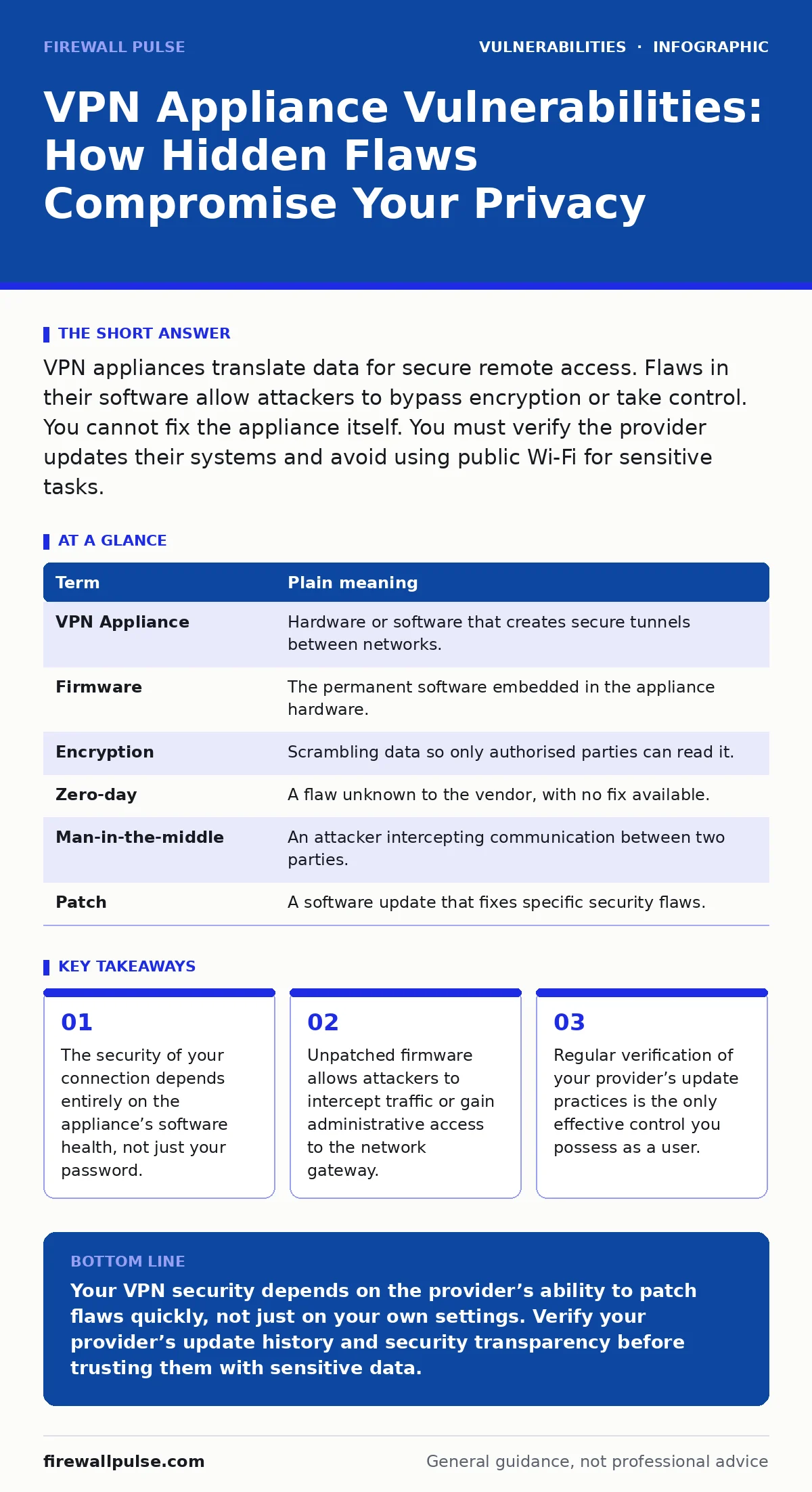
| Term | Plain meaning |
|---|---|
| VPN Appliance | Hardware or software that creates secure tunnels between networks. |
| Firmware | The permanent software embedded in the appliance hardware. |
| Encryption | Scrambling data so only authorised parties can read it. |
| Zero-day | A flaw unknown to the vendor, with no fix available. |
| Man-in-the-middle | An attacker intercepting communication between two parties. |
| Patch | A software update that fixes specific security flaws. |
How Flaws Bypass Security
Attackers exploit weaknesses in the code that handles connections. They do not need to break the encryption itself. They target the logic before or after encryption. A flaw in the authentication module allows login without credentials. A flaw in the tunneling protocol lets an attacker inject fake data. This is similar to how file upload vulnerabilities allow malicious files to bypass server checks. The appliance trusts the incoming packet structure. If the structure is malformed, the appliance may crash or execute unintended commands.
The Hidden Cost of Convenience
Many users assume a VPN provides total anonymity. This is a misconception. The appliance is a single point of failure. If the appliance is compromised, the attacker sees all traffic. They do not need to target you individually. They target the appliance. This mirrors the risk of exposed admin panels. If an administrator leaves the management interface open, anyone can log in. The appliance becomes a backdoor. Your privacy depends on the vendor’s ability to secure this interface against brute force and known exploits.
Why Updates Are Not Enough
Vendors release patches regularly. However, applying them requires downtime. Many organisations delay updates to avoid service disruption. This creates a window of exposure. Attackers scan for known vulnerabilities. They strike during this delay. This is why change management for security patches is critical for the provider. As a user, you cannot force an update. You can only choose providers who prioritise rapid deployment. Delaying updates turns a minor flaw into a major breach.
What This Means for You
You cannot inspect the appliance’s code. You rely on the provider’s transparency. Look for detailed security reports. Avoid providers who hide their infrastructure details. If your provider suffers a breach, your data may be exposed. This is similar to JWT vulnerabilities where stolen tokens allow session hijacking. The token is valid, but the context is compromised. Your session on the VPN may be hijacked if the appliance’s session management is flawed. You lose control of your connection.
Simple Safety Habits
You can reduce your risk with specific actions. These steps do not fix the appliance. They reduce your exposure.
- Verify your provider’s update policy. Check their security blog for recent patches.
- Avoid using the VPN for high-risk activities on public Wi-Fi. The entry point is still vulnerable.
- Monitor for service interruptions. Sudden drops may indicate an attack or maintenance.
The Broader Threat Context
VPN flaws are part of a larger ecosystem. Attackers chain multiple vulnerabilities. They might use a zero-click exploit to gain initial access. Then they move laterally. This is similar to unsafe YAML deserialization where untrusted data causes code execution. The appliance processes configuration data. If that data is malicious, the appliance executes it. The result is full control. You must assume the appliance is a potential target.
Final Checks for Users
Before relying on a VPN, perform these checks.
- Confirm the provider uses open standards. Proprietary protocols hide flaws.
- Ensure the provider has a clear incident response plan.
- Avoid storing sensitive data on devices connected via the VPN.
The security of your connection is only as strong as the weakest link. The appliance is that link. You must treat it with suspicion. Verify, update, and monitor.
Key takeaways
- The security of your connection depends entirely on the appliance’s software health, not just your password.
- Unpatched firmware allows attackers to intercept traffic or gain administrative access to the network gateway.
- Regular verification of your provider’s update practices is the only effective control you possess as a user.
Your VPN security depends on the provider’s ability to patch flaws quickly, not just on your own settings. Verify your provider’s update history and security transparency before trusting them with sensitive data.
Frequently asked questions
Can I fix a vulnerability in my VPN appliance myself?
No, you cannot modify the appliance’s firmware. You must rely on the provider to issue patches or switch to a more secure provider.
Does a VPN protect me from all online threats?
No, a VPN only encrypts traffic between you and the appliance. It does not protect against malware, phishing, or flaws within the appliance itself.
How do I know if my VPN provider has been breached?
Check their official security blog and independent security news sources. Reputable providers disclose breaches promptly and provide remediation steps.
Are open-source VPN appliances safer?
Open-source code allows independent review, which can uncover flaws faster. However, it requires active maintenance. Neglected open-source projects can be highly vulnerable.
How this guide was produced: written by the Firewall Pulse editorial team with AI assistance, checked against the public references listed below, and reviewed when the facts change. See our editorial policy or report an error.