Vulnerability Chaining: How Attackers Link Weaknesses
Attackers rarely exploit a single flaw; they chain minor issues to bypass defences and achieve full system control.
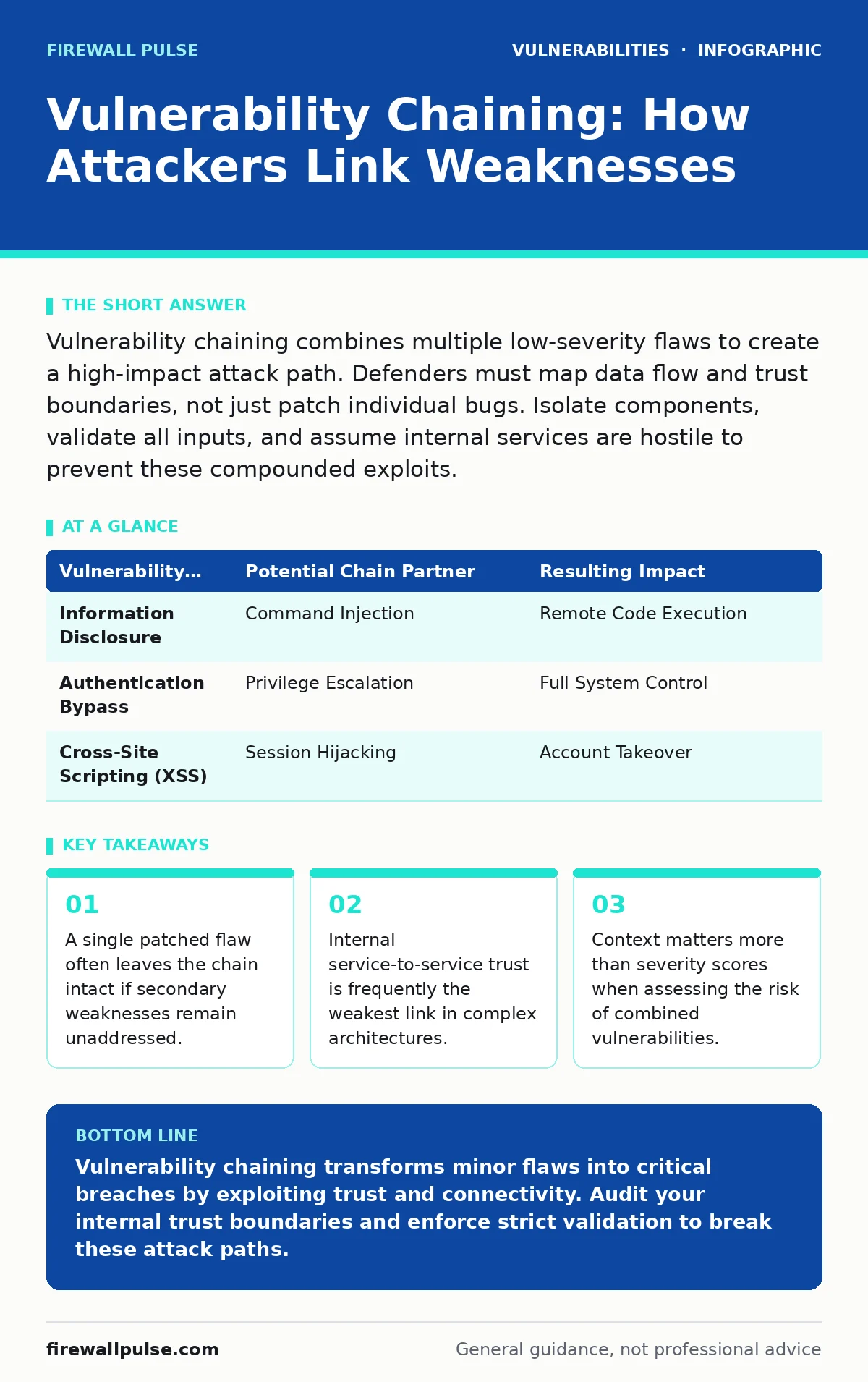
Vulnerability chaining combines multiple low-severity flaws to create a high-impact attack path. Defenders must map data flow and trust boundaries, not just patch individual bugs. Isolate components, validate all inputs, and assume internal services are hostile to prevent these compounded exploits.
What is vulnerability chaining in cybersecurity?
Vulnerability chaining is the technique of linking multiple distinct security flaws to achieve a result that no single flaw could produce alone. An attacker might use a minor information leak to discover credentials, then use those credentials to access a system with a separate configuration error. This approach turns weak, isolated issues into a powerful breach vector.
Why do severity scores fail to predict chaining risk?
Common Vulnerability Scoring System metrics evaluate individual flaws in isolation, ignoring how they interact within a specific environment. A low-severity bug that leaks an internal IP address may seem harmless until combined with an unpatched service running on that IP. The combined effect bypasses network segmentation, creating a critical path that standard scanners miss.
Imagine a web application with a minor logging error. Alone, it reveals nothing sensitive. However, when chained with a lack of input validation on an admin panel, it allows an attacker to inject commands into the log file, which is then executed by a privileged process. This demonstrates why context overrides raw scores.
How does an attacker identify chainable vulnerabilities?
Attackers start by mapping the application’s data flow and trust boundaries. They look for places where data moves between systems with different security levels, such as from a public web server to an internal database. They then search for weaknesses at each transition point, focusing on authentication bypasses, input validation failures, and excessive privileges.
Can patched vulnerabilities still be part of an attack chain?
Yes, because removing one link does not always break the entire chain. If an attacker used a known flaw to gain initial access, they may have already established persistence or stolen credentials. Even if you patch that specific vulnerability, the attacker retains access through the stolen keys or backdoors. This is why remediation must include credential rotation and session invalidation.
What role does configuration hardening play in preventing chains?
Configuration hardening reduces the attack surface by disabling unnecessary services and restricting default permissions. Many chains rely on default settings that allow internal services to communicate without authentication. By enforcing strict access controls and least privilege principles, you remove the easy steps attackers need to move laterally. Proper configuration ensures that even if one service is compromised, it cannot easily pivot to others.
See also: Detect Exposed .git Directories: Signs, Logs and Blind Spots
How do exposed .git directories facilitate vulnerability chaining?
Exposed version control directories reveal the entire source code history of an application, including previous commits that may contain hardcoded credentials or API keys. Attackers use this information to understand the application’s architecture and identify potential weaknesses. This knowledge allows them to craft targeted exploits that bypass standard defences, turning a simple information disclosure into a full compromise.
Why is trust between internal services a critical weakness?
Internal services often assume that traffic from within the network is safe, leading to lax validation and authentication. Attackers who breach the perimeter can exploit this implicit trust to move laterally. They may use a compromised low-privilege service to send malicious requests to a high-privilege backend, bypassing external security controls. This internal trust is often the final step in a successful chain.
How does vulnerability scanning help detect potential chains?
Vulnerability scanning identifies known weaknesses in systems, providing a baseline for risk assessment. However, standard scans do not automatically link these findings. You must correlate scan results with your application’s architecture to spot potential chains. Look for combinations of issues like information disclosure and command injection, or authentication flaws and privilege escalation vectors.
| Vulnerability Type | Potential Chain Partner | Resulting Impact |
|---|---|---|
| Information Disclosure | Command Injection | Remote Code Execution |
| Authentication Bypass | Privilege Escalation | Full System Control |
| Cross-Site Scripting (XSS) | Session Hijacking | Account Takeover |
What is the impact of unsafe YAML deserialization on chaining?
Unsafe YAML deserialization allows attackers to execute arbitrary code by crafting malicious input files. This flaw is particularly dangerous because it often resides in configuration parsers used by many services. When chained with a file upload vulnerability or an insecure API endpoint, it enables remote code execution without needing additional authentication. This combination turns a parsing error into a critical breach.
How do n-day vulnerabilities affect chaining strategies?
N-day vulnerabilities are known flaws for which patches are already available. Attackers often use these because they are documented and easy to exploit. They chain n-day flaws with zero-day or custom exploits to maintain access even if you patch the known issue. This strategy ensures resilience against defensive measures, making it harder to fully remediate the breach.
What are use-after-free vulnerabilities and their chaining potential?
Use-after-free vulnerabilities occur when a program accesses memory that has been freed, leading to unpredictable behaviour. Attackers can exploit this to execute arbitrary code or crash the system. When chained with other memory corruption flaws or privilege escalation bugs, it allows for sophisticated exploits that bypass modern memory protection mechanisms. This makes it a powerful component in advanced attack chains.
How do vulnerabilities in VPN appliances enable chaining?
VPN appliances often serve as gateways to internal networks, making them high-value targets. Flaws in these devices can allow attackers to bypass authentication or decrypt traffic. Once inside, attackers chain this initial access with other internal vulnerabilities to move laterally. Compromising a VPN appliance gives attackers a foothold that is difficult to detect and remove, facilitating long-term persistence.
How can you break existing vulnerability chains?
Breaking a chain requires identifying and removing the weakest link, often by isolating components and enforcing strict validation. You must also rotate credentials and invalidate active sessions to ensure attackers cannot maintain access. Regularly reviewing and updating your architecture to reduce trust boundaries helps prevent future chains. Focus on reducing the attack surface and monitoring for unusual activity within internal services.
Key takeaways
- A single patched flaw often leaves the chain intact if secondary weaknesses remain unaddressed.
- Internal service-to-service trust is frequently the weakest link in complex architectures.
- Context matters more than severity scores when assessing the risk of combined vulnerabilities.
Vulnerability chaining transforms minor flaws into critical breaches by exploiting trust and connectivity. Audit your internal trust boundaries and enforce strict validation to break these attack paths.
Frequently asked questions
How do I prioritize which vulnerabilities to patch first?
Prioritise flaws that can be chained with other known issues in your environment, especially those involving authentication or data flow between services.
Can vulnerability chaining occur in cloud environments?
Yes, cloud environments often have complex service interactions, making them susceptible to chaining if trust boundaries are not strictly enforced.
What is the difference between vulnerability chaining and compounding vulnerabilities?
Chaining involves sequential exploitation of distinct flaws, while compounding refers to multiple flaws in the same component that increase the likelihood of exploitation.
How often should I review my vulnerability chains?
Review your architecture and potential chains after any significant change, such as new service deployments or configuration updates, to identify new attack paths.
How this guide was produced: written by the Firewall Pulse editorial team with AI assistance, checked against the public references listed below, and reviewed when the facts change. See our editorial policy or report an error.