Account Takeover Fraud Prevention Checklist for Secure Systems
Attackers bypass traditional login screens by exploiting session tokens and weak identity verification protocols rather than guessing passwords.
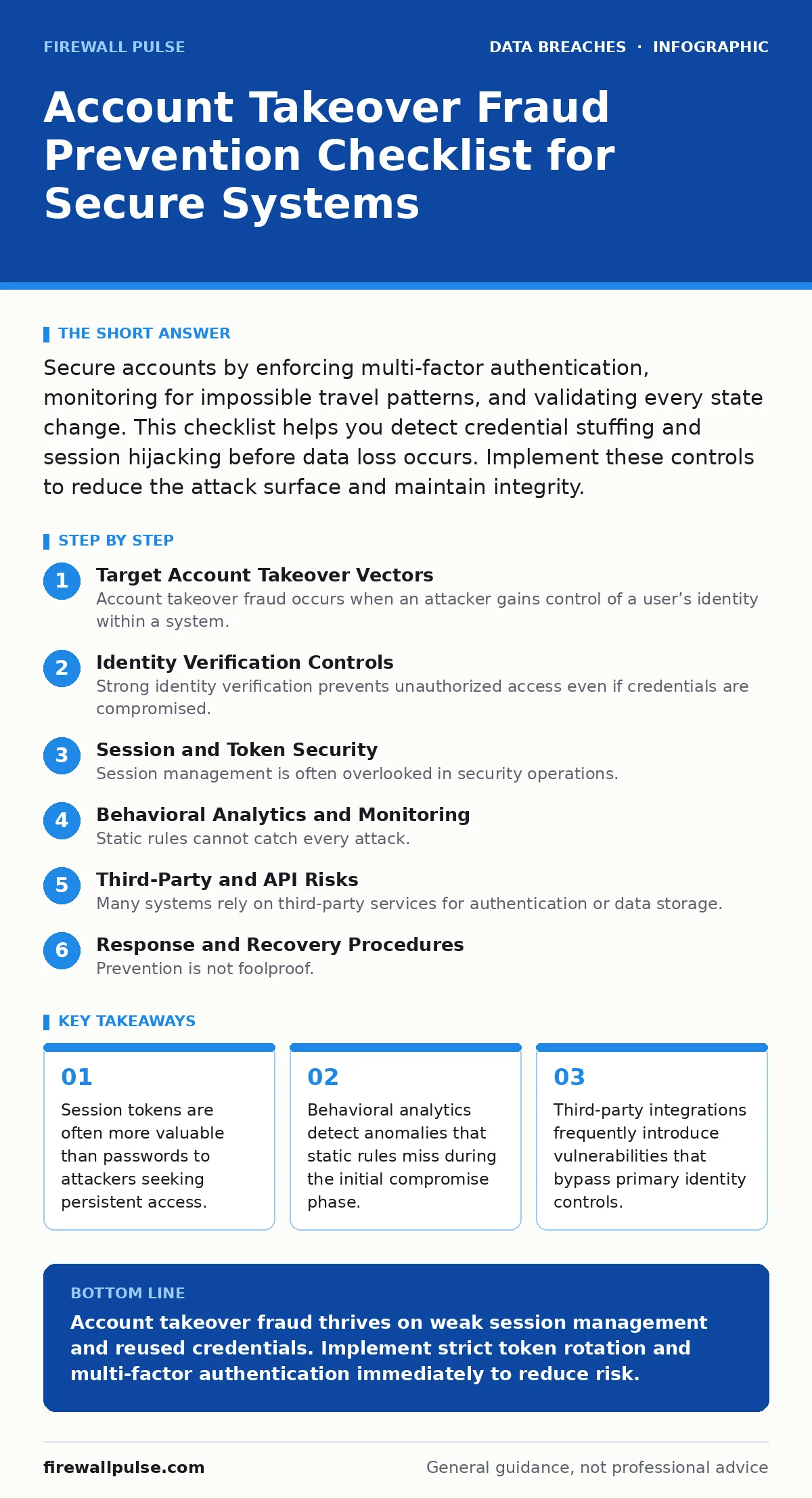
Secure accounts by enforcing multi-factor authentication, monitoring for impossible travel patterns, and validating every state change. This checklist helps you detect credential stuffing and session hijacking before data loss occurs. Implement these controls to reduce the attack surface and maintain integrity.
Target Account Takeover Vectors
Account takeover fraud occurs when an attacker gains control of a user’s identity within a system. You must understand how these breaches happen before you can stop them. Attackers rarely guess passwords directly anymore. They use automated tools to submit millions of credential pairs harvested from other breaches. This is known as credential stuffing. When a user reuses passwords, this method succeeds instantly. You need to block these attempts at the edge.
You also face session hijacking risks. If an attacker steals a valid session cookie, they bypass the login screen entirely. Standard password protections do not help here. The system trusts the cookie, not the user. You must treat session tokens as sensitive credentials. Rotate them frequently and bind them to specific device fingerprints. This reduces the window of opportunity for theft.
Identity Verification Controls
Strong identity verification prevents unauthorized access even if credentials are compromised. Multi-factor authentication adds a second layer of defence. It requires something the user knows and something they have. This stops attackers who only possess the password. You should enforce this for all sensitive actions, not just initial login. Push notifications can be spoofed, so prefer time-based one-time passwords or hardware keys.
- Enforce multi-factor authentication: prevents access with stolen passwords alone.
- Disable SMS-based verification: SIM swapping attacks bypass SMS codes easily.
- Require re-authentication for sensitive changes: stops attackers from altering account settings.
Password reuse is a major vulnerability. Users often use the same credentials across multiple services. When one service is breached, attackers try those credentials elsewhere. You cannot control user behaviour outside your system, but you can check against known compromised databases. Integrate a breach notification service to alert users when their credentials appear in public leaks. This encourages immediate password changes.
Session and Token Security
Session management is often overlooked in security operations. A session token grants access without requiring repeated authentication. If this token is leaked, the attacker gains full access. You must implement strict token lifecycle policies. Tokens should have short expiration times. They must be invalidated immediately upon logout. Binding tokens to specific browser fingerprints adds another layer of security.
- Rotate session tokens after login: prevents replay attacks using old tokens.
- Bind tokens to device characteristics: detects session hijacking on new devices.
- Invalidate tokens on logout: ensures no lingering access after session end.
Imagine a user logs in from a public computer. They forget to log out. The session token remains active. An attacker on the same machine can extract this token. If your system does not bind tokens to devices, the attacker gains access. This is why device binding matters. It ensures the session is tied to the original hardware.
Behavioral Analytics and Monitoring
Static rules cannot catch every attack. You need dynamic monitoring to detect unusual activity. Behavioral analytics establish a baseline for each user. This includes login times, locations, and typical actions. Deviations from this baseline trigger alerts. For example, a login from a different country within minutes is impossible travel. This indicates account takeover. You must investigate these anomalies promptly.
- Monitor for impossible travel: detects logins from geographically distant locations.
- Track login velocity: identifies rapid, automated login attempts.
- Alert on unusual data access: flags bulk downloads or exports.
Data classification helps you prioritise alerts. Not all actions carry the same risk. Accessing a profile picture is low risk. Downloading financial records is high risk. You should tailor your monitoring thresholds based on data sensitivity. This reduces alert fatigue and focuses resources on critical events.
Third-Party and API Risks
Many systems rely on third-party services for authentication or data storage. These integrations expand your attack surface. A vulnerability in a partner’s system can lead to unauthorized access in yours. You must assess these risks carefully. Conduct regular third-party risk assessments to evaluate their security posture. Ensure they follow industry standards and undergo regular audits.
- Audit third-party API access: ensures external services have minimal permissions.
- Review partner security certifications: verifies they meet your security requirements.
- Monitor API usage patterns: detects abuse or data exfiltration.
Leaked source code can expose API endpoints and logic flaws. If attackers find your source code, they can map your system’s weaknesses. This makes targeted attacks easier. Protect your code repositories strictly. Use access controls to limit who can view or modify the code. Regularly scan for accidental commits of sensitive information.
See also: How to Stop Source Code Leaks Before They Happen
Response and Recovery Procedures
Prevention is not foolproof. You must have a plan for when breaches occur. Chain of custody is vital during investigations. You need to preserve evidence to understand how the breach happened. This helps you patch vulnerabilities and prevent recurrence. Document every step of the response process. Assign clear roles and responsibilities to your team.
- Document incident timeline: provides clarity for forensic analysis.
- Preserve log evidence: supports investigation and legal requirements.
- Communicate with affected users: maintains trust and transparency.
Payment card theft is a common consequence of account takeover. If attackers access payment details, they can make fraudulent transactions. You must monitor for unusual purchase patterns. Implement transaction limits and require additional verification for large purchases. This reduces financial loss and protects your reputation.
Credit freezes are a user-side mitigation. They prevent attackers from opening new accounts in the victim’s name. While this does not stop the initial takeover, it limits the damage. Educate your users on this option. Provide clear instructions on how to implement it. This empowers them to protect their broader financial identity.
Continuous Improvement
Security is an ongoing process. Threats evolve, and so must your defences. Regularly review and update your controls. Test your incident response plans through simulations. Identify gaps and address them promptly. Stay informed about new attack techniques. Engage with the security community to share knowledge. This proactive approach keeps your systems resilient.
- Conduct regular security audits: identifies weaknesses before attackers do.
- Update threat models: reflects new attack vectors and technologies.
- Train staff on phishing: reduces the risk of social engineering attacks.
Unauthorized access is the core issue. Every control you implement should aim to reduce this risk. Focus on the most impactful measures first. Prioritise based on your specific risk profile. There is no one-size-fits-all solution. Tailor your approach to your organisation’s needs. This ensures efficient use of resources and maximum protection.
Key takeaways
- Session tokens are often more valuable than passwords to attackers seeking persistent access.
- Behavioral analytics detect anomalies that static rules miss during the initial compromise phase.
- Third-party integrations frequently introduce vulnerabilities that bypass primary identity controls.
Account takeover fraud thrives on weak session management and reused credentials. Implement strict token rotation and multi-factor authentication immediately to reduce risk.
Frequently asked questions
How do I stop credential stuffing attacks?
Block known bad IP addresses, enforce multi-factor authentication, and monitor for high volumes of failed login attempts.
What is the difference between session hijacking and account takeover?
Session hijacking steals an active session token, while account takeover typically involves compromising login credentials to gain access.
Should I use SMS for two-factor authentication?
No, SMS is vulnerable to SIM swapping. Use authenticator apps or hardware security keys for stronger protection.
How often should I rotate session tokens?
Rotate tokens on every login and invalidate them immediately upon logout to prevent replay attacks.
How this guide was produced: written by the Firewall Pulse editorial team with AI assistance, checked against the public references listed below, and reviewed when the facts change. See our editorial policy or report an error.