Difference Between CVE and CVSS Score: How to Priorise Remediation
CVE identifiers name vulnerabilities while CVSS scores measure severity, creating a gap where high scores do not always demand immediate patching.
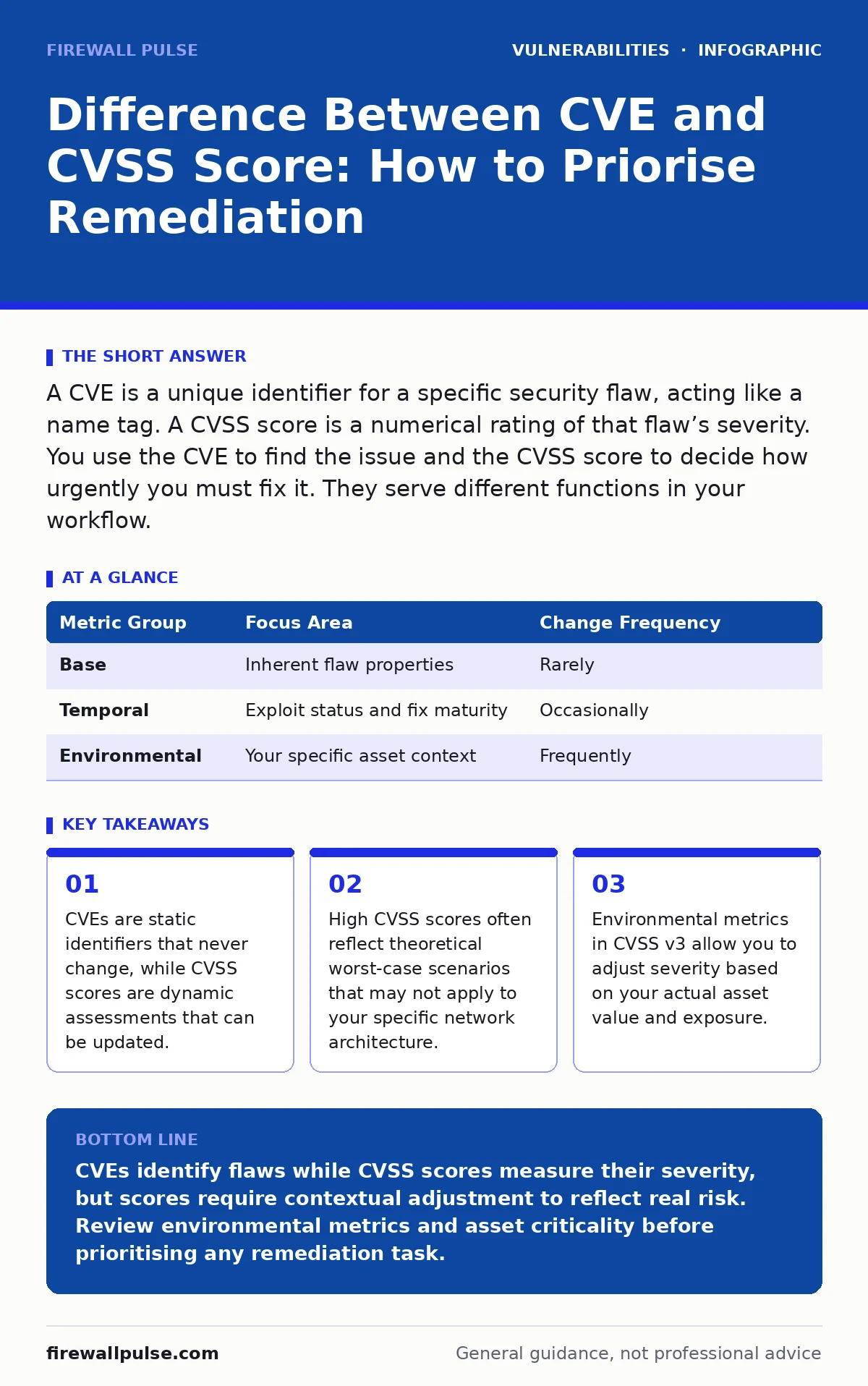
A CVE is a unique identifier for a specific security flaw, acting like a name tag. A CVSS score is a numerical rating of that flaw’s severity. You use the CVE to find the issue and the CVSS score to decide how urgently you must fix it. They serve different functions in your workflow.
What is the difference between CVE and CVSS score?
A CVE is the label for the vulnerability, whereas a CVSS score is the measurement of its impact. You cannot have a CVSS score without a CVE or similar identifier to attach it to. The CVE tells you what the problem is. The CVSS score tells you how bad it is. This distinction separates identification from prioritisation.
How do CVE identifiers work in practice?
CVEs follow a strict naming convention managed by the MITRE Corporation. Each identifier includes a year and a unique number, ensuring no two flaws share the same tag. This system allows vendors, researchers and security teams to reference specific issues without ambiguity. You use CVEs to track patches and coordinate disclosure.
CVEs do not contain technical details about the exploit. They do not indicate whether a patch exists. They do not suggest how difficult the attack might be. They simply provide a common language for communication. This neutrality prevents confusion when multiple parties discuss the same flaw.
How is a CVSS score calculated?
CVSS uses a vector string to represent various attack characteristics. The base score reflects the inherent qualities of the vulnerability, independent of your environment. It considers factors like attack vector, complexity, privileges required and scope. These metrics produce a number between 0.0 and 10.0.
The temporal score adjusts the base score based on current conditions. It accounts for the availability of exploit code and the maturity of fixes. The environmental score tailors the rating to your specific infrastructure. It weighs the importance of the affected system and the presence of mitigating controls. This three-layer approach provides depth.
| Metric Group | Focus Area | Change Frequency |
|---|---|---|
| Base | Inherent flaw properties | Rarely |
| Temporal | Exploit status and fix maturity | Occasionally |
| Environmental | Your specific asset context | Frequently |
Why do high CVSS scores mislead teams?
High scores often reflect maximum theoretical damage rather than likely real-world impact. A remote code execution flaw might score 9.8, but if the service is isolated behind a firewall, the actual risk is low. Teams that patch solely by score waste resources on theoretical threats. They ignore context that matters more for operational security.
Imagine a server handling public file upload vulnerabilities. A flaw here might have a lower base score but higher actual risk due to exposure. Conversely, an internal tool with a 10.0 score poses little threat if no external access exists. Blindly following scores creates alert fatigue and misses true priorities.
How do environmental metrics change the picture?
Environmental metrics let you override default assumptions with your reality. You can adjust the confidentiality, integrity and availability requirements for specific assets. A database holding sensitive customer data gets higher weight than a public-facing blog. This adjustment aligns the score with business impact.
You must maintain these environmental settings as your infrastructure changes. Static configurations become outdated quickly. Regular reviews ensure the scores reflect current asset value. This process requires effort but yields accurate prioritisation. It bridges the gap between generic ratings and specific needs.
See also: Detect PHP Object Injection: Logs, Tools and Blind Spots
What role does vulnerability scanning play?
Automated tools rely heavily on CVE databases to identify flaws. They map detected issues to known CVEs and retrieve associated CVSS scores. This automation speeds up discovery but often lacks context. Scanners cannot easily determine if a vulnerability is exploitable in your specific setup.
Human analysis remains necessary to validate scanner results. You must verify which CVEs are actually present and relevant. False positives clutter reports and dilute urgency. Integrating scanning with manual review ensures accuracy. This combination balances speed with precision.
How do disclosure policies affect scoring?
Vulnerability disclosure policies dictate how flaws are reported and rated. Responsible disclosure allows vendors time to patch before public release. This delay affects the temporal CVSS score, as exploit code is not yet available. Public disclosure without a patch raises the temporal score significantly.
Suppose a researcher finds a use-after-free vulnerability. If they disclose responsibly, the temporal score remains low. If they publish details immediately, the score spikes. Understanding this dynamic helps you anticipate risk changes. It also informs your own disclosure strategy.
How do you prioritise remediation effectively?
Start by filtering out vulnerabilities that do not affect your environment. Check if the affected software is installed. Verify if the service is exposed to untrusted networks. Then apply environmental CVSS scores to remaining issues. Focus on high-score items that affect critical assets.
Least privilege access reduces the impact of many vulnerabilities. If a service runs with minimal permissions, the damage from exploitation is limited. Configuration hardening further reduces attack surfaces. Combine these controls with patching for layered defence. Do not rely on scores alone for decisions.
What are the limitations of CVSS versions?
Different CVSS versions calculate scores differently. CVSS v2 is outdated and lacks modern context. CVSS v3 introduced scope changes and more granular metrics. CVSS v3.1 refined the calculation for better accuracy. Mixing versions causes confusion and inconsistent prioritisation.
Ensure all tools and reports use the same CVSS version. Compare apples to apples. Check which version your scanner uses. Check which version your ticketing system expects. Consistency prevents misalignment in your security operations.
How does this fit with other controls?
CVSS scores inform patching priorities, but they do not replace other security measures. Exposed admin panels often bypass authentication entirely, rendering vulnerability scores irrelevant. Dependency confusion attacks exploit build processes, not runtime flaws. File upload vulnerabilities require input validation, not just patching.
Integrate CVSS data with your broader security strategy. Use scores to guide patching, but use controls to prevent exploitation. This holistic approach reduces risk more effectively than chasing high scores. It addresses the root causes of compromise.
Key takeaways
- CVEs are static identifiers that never change, while CVSS scores are dynamic assessments that can be updated.
- High CVSS scores often reflect theoretical worst-case scenarios that may not apply to your specific network architecture.
- Environmental metrics in CVSS v3 allow you to adjust severity based on your actual asset value and exposure.
CVEs identify flaws while CVSS scores measure their severity, but scores require contextual adjustment to reflect real risk. Review environmental metrics and asset criticality before prioritising any remediation task.
Frequently asked questions
Can a vulnerability have multiple CVSS scores?
Yes, different organisations may calculate environmental scores differently, resulting in varied final ratings for the same CVE.
Does a CVE number indicate severity?
No, the CVE number is sequential and arbitrary, providing no information about the severity or impact of the vulnerability.
How often are CVSS scores updated?
Scores can be updated anytime new information emerges, such as exploit code availability or patch maturity changes.
Should I ignore low CVSS scores?
No, low scores may hide high-risk scenarios in your specific environment, especially if the asset is critical or exposed.
How this guide was produced: written by the Firewall Pulse editorial team with AI assistance, checked against the public references listed below, and reviewed when the facts change. See our editorial policy or report an error.