Data Classification Mistakes That Expose Your Infrastructure
Misclassifying data creates hidden attack surfaces that standard security controls cannot see or protect against effectively.

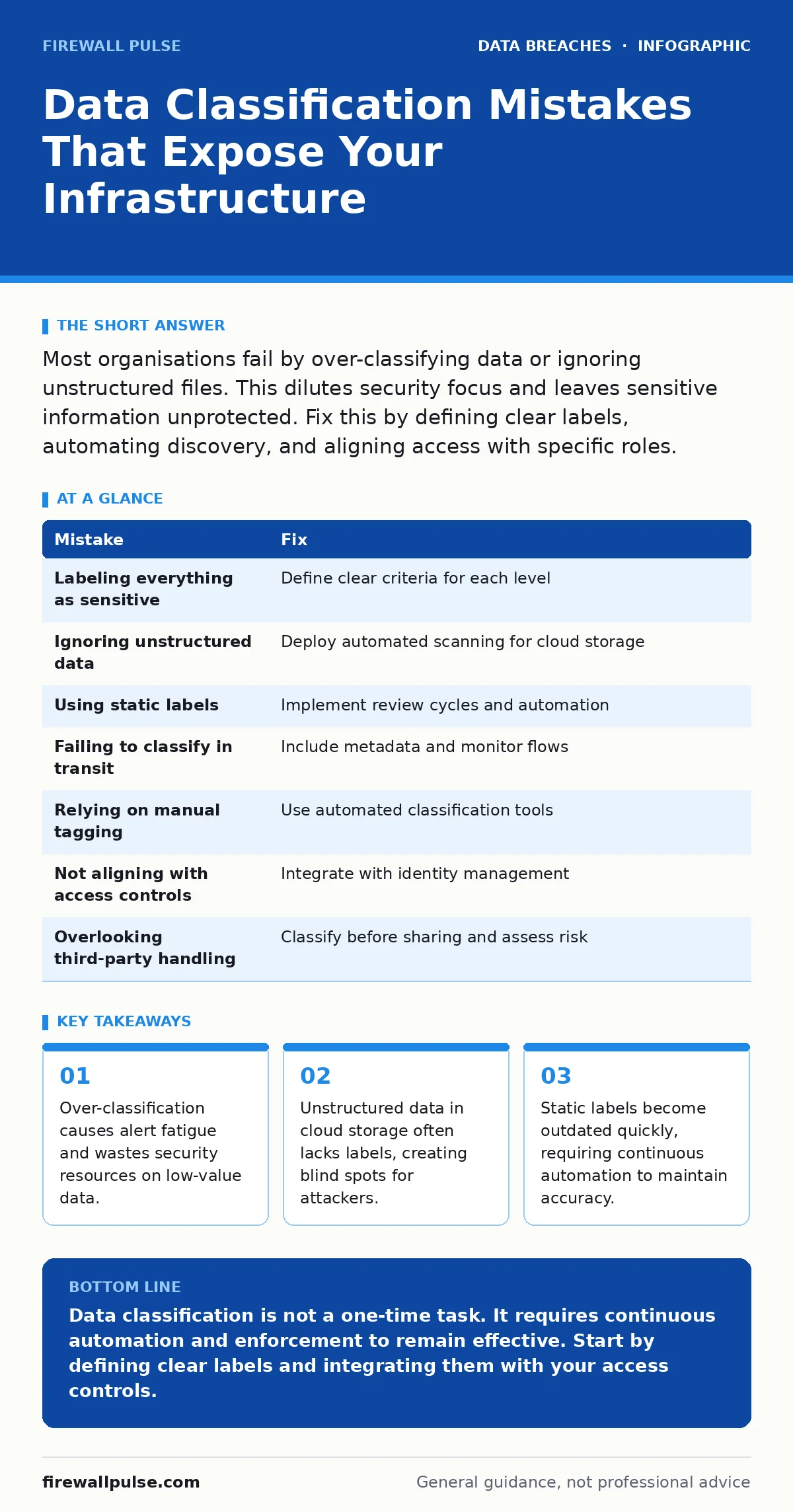
Most organisations fail by over-classifying data or ignoring unstructured files. This dilutes security focus and leaves sensitive information unprotected. Fix this by defining clear labels, automating discovery, and aligning access with specific roles.
Mistake 1: Labeling everything as highly sensitive
Security teams often apply the highest classification label to every file to ensure nothing is missed. This approach assumes that maximum protection is always the best strategy. It ignores the operational cost of securing large volumes of low-value data.
Why it hurts:
Treating all data as critical creates noise. Security tools generate excessive alerts for minor violations. Analysts become desensitised to warnings. Real threats get buried under false positives. Resources are wasted protecting public marketing materials instead of focusing on intellectual property or personal data.
The fix:
Define clear criteria for each level. Use only four or five distinct labels. Apply the highest label only to data that causes severe harm if leaked. Review these criteria regularly. Ensure every team member understands what qualifies for each tier. This focuses protection where it matters most.
Mistake 2: Ignoring unstructured data in cloud storage
Organisations often focus classification efforts on structured databases. They assume that files stored in cloud buckets or shared drives are less important. This overlooks the reality that sensitive information often resides in documents, spreadsheets, and emails.
Why it hurts:
Unstructured data is difficult to search and monitor. Attackers know this. They target cloud storage for easy wins. Without labels, security tools cannot identify sensitive files. This leaves a large portion of your data estate completely invisible to your defence systems.
The fix:
Deploy automated scanning tools for cloud storage. These tools identify sensitive patterns like credit card numbers or national IDs. Apply labels automatically based on content. Integrate this with your data loss prevention systems. This ensures that files moving to the cloud retain their classification.
Mistake 3: Using static labels for dynamic data
Data changes over time. A project file may start as confidential and become public. A customer record may expire and lose its sensitivity. Applying a label once and never updating it is a common error. It assumes data sensitivity is permanent.
Why it hurts:
Outdated labels create false security postures. You may restrict access to public data, hindering business operations. Conversely, you may leave expired sensitive data accessible to too many users. This increases the risk of unauthorized access. It also complicates compliance audits.
The fix:
Implement review cycles for classified data. Automate label updates where possible. For example, reduce classification after a set period of inactivity. Allow users to request reclassification with justification. This keeps your data map accurate and reduces unnecessary restrictions.
Mistake 4: Failing to classify data in transit
Many teams focus on data at rest and in use. They neglect the data moving between systems. Encryption is often applied, but without classification, you do not know what is being sent. This is a significant oversight in complex environments.
Why it hurts:
Unlabelled data in transit is hard to prioritise. You cannot apply appropriate encryption strength if you do not know the value of the payload. Attackers intercepting network traffic may find high-value data unprotected. This exposes you to interception risks.
The fix:
Include classification metadata in data packets where possible. Use protocols that support this. Ensure that encryption keys are managed based on data sensitivity. Monitor network flows for anomalies. This ensures that data protection matches its value during movement.
Mistake 5: Relying on manual tagging by users
Asking employees to manually label every file they create is unrealistic. Users are busy and often unaware of classification rules. They may mislabel files or skip the process entirely. This places the burden of security on individuals who lack the context.
Why it hurts:
Manual tagging is inconsistent and error-prone. One user may label a file as public, while another labels identical content as confidential. This inconsistency breaks security policies. It also makes auditing difficult. You cannot trust the labels if humans applied them without guidance.
The fix:
Use automated classification tools. These scan content for sensitive patterns and apply labels. Provide clear guidelines to users. Train them on why classification matters. Combine automation with user input for context that machines cannot understand. This reduces human error.
See also: Detection Engineering Lifecycle: Build, Tune and Maintain Alerts · Build a Security Operations Center: A Practical Implementation Plan
Mistake 6: Not aligning labels with access controls
Classification is useless if it does not drive access decisions. Many organisations label data but fail to enforce those labels. Users can still access files regardless of their classification. This disconnect renders the entire classification effort ineffective.
Why it hurts:
Without enforcement, labels are just cosmetic. Attackers can exploit this gap. They may access sensitive data simply because the system does not check labels. This leads to data breaches. It also violates compliance requirements. You must link classification to permission systems.
The fix:
Integrate classification with your identity management system. Use role-based access control to enforce labels. Only users with the right clearance can open specific files. Automate this enforcement. Regularly audit access logs to ensure compliance. This closes the loop between classification and protection.
Mistake 7: Overlooking third-party data handling
Data often leaves your organisation. Vendors, partners, and service providers access your information. Failing to classify and protect this data outside your perimeter is a major risk. You may assume they have similar security standards.
Why it hurts:
Third parties may have weaker security. If you do not classify data before sharing it, you cannot enforce protection requirements. This increases the risk of data leakage. It also complicates incident response. You may not know what was exposed or to whom.
The fix:
Classify data before sharing it with external parties. Include classification requirements in contracts. Conduct third-party risk assessments to verify their security. Monitor how they handle your data. This ensures that your data remains protected even outside your direct control.
| Mistake | Fix |
|---|---|
| Labeling everything as sensitive | Define clear criteria for each level |
| Ignoring unstructured data | Deploy automated scanning for cloud storage |
| Using static labels | Implement review cycles and automation |
| Failing to classify in transit | Include metadata and monitor flows |
| Relying on manual tagging | Use automated classification tools |
| Not aligning with access controls | Integrate with identity management |
| Overlooking third-party handling | Classify before sharing and assess risk |
Key takeaways
- Over-classification causes alert fatigue and wastes security resources on low-value data.
- Unstructured data in cloud storage often lacks labels, creating blind spots for attackers.
- Static labels become outdated quickly, requiring continuous automation to maintain accuracy.
Data classification is not a one-time task. It requires continuous automation and enforcement to remain effective. Start by defining clear labels and integrating them with your access controls.
Frequently asked questions
How do I classify data that contains mixed sensitivity levels?
Split the data into separate files or sections. Apply different labels to each part. This allows for granular access control.
What happens if I misclassify data?
You may expose sensitive information or restrict access to public data. Regular audits help catch these errors early.
Can automation replace human judgement in classification?
Automation handles the bulk of routine classification. Humans are still needed for complex or ambiguous cases.
How often should I review my classification policy?
Review it annually or whenever regulations change. Update it to reflect new data types and business needs.
How this guide was produced: written by the Firewall Pulse editorial team with AI assistance, checked against the public references listed below, and reviewed when the facts change. See our editorial policy or report an error.